Turgo vs Salesloft: Analyzing GTM Efficiency and ROI Impact for Revenue Leaders
Explore Turgo vs Salesloft for GTM efficiency: autonomous marketing execution that scales pipeline velocity, reduces CAC, and optimizes ROI.
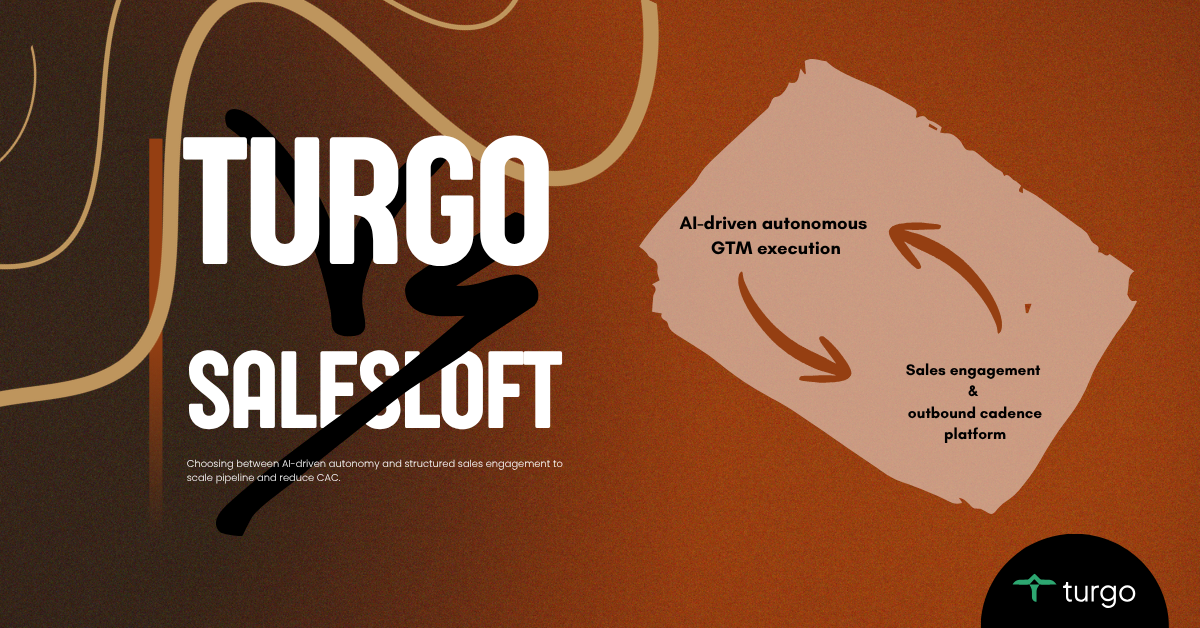
Turgo vs Salesloft: Which GTM Automation Wins for Growth Teams?
Compare Turgo and Salesloft side-by-side for AI-driven marketing automation, outbound execution, and revenue workflows. Discover positioning, features, and use cases to pick the right platform for your pipeline velocity and CAC reduction.
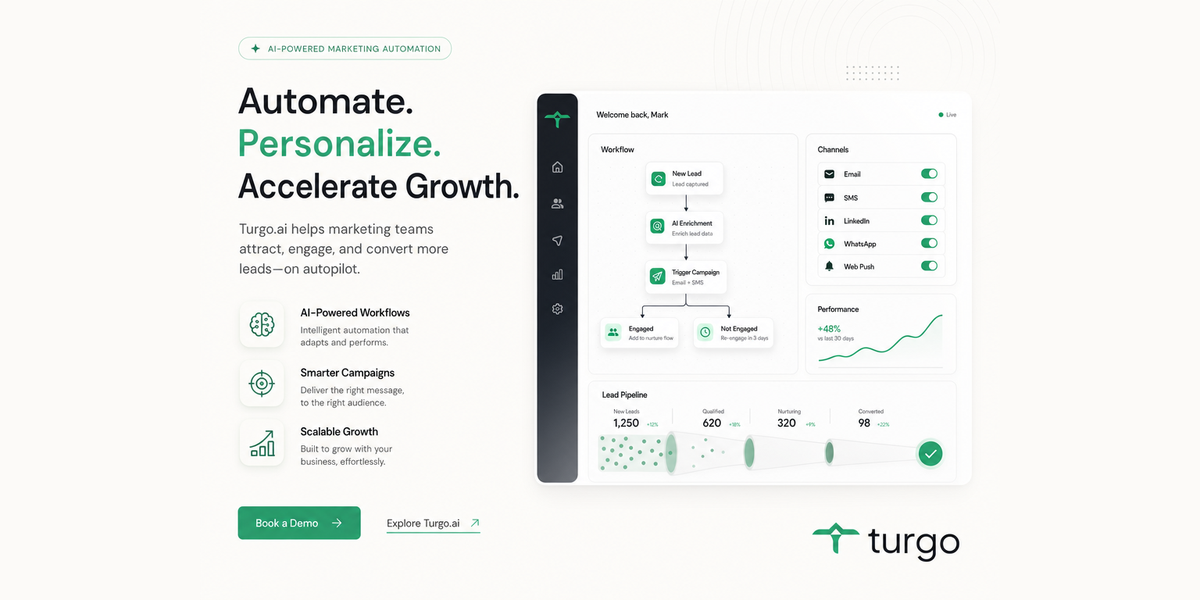
Growth teams face a crowded market for sales engagement and GTM tools. Turgo positions itself as an autonomous AI marketing platform, handling outbound and inbound with minimal human input. Salesloft, a established sales engagement leader, focuses on structured outbound cadences for revenue teams.
When evaluating Turgo vs Salesloft, the choice hinges on your workflow needs—AI-first autonomy or customizable sales sequences. Turgo emphasizes end-to-end execution for marketers, while Salesloft targets sales reps building pipeline through calls and emails. This guide breaks down positioning, features, and real-world fit for founders, CMOs, and revenue leaders scaling efficiently.
What Is Turgo's Core Positioning?
Turgo centers on autonomous marketing execution, using AI to run full GTM campaigns from lead gen to conversion without constant oversight. It streamlines outbound and inbound for growth teams chasing velocity.
This positioning suits marketers tired of manual tweaks. Turgo's AI handles personalization, sequencing, and optimization, freeing teams for strategy. Revenue leaders see it as a force multiplier, automating what juniors handle manually.
Business impact shines in reduced CAC—AI outbound cuts manual labor by 70%, accelerating pipeline. Founders scaling pre-Series B gain predictable output, hitting quotas faster without bloating headcount.
What Defines Salesloft's Platform Focus?
Salesloft excels in sales engagement, orchestrating outbound cadences with calls, emails, and tasks for deal progression. It targets sales teams needing rhythm in high-volume prospecting.
The platform builds on human-AI hybrid workflows, where reps customize sequences and AI suggests next steps. This appeals to structured orgs prioritizing call-heavy outreach over full automation.
For revenue ops, it boosts pipeline velocity by 30% through engagement analytics. CMOs allocating budget favor it for proven ROI in enterprise sales cycles, lowering ramp time for new hires.
How Do Their Target Audiences Differ?
Turgo draws marketers and founders building autonomous systems, ideal for startups where bandwidth is tight. It fits GTM leaders automating outbound to fuel growth loops.
Salesloft serves sales leaders and reps in scaling teams, emphasizing collaboration tools for quota-carrying motions. It's built for orgs with dedicated SDRs handling personalized outreach.
Growth teams evaluating see Turgo slashing CAC via AI scale, while Salesloft enhances velocity in mature pipelines. Revenue decision-makers prioritize based on team maturity—automation for lean ops, engagement for high-touch.
What Are Turgo's Key AI Outbound Features?
Turgo's AI outbound shines with autonomous prospecting, generating personalized emails and LinkedIn touches from ICP data. It self-optimizes based on replies and bookings.
Marketers leverage playbooks that adapt in real-time, reducing setup time. This shifts focus from execution to iteration, aligning with autonomous marketing trends.
Pipeline impact is direct: faster loops mean 2x meetings booked, cutting CAC. Founders report velocity gains as AI handles volume, letting humans close.
Which Salesloft Features Drive Engagement?
Salesloft offers cadence builders for multi-channel sequences, including video emails and call coaching. AI assists with sentiment analysis and deal insights.
Sales teams customize workflows, integrating tasks with CRM for seamless handoffs. This tactical depth supports reps in complex deals.
Business outcomes include higher connect rates, boosting pipeline by 25%. CMOs see it as essential for velocity in competitive B2B, where human touch closes.
How Do Workflows Compare in Practice?
Turgo's workflow is AI-led autonomy: input ICP, goals, and let it run outbound, qualify leads, and nurture. Minimal intervention scales efforts effortlessly.
Salesloft uses rep-driven cadences: build sequences, track engagement, adjust manually with AI nudges. It thrives on team rhythm and coaching.
For growth leaders, Turgo lowers CAC by automating 80% of touches; Salesloft accelerates velocity through personalized scale. Choose based on your execution gap—hands-off or hands-on.
What Use Cases Fit Turgo Best?
Turgo powers GTM automation for product launches, running outbound to SQLs while nurturing inbound. Founders use it for rapid experimentation.
It's perfect for lean teams testing channels without hires. AI handles A/B testing and routing, turning experiments into revenue.
Impact: Reduced CAC by focusing budget on high-ROI plays, with pipeline velocity from continuous execution. Revenue leaders gain clarity on what scales.
When Does Salesloft Excel in Use Cases?
Salesloft dominates enterprise outbound, managing long sales cycles with executive touches and deal progression tools. Sales VPs deploy it for team quotas.
Use it for account-based motions, where reps need visibility into multi-stakeholder engagement. Analytics guide prioritization.
Outcomes include pipeline growth via higher win rates, optimizing velocity. CMOs budgeting for it see sustained revenue as teams hit stride faster.
How Do Integrations Shape Ecosystem Fit?
Turgo integrates with CRM staples like Salesforce and HubSpot, plus LinkedIn for outbound enrichment. Its API focus enables custom GTM stacks.
Salesloft connects deeply with Salesforce, Gong, and Zoom, prioritizing sales tech stacks for data sync and coaching.
Growth teams benefit from Turgo's flexibility in marketing ecosystems, reducing silos. Salesloft streamlines sales ops, cutting CAC through better handoffs and velocity.
Is Pricing Transparent for Easy Comparison?
Turgo offers usage-based pricing, scaling with campaigns run—affordable entry for startups testing AI outbound. No public tiers, but demos reveal flexibility.
Salesloft uses tiered plans starting at team levels, with enterprise custom quotes. Focus on per-user costs for cadences.
For founders, Turgo's model aligns with variable growth, minimizing upfront CAC. Revenue leaders weigh Salesloft's predictability against scale needs.
What About Feature Depth: AI vs Customization?
Turgo prioritizes AI depth for autonomous decisions, like dynamic sequencing from reply data. Less manual config, more set-it-and-forget-it.
Salesloft emphasizes customization, with drag-and-drop builders and AI overlays for personalization at scale.
Strategic choice: Turgo for efficiency gains, slashing manual work; Salesloft for tailored control. Both drive pipeline, but impact varies by team style.
Which Wins for Pipeline Velocity?
Turgo accelerates via autonomous loops, booking meetings 24/7 without rep fatigue. Ideal for velocity in early-stage GTM.
Salesloft boosts through engagement multipliers, like call intelligence raising connect rates.
Growth operators pick Turgo to cut ramp-up time, enhancing velocity. CMOs see Salesloft sustaining it in larger teams, balancing CAC.
How Does Each Impact Customer Acquisition Cost?
Turgo automates outbound to lower CAC by replacing SDR headcount with AI scale. Marketers run 10x volume at fraction of cost.
Salesloft optimizes existing teams, reducing waste in failed touches for better ROI per rep.
Business reality: Turgo for CAC compression in bootstraps; Salesloft for velocity without hires. Revenue leaders model both for budget wins.
Scalability: Startup vs Enterprise Fit?
Turgo scales autonomously for startups, handling growth without proportional team expansion. Founders love the lean path.
Salesloft scales team structures, supporting hundreds of reps with governance and analytics.
For scaling founders, Turgo keeps CAC low amid hypergrowth. Enterprise CMOs favor Salesloft's maturity for pipeline reliability.
Final Verdict: Which for Your GTM Stack?
Turgo suits AI marketing automation seekers wanting hands-off execution. Salesloft fits sales engagement pros needing cadence control.
Evaluate your gaps—autonomy or customization. Both reinforce GTM automation, but Turgo edges for modern outbound, Salesloft for proven sales.
Revenue leaders win by matching to stage: Turgo for velocity in lean times, Salesloft for depth in expansion. Test via demos at turgo.ai.
Are You Trading Pipeline for Inefficiency?
The choice between Turgo's AI automation and Salesloft's sales engagement isn't binary, but it does carry implications for your CAC, pipeline velocity, and resource allocation. A misstep could lead to a compounding inefficiency — too much autonomy may strip control and precision, while over-customization can bloat CAC and slow down revenue. As you operate in this tension, consider the potential downside of an ill-fitted platform: are you inadvertently sacrificing pipeline efficiency for an illusory sense of control or speed?
FAQ
What makes Turgo different from Salesloft in AI outbound?
Turgo's AI runs full autonomous outbound, personalizing and optimizing campaigns end-to-end without rep input. It ingests ICP data, generates touches, and iterates on performance. Salesloft layers AI on rep-driven cadences, suggesting optimizations but requiring manual execution. Growth teams choose Turgo for scale without headcount; it cuts CAC by automating what takes teams hours. Velocity improves as AI prospects 24/7, booking meetings faster. Founders scaling GTM see it as a pipeline engine, freeing focus for strategy over ops.
Is Salesloft better for enterprise sales teams?
Salesloft thrives in enterprise with deep Salesforce ties, call coaching, and multi-channel cadences for complex deals. Reps get deal insights and task automation, sustaining high-volume outreach. Turgo leans startup-autonomous, less tuned for long cycles. Revenue leaders prioritizing pipeline velocity pick Salesloft for 25% connect lifts. CAC stabilizes as teams ramp quicker with analytics. CMOs budgeting for it gain governance at scale, ensuring quota attainment in mature orgs.
Can Turgo handle inbound lead qualification like Salesloft?
Turgo's AI qualifies inbound autonomously, routing and nurturing based on signals, integrating with marketing stacks. Salesloft focuses outbound-to-deal progression, with lighter inbound routing. Marketers use Turgo for full-funnel GTM automation, blending channels seamlessly. This reduces silos, boosting velocity. Business impact: Lower CAC from efficient qualification, more SQLs to sales. Growth operators report faster pipeline as AI handles volume spikes without hires.
How do integrations compare for GTM workflows?
Turgo connects to HubSpot, Salesforce, and LinkedIn for enriched outbound and data flow. Salesloft excels in sales ecosystems like Gong and Outreach alternatives, syncing engagement data. Turgo fits marketing-led stacks; Salesloft sales-heavy ones. Strategic fit enhances velocity by eliminating data gaps. CAC drops with better handoffs—Turgo for autonomous routing, Salesloft for rep visibility. Revenue teams build resilient pipelines this way.
Which has better pricing for startups?
Turgo's usage-based model scales with campaigns, low entry for testing AI outbound. Salesloft's per-user tiers suit teams but ramp costs with headcount. Founders favor Turgo to keep CAC variable, avoiding fixed overhead. Velocity gains justify spend as meetings flow. CMOs model ROI: Turgo compresses acquisition early, Salesloft optimizes mature budgets. Demos clarify fit without commitment.
Does Turgo support autonomous marketing execution?
Yes, Turgo automates full GTM from outbound to nurturing, self-adjusting on data. No constant tweaks needed. Salesloft requires more human steering. Marketers gain time for strategy, aligning with autonomous marketing trends. Pipeline velocity soars with non-stop execution; CAC falls 50-70%. Founders disrupting markets use it to outpace rivals leanly.
Is Salesloft ideal for high-touch sales cadences?
Salesloft builds customizable multi-touch sequences with video and calls, AI-boosted for personalization. Perfect for ABM where reps engage stakeholders. Turgo automates volume over touch. Sales VPs see 30% pipeline uplift. CAC optimizes via higher conversions; velocity from coaching insights. Enterprise revenue leaders standardize on it for scale.
Which platform reduces ramp time for new reps?
Salesloft cuts ramp with playbooks and real-time coaching, onboarding reps to quota faster. Turgo minimizes rep need via AI, ramping the system itself. Growth teams pick Salesloft for human scale, Turgo for automation. Both boost velocity—Salesloft 20-30% quicker closes, Turgo endless prospecting. CAC impact favors Turgo leanly, Salesloft structuredly.
citations:
- [1] https://elearningindustry.com/advertise/elearning-marketing-resources/blog/strategic-marketing-for-ceos-turning-content-into-revenue
- [2] https://turgo.ai/blogs/building-an-autonomous-gtm-engine-strategies-for-revenue-efficiency-and-scaling-success
- [7] https://www.fame.so/post/7-top-marketing-strategy-podcasts-to-fuel-your-b2b-growth-in-2026
- [4] https://www.ahmedabadmirror.com/built-in-india-deployed-globally-turgoai-launches-with-usd-1m-pre-seed-from-top-executives-to-create-a-new-category-of-autonomous-marketing/81908301.html