How Does n8n Lead Scoring Workflow AI Enhance CRM Efficiency?
AI lead scoring in n8n enhances CRM efficiency by automatically qualifying leads, improving pipeline quality and conversion rates, and reducing CAC.
n8n Lead Scoring Workflow: Auto-Qualify Leads With AI
AI lead scoring in n8n automatically qualifies inbound leads before they hit your CRM, improving pipeline quality, conversion rates, and overall revenue efficiency.
Modern go-to-market teams are drowning in inbound form fills, demo requests, and event leads while sales capacity stays constrained. The real bottleneck is not generating interest—it’s separating signal from noise fast enough to act on the best opportunities.
AI-powered lead scoring in n8n solves that problem by automatically researching, qualifying, and routing every lead in minutes, without manual SDR triage. This article breaks down how to design a robust lead scoring workflow in n8n, plug it into your CRM, and turn AI into a reliable gatekeeper for your pipeline.
You’ll see how to combine AI inbound lead qualification with autonomous marketing execution, AI outbound automation, and GTM automation so only the right leads ever reach your reps.
What Is an n8n Lead Scoring Workflow?
A n8n lead scoring workflow is an automated process that ingests new leads, enriches them with context, uses AI to score and qualify them, and then routes only the best-fit leads into your CRM while triggering follow-up sequences for each segment.
- Trigger from forms, ads, or inbound channels
- Enrich lead and company data automatically
- Use AI models to score fit, intent, and urgency
- Route hot/warm/cold leads into distinct paths
- Sync qualified leads and activity into your CRM
Why Automate Lead Qualification Before the CRM?
Automating lead qualification upstream of the CRM prevents low-quality contacts from cluttering your database, skewing reports, and wasting sales cycles. When scoring happens at the edge—right after form submission or capture—you decide what “counts” as pipeline before it enters your systems.
Strategically, this shifts your CRM from being a dumping ground into a curated record of active opportunities and prioritized accounts. It enables autonomous marketing execution where inbound leads are filtered, scored, and either accelerated or nurtured without human intervention.
From a business perspective, upstream qualification reduces CAC by cutting time spent on non-buyers, improves pipeline velocity by fast-tracking high-intent prospects, and gives revenue leaders cleaner data to forecast and allocate headcount. Your CRM becomes a system of record for qualified demand, not just raw volume.
How Does n8n AI Lead Scoring Work End-to-End?
At its core, an n8n AI lead scoring workflow is a chain of nodes: trigger → enrich → analyze → score → route → sync. A typical flow starts with a webhook or form node capturing details like name, company, website, budget, and timeline. n8n then calls enrichment APIs or scrapes the company site to build a richer profile.
An AI model—often via OpenAI or Claude—is prompted with your Ideal Customer Profile and scoring logic to output a structured score (e.g., 0–100) plus reasoning and recommended action. Downstream, Switch or IF nodes categorize the lead into hot, warm, or cold paths, each with tailored follow-up.
This end-to-end design directly impacts pipeline quality and speed. Hot leads can trigger Slack alerts and instant “book a call” emails within seconds, while warm and cold leads enter automated nurture. The result is more meetings from the same inbound volume and fewer wasted touches on poor-fit leads.
Designing an Effective Lead Scoring Model in n8n
A strong scoring model is more important than the AI vendor or tech stack. Start by defining your ICP clearly: industries, company size, technology stack, buying roles, and disqualifiers. Translate that ICP into weighted criteria—budget clarity, decision-making authority, urgency, and fit—each contributing to a final score.
In n8n, these rules live in your AI prompt and routing logic. You can use BANT, CHAMP, or custom frameworks, but the key is consistency. Ask the model to output JSON with numeric scores and a recommended action so your Switch node can branch cleanly without fragile text parsing.
When done well, this model gives leadership confidence that “hot” really means high-probability pipeline. It also makes CAC more predictable: you know that reps are focusing on leads that meet defined thresholds rather than chasing gut-feel opportunities that rarely convert.
What Lead Data Should You Capture and Enrich?
The best n8n lead scoring workflows pair minimal form friction with heavy backend enrichment. You might only request name, email, company, and website on the form, then use n8n to pull company metadata, LinkedIn profiles, tech stack, and firmographics automatically.
Strategically, this keeps conversion rates high while giving your AI enough context to score meaningfully. Data enrichment nodes can tap into tools for follower counts, employee numbers, activity levels, or relevant signals like funding or hiring trends. Fine-grained inputs make AI scoring far more reliable than generic analysis.
From a business standpoint, enriched data improves segmentation and personalization downstream. It enables AI outbound automation that references company details accurately, boosts reply rates, and ultimately increases pipeline generated per lead. Better inputs into scoring mean higher-quality outputs into your CRM.
Building the Core n8n Lead Scoring Workflow
A practical workflow blueprint usually includes: a webhook or form trigger, a validation step (checking email and required fields), an enrichment sequence, an AI scoring node, routing, and CRM sync. Each stage should be modular so you can tune criteria without breaking the entire flow.
In n8n, you might use one workflow to handle top-of-funnel scoring and a sub-workflow to perform detailed AI research and scoring. The AI node receives the lead plus enrichment data, applies your scoring framework, and returns a score, label, and recommended path for follow-up.
This structured core becomes the backbone for GTM automation. When only tagged and scored leads hit your CRM, downstream automation—playbooks, sequences, reporting—works more cleanly. Pipeline becomes more predictable, and your SDRs or AEs spend more time on high-leverage conversations.
Routing Hot, Warm, and Cold Leads Automatically
Routing is where lead scoring turns into action. In n8n, you can define thresholds—for example, 80+ as high priority, 40–79 as medium, and below 40 as low or discard. Switch or IF nodes route each lead to a separate path: immediate outreach, nurture, or silent logging.
Strategically, this lets you align follow-up intensity with deal probability. Hot leads might trigger instant Slack alerts, round-robin assignment, and same-day sequences. Warm leads might enter a scheduled nurture program, and cold leads could receive lightweight content or be held out of active sequences entirely.
From a revenue perspective, automated routing improves sales productivity and pipeline velocity. High-scoring leads receive human contact within minutes, increasing meeting rates and reducing drop-off. At the same time, your CAC benefits from reserving expensive human effort for opportunities most likely to close.
How Do You Integrate n8n Lead Scoring With Your CRM?
The CRM sync is the final gate. After scoring and routing, n8n should write qualified leads into your CRM with structured fields: score, segment (hot/warm/cold), reasoning, and recommended next action. You can integrate directly via API or through intermediary tools like Google Sheets or Airtable.
Strategically, you want CRM records to mirror your automation logic, not fight it. Custom fields for AI score, intent, and urgency allow sales leaders to filter views and prioritize queues. They also make it easier to analyze performance by segment and refine the scoring model over time.
The business impact is substantial: cleaner CRM data, fewer duplicates, better attribution, and more accurate pipeline reporting. Sales and marketing alignment improves because both teams are working from the same qualified lead signals, not debating whether a contact is truly sales-ready.
Using Autonomous GTM Execution for Follow-Up
Once scoring and routing are stable, the next step is autonomous GTM execution. n8n can orchestrate multi-channel sequences that run without manual touches: email, LinkedIn, WhatsApp, and calendar booking links tailored to each lead segment and persona.
Strategically, this turns your scoring workflow into a true GTM automation platform. Hot leads receive personalized, short-latency outreach; warm leads enter education-driven sequences; and cold leads get low-effort touchpoints or are suppressed altogether. Over time, you can feed engagement data back into the scoring loop.
Business-wise, this enables AI outbound automation that scales without SDR headcount. Teams using autonomous GTM execution have reported generating 108 qualified leads with no SDRs, 80 leads from fully automated event-driven outbound, and multi-channel sequences achieving 81.5% open rates—driving more pipeline with less human cost.
What Are the Real-World Benefits of AI Lead Scoring in n8n?
Real-world impact is measured in hours saved, meetings booked, and deals closed. Teams often report going from manual spreadsheet triage to fully automated, always-on qualification that runs daily or hourly without oversight. Lead response times drop from days to minutes.
Strategically, this changes how you think about inbound. Instead of “more leads,” the focus shifts to “more qualified opportunities per week.” Marketing can confidently ramp paid and organic acquisition knowing that only the right contacts will reach sales, protecting CAC and brand reputation.
The business benefits extend across the funnel: higher conversion from lead to meeting, more consistent sales activity on the right accounts, and a pipeline composed of buyers who meet your ICP. This improves forecasting accuracy and supports revenue-efficient growth as you scale into new markets.
How Does n8n Compare to Native CRM Lead Scoring?
Native CRM lead scoring is typically rules-based: points for job title, company size, clicks, or page views. It’s fast but rigid, and often misses nuance around intent or strategic fit. n8n, by contrast, lets you embed AI analysis and external data sources directly in the scoring process.
Strategically, n8n becomes the orchestrator layer above your CRM, combining qualitative signals (website messaging, LinkedIn profile, content responses) with quantitative factors. You can use your CRM’s scoring as a simple filter while relying on n8n for deeper AI inbound lead qualification.
From a business angle, this hybrid approach improves precision without locking you into one vendor’s scoring logic. It also reduces the risk of “false positives” that waste sales cycles. The outcome is more accurate prioritization and better ROI on the tools you already own, including Salesforce or HubSpot.
How to Align Marketing, Sales, and RevOps Around AI Scoring
AI lead scoring only works if all go-to-market stakeholders trust and understand it. That means marketing, sales, and RevOps need shared definitions of hot, warm, and cold, and clarity on what actions each segment triggers. Build these definitions collaboratively, then encode them in n8n.
Strategically, this alignment turns scoring into a governance mechanism, not just a workflow. RevOps can maintain the rules, marketing can tune thresholds based on campaign performance, and sales can provide qualitative feedback about lead quality and meeting outcomes. n8n becomes the technical enforcer of your GTM agreements.
The impact on pipeline and CAC is significant. When everyone agrees on what “qualified” means, you reduce friction between teams, cut cycle time debating lead quality, and increase the proportion of leads that progress to opportunities. That cohesion directly supports better revenue efficiency.
Implementing AI Lead Scoring Without a Data Science Team
You do not need a data science team to implement reliable AI lead scoring in n8n. You need clear ICP definitions, representative examples of good and bad leads, and a willingness to iterate prompts. Most teams start with simple scoring frameworks and refine over a few weeks.
Strategically, treat your first version as a baseline experiment. Monitor how many hot leads convert to meetings and opportunities, then adjust thresholds and prompts accordingly. Use n8n’s logs and your CRM reports to see where scoring disagrees with reality and close the gap.
From a business perspective, this iterative approach keeps implementation costs low while delivering quick wins. You can start with a single inbound form, prove impact on conversion and response times, then expand to more channels. The incremental gains in pipeline quality compound over time.
How to Measure and Improve Your n8n Lead Scoring Workflow
Measurement is essential. Track metrics like percentage of leads labeled hot/warm/cold, meeting booking rates per segment, opportunity creation rate per segment, and eventual win rates. Compare these numbers before and after implementing AI scoring to quantify impact.
Strategically, focus on precision rather than volume. If too many leads are marked hot but don’t convert, tighten criteria. If very few reach hot status but close at high rates, consider lowering thresholds to capture more upside. Use feedback from AEs to refine what “good” looks like.
The business payoff is a continuously improving qualification engine. As your scoring becomes more accurate, you raise pipeline quality, reduce wasted outreach, and optimize CAC. Over time, this gives you a defensible edge: your GTM automation platform doesn’t just move faster—it moves smarter.
Getting Started With n8n Lead Scoring and AI Marketing Automation
To start, pick one high-value inbound source—a demo request form, webinar registration, or high-intent content asset—and build your first lead scoring workflow around it. Keep the form simple, enrich data in the background, and design a clear routing scheme for hot, warm, and cold leads.
Strategically, this pilot becomes your proof of concept for autonomous B2B outreach and AI outbound automation. Once you see improved meeting rates and cleaner CRM entries from that single flow, replicate the pattern across channels, adding complexity only when needed.
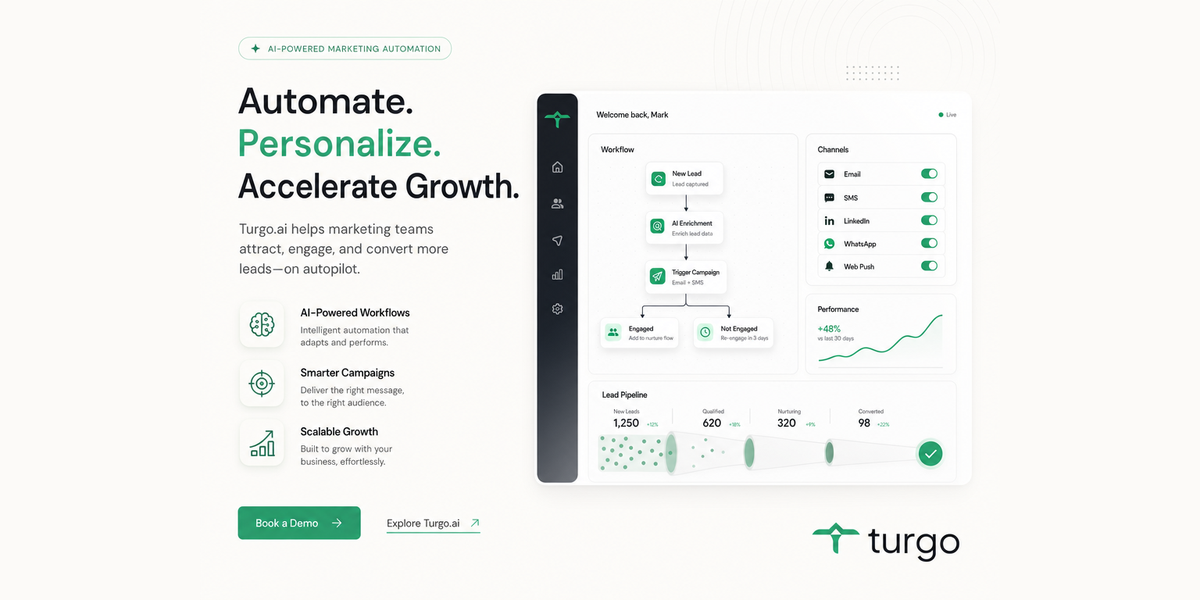
As you scale, consider pairing n8n with a broader marketing automation platform so AI scoring feeds directly into lifecycle flows. A strong starting point for understanding how AI-led GTM automation fits together is exploring a modern AI marketing automation homepage and deeper strategy content via its blogs index.
Are you letting low-quality leads clog your CRM and slow down your pipeline velocity?
The manual triage is not only inefficient but also increases your Customer Acquisition Cost (CAC) due to wasted resources on non-buyers. By implementing an AI-powered lead scoring workflow, you'll be able to filter out the noise, reduce your CAC, and boost your revenue efficiency. But the real question is, can you afford to ignore this opportunity and continue with your current inefficient system?
Turgo automates this entire workflow. Try it free at turgo.ai.
FAQ
What is an n8n lead scoring workflow?
An n8n lead scoring workflow is an automated process that captures new leads, enriches their data, uses AI to score and qualify them, and routes only the best-fit leads into your CRM. It replaces manual triage with rules-driven, AI-backed decisions that run continuously, improving pipeline quality and response times. By filtering leads before they enter your systems, you prevent clutter, focus sales effort on high-probability opportunities, and build a more predictable revenue engine anchored in structured, consistent qualification.
How does AI lead scoring in n8n work technically?
AI lead scoring in n8n works by chaining nodes for data capture, enrichment, and analysis. A trigger node receives the lead, enrichment nodes gather company and profile data, and an AI node evaluates fit, intent, and urgency against your ICP. The AI returns a numeric score and recommended segment, which routing nodes use to send the lead into hot, warm, or cold paths. Finally, CRM integration nodes record scored leads and trigger follow-up. This technical flow is modular, so you can refine prompts, thresholds, and downstream actions without rebuilding the entire system.
Why do teams qualify leads before they hit the CRM?
Teams qualify leads before they hit the CRM to keep the database clean, reduce noise in reporting, and prevent sales from chasing low-quality contacts. Upstream qualification ensures only leads that meet predefined criteria are treated as pipeline. This reduces the burden on SDRs and AEs, limits duplicate or junk records, and aligns marketing and sales around what “qualified” truly means. As a result, conversion rates from lead to opportunity improve, CAC drops because fewer resources are spent on non-buyers, and forecasting becomes more accurate.
How does AI lead scoring affect CAC and pipeline efficiency?
AI lead scoring reduces CAC by directing human effort toward leads that have a higher probability of converting. Instead of spreading outreach evenly, teams concentrate on hot and warm segments that align with their ICP and show strong intent. This targeted focus increases meeting and opportunity rates per contact touched. Pipeline efficiency improves because leads move faster through stages and fewer contacts stall or churn unnoticed. Over time, the combination of better prioritization and automation yields more revenue from the same acquisition spend and headcount.
What tools integrate well with n8n for lead scoring workflows?
n8n integrates well with CRMs like HubSpot and Salesforce, marketing tools, spreadsheets such as Airtable and Google Sheets, and communication platforms like Slack. You can also connect AI providers for scoring and enrichment APIs for firmographic or technographic data. This flexibility lets you design a GTM automation platform tailored to your stack. For example, you might store scored leads in Airtable, sync qualified records to your CRM, and send alerts via Slack. As your process matures, these integrations support more complex autonomous marketing execution and reporting.
How do you set thresholds for hot, warm, and cold leads?
You set thresholds by combining ICP criteria with observed performance. Start with a simple scale, such as 0–100, and define ranges that reflect realistic deal probabilities: perhaps 80+ as hot, 50–79 as warm, and below 50 as cold. After running the workflow for a few weeks, analyze how each band converts to meetings and opportunities. If hot leads aren’t closing at a higher rate, tighten criteria; if warm leads perform strongly, consider adjusting thresholds. This iterative calibration ensures your segmentation aligns with true commercial outcomes.
What is autonomous marketing execution in the context of n8n?
Autonomous marketing execution is the ability to run end-to-end campaigns—from qualification through multi-channel follow-up—without manual intervention. In n8n, this means workflows that score leads, choose the right path, and trigger personalized emails, messages, and nurtures automatically. The system reacts to events like form fills or replies, adjusts actions based on segments, and logs activity into your CRM. This autonomy frees teams from repetitive tasks, increases responsiveness, and ensures consistent treatment of every lead, ultimately improving pipeline velocity and revenue efficiency.
How can smaller teams adopt AI outbound and lead scoring quickly?
Smaller teams can adopt AI outbound and lead scoring by starting with one tightly scoped workflow and a simple scoring model. Use n8n to capture leads from a single high-intent source, enrich basic data, and prompt an AI model to return a score and recommended action. Then connect that output to a lightweight outbound sequence that runs automatically. As you see results—more qualified meetings with minimal manual work—you can expand to additional channels and refine your prompts. This gradual approach delivers impact without requiring complex infrastructure or specialized staff.
Citations:
[1] https://n8n.io/workflows/8773-automate-lead-qualification-and-multi-channel-follow-up-with-ai-bant/