How Can AI Calling at Scale Qualify 500 Leads Daily Without a Team?
AI calling at scale can transform your GTM by qualifying 500 leads daily, reducing CAC and accelerating pipeline velocity.
AI Calling at Scale: Qualify 500 Leads a Day
Build a repeatable system for high-volume lead qualification with AI calling, faster routing, and lower CAC. Learn how to screen 500 leads daily without adding SDR headcount.
AI calling at scale changes the economics of lead qualification. Instead of waiting for reps to call back, an AI voice layer can respond instantly, ask structured qualification questions, capture intent, and route only the best opportunities into the pipeline.
For teams that need speed, the real value is not just volume. It is the ability to turn inbound interest or outbound lists into clean, qualified conversations without adding a proportional human team. That is where AI marketing automation and autonomous marketing execution start to matter operationally.
What Is AI Calling at Scale?
AI calling at scale is the use of voice agents to make, answer, and qualify large volumes of phone conversations automatically. A AI calling at scale system is a voice-driven workflow that places or receives calls, asks predefined qualification questions, scores intent, records outcomes, and updates CRM records in real time. It reduces manual dialing and helps teams process hundreds of leads daily.
- Place outbound calls or answer inbound calls automatically
- Ask consistent qualification questions across every conversation
- Capture contact data, intent signals, and objections
- Score leads using rules such as fit, budget, and urgency
- Sync outcomes to CRM and routing workflows
Why Does Lead Qualification Break Down at 500 Leads a Day?
Lead qualification breaks down at 500 leads a day because human teams cannot maintain instant response, consistent questioning, and fast follow-up at that volume. The first failure point is speed: many leads age out before a rep can engage. The second is inconsistency: different reps qualify differently, which creates noisy pipeline data.
At higher volume, the problem becomes operational, not just staffing-related. Even a strong SDR team spends time on repetitive screening, basic information gathering, and calendar coordination. AI outbound automation and AI inbound lead qualification reduce that friction by turning repetitive calls into a standardized workflow.
The business impact is direct: faster response times usually improve contact rates, fewer unqualified meetings reduce wasted sales capacity, and cleaner qualification improves pipeline velocity. That lowers acquisition waste and makes revenue forecasting easier.
Which Leads Should Be Handled by AI Calling?
AI calling works best for leads that can be screened with clear criteria and a short discovery flow. That includes form fills, demo requests, event registrants, webinar attendees, trial signups, abandoned checkout leads, and outbound prospect lists with known firmographic filters. If the qualification logic is objective, AI can usually handle the first pass.
The strongest use cases are where the team already knows what “qualified” means. For example, company size, role, geography, budget band, implementation timeline, and product category interest can all be captured in a short conversation. AI outbound works especially well when those variables are already available in the CRM or enrichment stack.
This matters because qualification should not be treated as a one-size-fits-all motion. Using AI for the first touch preserves human time for later-stage conversations, which improves cost efficiency and helps revenue teams focus on high-probability deals.
How Does the AI Qualification Flow Work?
The qualification flow starts the moment a lead enters the system. A call is triggered from a form, list, event, or routing rule. The agent opens with context, confirms the person’s need, asks a small set of qualification questions, and determines whether the lead should be passed to sales, nurtured, or disqualified.
A strong flow is built around decision points, not open-ended chatter. The call should ask only what is required to score fit and urgency, then move to a clear next step. This is where a GTM automation platform becomes more useful than a standalone dialer: it can combine calling, scoring, enrichment, scheduling, and CRM updates in one execution layer.
The business result is faster pipeline progression. When qualification, booking, and record updates happen in one motion, teams reduce lead leakage, improve handoff quality, and compress the time from interest to meeting.
What Makes a High-Converting AI Call Script?
A high-converting AI call script is short, specific, and adaptive. It should introduce the reason for the call, confirm relevance, ask one question at a time, and move toward a booking or routing decision quickly. The best scripts sound natural because they are organized around intent, not around a rigid script tree.
The script should include four elements: context, qualification, objection handling, and next action. Context tells the lead why they are being called. Qualification identifies fit. Objection handling keeps the conversation moving. Next action converts the call into a booked meeting, a warm transfer, or a nurture path.
This improves conversion because the system avoids the two extremes that hurt performance: generic robocall language and over-engineered conversation trees. Better scripts shorten handle time, increase completion rates, and improve the percentage of leads that enter sales with enough context to convert.
How Do You Route Qualified Leads Without Slowing Down?
You route qualified leads by defining rules before the call begins. If the lead matches the ICP and shows buying intent, the agent can book a meeting, transfer the call, create a task, or push the record to the right owner. If the lead is partial-fit, it can be sent to nurture or a different queue. If it is unqualified, it can be tagged and excluded from human follow-up.
Routing works best when it is deterministic. That means the qualification logic, handoff rules, and calendar availability are all connected. AI marketing automation becomes valuable here because it links conversation outcomes to the next action without manual review.
The operational payoff is less back-and-forth and fewer dropped handoffs. That means faster speed-to-lead, higher meeting rates, and lower CAC because your human team spends time only where it compounds.
What Systems and Integrations Does AI Calling Need?
AI calling needs a small but connected stack: lead source, calling engine, CRM, scheduling, enrichment, and reporting. The best systems also connect to inboxes, calendar tools, and lifecycle stages so the whole motion can run without manual intervention. A disconnected stack will still create work for ops teams.
The most useful integrations are the ones that preserve context. When a lead is called, the system should know where it came from, what campaign triggered it, what segment it belongs to, and what outcome should happen next. That is the difference between simple calling and autonomous marketing execution.
For teams evaluating a broader operating model, this is where autonomous marketing execution becomes a category rather than a feature. It connects lead capture, outreach, qualification, and routing into one workflow that can run continuously.
How Do Teams Use AI Calling for Inbound and Outbound Together?
The best teams use AI calling as a unified layer across inbound and outbound. Inbound handles fast response to high-intent forms, demos, and event signups. Outbound handles dormant leads, reactivation lists, and targeted prospecting. Both motions can use the same qualification logic, scoring rules, and CRM handoff paths.
This matters because separate systems often produce separate data. Inbound teams optimize for speed, outbound teams optimize for reach, and the two motions drift apart. A single AI inbound lead qualification framework makes it easier to compare performance, refine scoring, and maintain consistent pipeline standards.
The business effect is cleaner forecasting and better resource allocation. When inbound and outbound run on the same qualification layer, leaders can see which source produces stronger meetings, shorter cycle times, and better revenue efficiency.
What Results Are Realistic at This Volume?
The realistic result is not just more calls; it is fewer wasted human hours and more qualified meetings. Teams using autonomous GTM execution have reported 108 qualified leads with no SDR headcount, 80 leads from fully automated event-driven outbound campaigns, and 81.5% open rates from personalised multi-channel sequences. Those outcomes show that automation can create real pipeline when the qualification logic is clear.
What matters is the operating model behind the result. High-volume AI calling works when the inputs are clean, the criteria are explicit, and the handoff is immediate. Without those pieces, more calls just create more noise. With them, the system becomes a repeatable engine for pipeline creation.
That is why AI outbound is most valuable when measured by qualified opportunities per hour, not raw call counts. The right KPI is revenue efficiency: more meetings from the same or lower headcount, with less manual work and shorter time to action.
Which Metrics Should Revenue Leaders Track?
Revenue leaders should track contact rate, qualification rate, meeting-booked rate, speed-to-lead, disqualification rate, and downstream conversion to opportunity. These metrics show whether AI calling is actually improving pipeline quality or just increasing activity. Raw call volume is not enough.
The most useful view is a funnel by source and segment. That lets leaders see whether certain campaigns, lists, or triggers produce stronger conversations. It also helps identify where the agent needs better prompts, tighter criteria, or different routing rules. This is the practical side of a marketing automation platform: measuring what happens after the call, not just during it.
The business impact is better budget allocation. If one segment produces cheaper qualified meetings and a higher opportunity rate, you can scale it confidently. If another segment produces volume but poor conversion, you can stop wasting spend and rep time.
How Do You Keep AI Calling Compliant and On-Brand?
You keep AI calling compliant and on-brand by controlling disclosure, consent, data retention, call recording rules, and escalation paths. The agent should identify itself clearly, follow regional calling laws, and hand off to a person when the conversation becomes sensitive or complex. Compliance should be designed into the workflow, not added later.
Brand consistency matters just as much. The system should use the same value proposition, qualification language, and tone across every call. That prevents the experience from feeling fragmented across marketing, sales, and operations. It also makes the call engine a better extension of your go-to-market system.
This lowers risk while preserving scale. When compliance and brand controls are built into AI calling, teams can expand outreach safely, protect trust, and avoid the operational drag that often comes with manual review.
How Should You Roll This Out in 30 Days?
Start with one use case, one segment, and one success metric. A practical rollout usually begins with inbound form fills or event leads, because the intent is already present and the qualification path is shorter. Then connect the call flow to CRM updates, routing, and scheduling before expanding to outbound lists.
The rollout should be iterative. Week one is for script design and criteria. Week two is for integration and testing. Week three is for live traffic on a narrow segment. Week four is for analyzing outcomes and tightening the workflow. That approach is safer than trying to automate every motion at once.
The upside is fast proof. Once one segment shows better speed-to-lead, lower CAC, or more qualified meetings, the model can be expanded across more programs and treated as a repeatable GTM automation platform.
What Does the Future of AI Calling Look Like?
The future of AI calling is less about standalone voice agents and more about autonomous systems that execute across channels. Calls will increasingly sit inside larger workflows that include email, SMS, enrichment, routing, and CRM actions. The value will come from orchestration, not just conversation.
That shift changes how teams think about staffing. Instead of asking how many reps are needed to handle volume, leaders will ask which parts of the motion require human judgment and which can be automated. AI marketing automation will continue moving toward broader execution, where one system handles the repetitive parts of demand creation and qualification.
For founders and revenue leaders, the strategic implication is simple: the winners will not be the teams with the most call capacity. They will be the teams with the best autonomous marketing execution, the cleanest handoffs, and the fastest path from lead to qualified pipeline.
Are you truly capitalizing on your lead volume or are you leaving opportunities on the table?
Inefficiencies and missed leads are compounding, disrupting your pipeline and inflating your CAC. It's time to rethink your strategy - before your competition does.
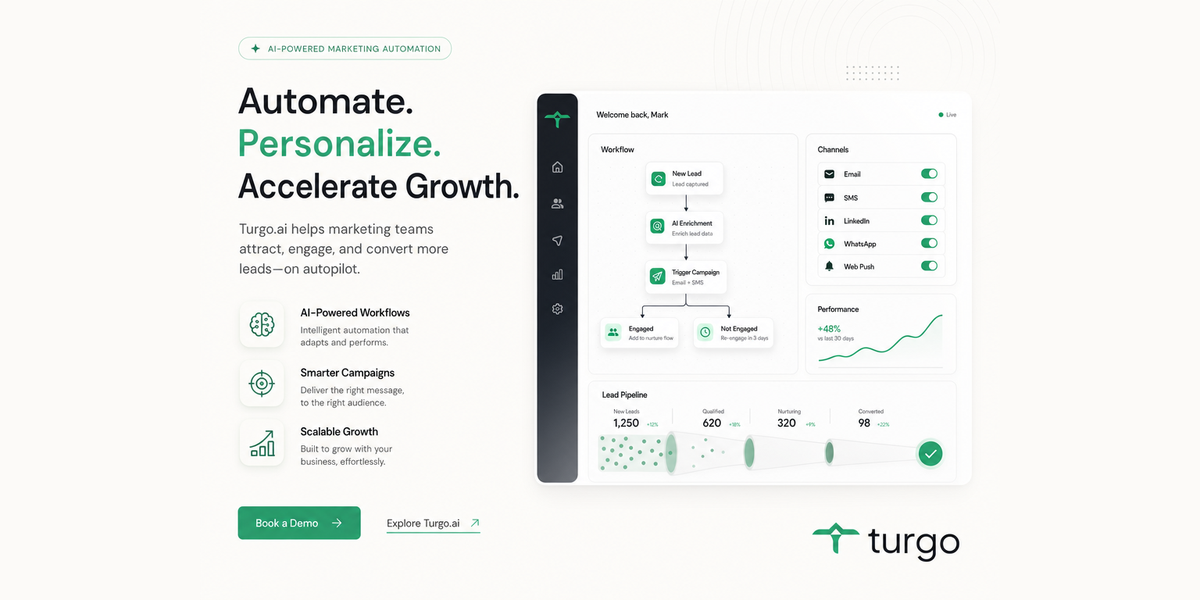
Turgo automates this entire workflow. Try it free at turgo.ai.
FAQ
What is AI calling at scale?
AI calling at scale is the use of automated voice agents to make or answer large numbers of calls, qualify leads, and route outcomes into sales workflows. It is designed for repetitive, structured conversations where the qualification criteria are clear. The main advantage is that the system can respond instantly and keep working across the day without adding human headcount. That makes it useful for lead capture, qualification, booking, and initial routing.
How does AI qualify 500 leads a day?
AI qualifies 500 leads a day by triggering a call workflow from forms, lists, or event data, then following a consistent qualification script. The agent asks a short set of questions, captures responses, scores the lead, and updates the CRM automatically. The volume comes from parallel execution and instant response, while the quality comes from fixed criteria. This reduces manual screening and helps teams move faster from interest to meeting.
Why do teams use AI for lead qualification?
Teams use AI for lead qualification because human teams struggle to maintain speed, consistency, and coverage at high volume. AI can respond immediately, apply the same criteria to every lead, and reduce the time spent on repetitive screening. That improves speed-to-lead and helps sales teams focus on better-fit opportunities. It is especially useful when the lead volume is high enough that manual calling becomes a bottleneck.
What leads are best for AI calling?
The best leads for AI calling are those with clear qualification rules, such as demo requests, webinar signups, event registrants, trial users, and targeted outbound lists. These leads usually need a short conversation to confirm fit, urgency, and next steps. AI performs best when the criteria are structured and the handoff is simple. If the conversation requires deep discovery or complex negotiation, a human rep should take over later.
How does AI calling affect CAC and pipeline velocity?
AI calling can lower CAC by reducing the manual time required to qualify and route leads. It can also improve pipeline velocity by shortening the time between lead capture and first conversation. When response times drop and handoffs become cleaner, more leads progress into meetings and opportunities. The biggest gains usually come from less wasted rep time, fewer missed leads, and a more efficient qualification process.
What systems does AI calling integrate with?
AI calling typically integrates with CRM platforms, scheduling tools, enrichment services, form builders, and campaign sources. These integrations let the system know who to call, what to say, how to score the lead, and where to send the outcome. The goal is to make the workflow continuous from capture to qualification to routing. Without integrations, the process usually breaks into manual tasks and loses speed.
What is the difference between AI inbound lead qualification and AI outbound automation?
AI inbound lead qualification handles people who already raised their hand, such as form fills, demo requests, or event registrations. AI outbound automation reaches out to target accounts or dormant leads first. The qualification logic can be similar, but the intent level is different. Inbound usually prioritizes fast response and booking, while outbound prioritizes relevance, personalization, and identifying interest before passing the lead to sales.
How do you keep AI calling compliant?
You keep AI calling compliant by building in disclosure, consent rules, call recording controls, escalation paths, and regional calling restrictions. The system should clearly identify itself and follow the policies that apply to the audience being called. Compliance should be part of the workflow design, not an afterthought. That protects trust while still allowing scale, which is especially important for teams running high-volume outbound programs.
Citations:
[1] https://monday.com/blog/crm-and-sales/ai-inbound-call-agents/
[2] https://www.pharynx.ai/ai-voice-agents-for-lead-qualification-scale-calls-without-scaling-headcount/
[3] https://turgo.ai/blogs/how-are-ai-voice-agents-revolutionizing-warm-lead-follow-up-in-b2b-marketing
[4] https://thoughtly.com/blog/best-ai-voice-agents-for-high-volume-lead-qualification-2026