How Can AI Marketing Automation Elevate Your B2B SaaS Revenue Efficiency?
AI marketing automation elevates B2B SaaS revenue efficiency by reducing CAC and accelerating pipeline velocity without expanding SDR headcount.
AI Marketing Automation: Complete Guide for Revenue Leaders
AI marketing automation drives 84% faster content delivery and 15% revenue growth by automating personalization, lead scoring, and multi-channel campaigns at scale.
Introduction
AI marketing automation represents a fundamental shift in how growth teams execute demand generation, nurture campaigns, and pipeline acceleration. Unlike traditional rule-based automation, AI-powered systems learn from customer behavior patterns, continuously optimize messaging and timing, and scale personalization to individual prospects without proportional resource increases.
For revenue leaders, the strategic value lies in three areas: reducing cost-per-acquisition through predictive lead scoring, compressing sales cycles via dynamic journey mapping, and maximizing marketing efficiency by automating repetitive tasks that consume 40%+ of team capacity. Organizations implementing AI marketing automation report 84% faster content delivery, significant cost reductions through behavioral personalization, and 15% revenue uplift among fast-growing companies.
This guide addresses the core decision framework revenue teams need to evaluate AI marketing automation platforms, understand capability gaps versus traditional systems, and align automation strategy with pipeline velocity and CAC targets.
What Is AI Marketing Automation?
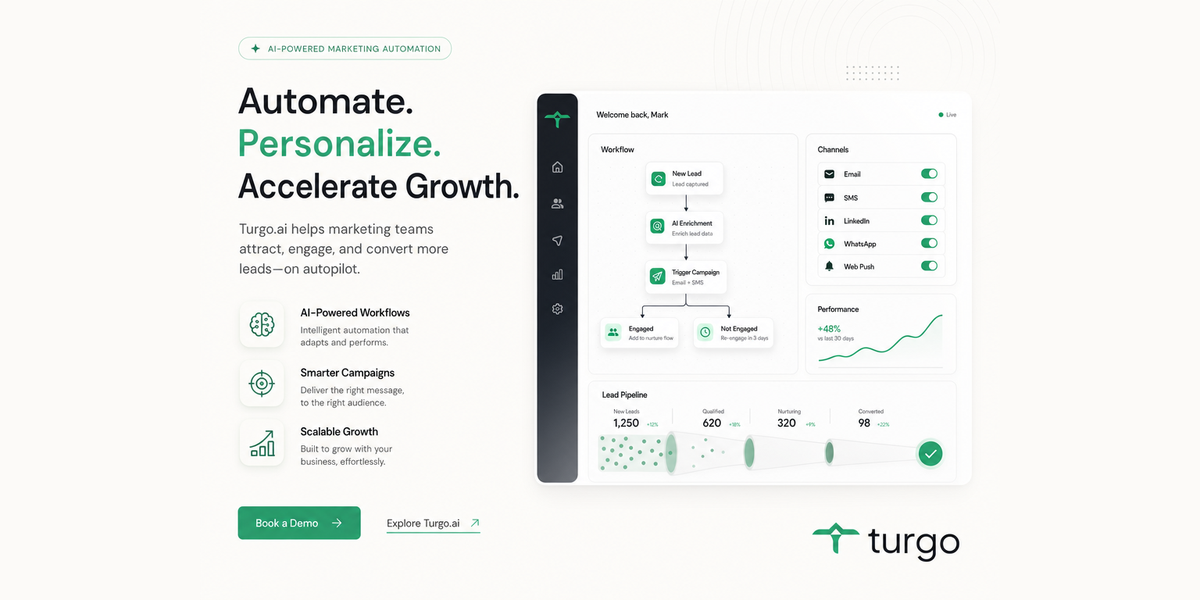
AI marketing automation combines machine learning algorithms with workflow orchestration to execute marketing tasks that traditionally required manual intervention or static rule-based triggers. The system analyzes customer behavior in real time, predicts which prospects are sales-ready, personalizes messaging at scale, and optimizes campaign performance across email, social, SMS, and web channels from a unified platform.
The distinction from traditional automation is critical: rule-based systems execute actions when conditions match (e.g., "if email opened, then send follow-up"). AI systems learn which conditions actually predict conversion, adjust those conditions as new data arrives, and recommend actions based on probabilistic outcomes rather than predetermined rules.
For CMOs allocating budget, this means shifting from campaign-centric thinking to customer-journey thinking. Instead of launching campaigns and measuring results, teams orchestrate continuous, adaptive interactions that respond to how prospects actually behave. The business impact compounds: better lead prioritization reduces wasted sales effort, dynamic personalization improves engagement rates, and real-time optimization ensures marketing spend flows toward highest-probability conversions.
How Does Predictive Lead Scoring Work?
Predictive lead scoring assigns numerical values to prospects based on hundreds of behavioral and firmographic signals—website visits, content downloads, email engagement, pricing-page views, and demographic attributes. Machine learning models trained on historical closed-won and closed-lost deals identify which signal combinations correlate with conversion.
The system updates scores in real time as prospects take new actions. A contact who visits your pricing page three times and opens every email might score 85, while someone who opened one email scores 15. Sales teams focus on high-scoring leads instead of wasting cycles on unqualified contacts, directly improving sales productivity and reducing CAC.
For revenue leaders, predictive lead scoring addresses a core GTM tension: sales teams want more leads, but marketing wants to send only qualified leads. AI scoring resolves this by quantifying readiness. A company with 500 monthly inbound leads might discover that only 120 score above 70—those are the leads worth immediate sales outreach. The remaining 380 enter nurture workflows, reducing sales friction while keeping prospects engaged. This segmentation typically improves sales conversion rates by 20–30% and reduces average sales cycle length by 2–3 weeks.
What Role Does Personalization Play in Revenue Growth?
Personalization in AI marketing automation extends far beyond adding a first name to email subject lines. The system analyzes browsing history, product views, cart abandonment data, and engagement patterns to customize email content, landing page messaging, and product recommendations for each individual prospect.
Dynamic subject lines change based on user behavior. Product recommendations pull from purchase history and similar-customer preferences. Re-engagement campaigns automatically trigger for inactive subscribers. Send-time optimization ensures each prospect receives messages when they're most likely to engage, based on their historical open patterns.
For growth teams evaluating automation platforms, personalization capability directly impacts conversion rates and customer lifetime value. A B2B SaaS company might discover that prospects who receive personalized case studies relevant to their industry convert 35% higher than those receiving generic content. An ecommerce brand might find that AI-powered product recommendations generate 18% of total revenue despite representing only 8% of email volume. The ROI compounds: better personalization improves initial conversion, increases repeat purchase rates, and reduces churn by making customers feel understood rather than marketed to.
How Does Multi-Touch Attribution Change Budget Allocation?
Traditional last-click attribution gives all credit to the final touchpoint before conversion—typically a retargeting ad or final email. Multi-touch attribution maps the entire customer journey and distributes credit across all interactions based on their influence on the conversion decision.
The first ad a prospect saw, the educational content they downloaded, the email they opened, and the retargeting ad they clicked all receive appropriate credit. This reveals which channels and touchpoints actually drive pipeline, not just which ones happen to be last.
For revenue leaders, attribution accuracy directly impacts budget allocation efficiency. A company might discover that their highest-performing channel by last-click attribution (retargeting ads) actually depends on top-of-funnel awareness created by content marketing and LinkedIn outreach. Without multi-touch attribution, they'd over-invest in retargeting and under-invest in awareness. With accurate attribution, they optimize the entire funnel. Organizations using multi-touch attribution typically reallocate 15–25% of budget toward earlier-stage channels, improving overall pipeline quality and reducing CAC by 12–18%.
What Are the Core Capabilities of Modern AI Marketing Automation Platforms?
Modern AI marketing automation platforms consolidate seven core capabilities: predictive lead scoring, customer segmentation based on behavior patterns, automated workflow triggers, AI-generated personalized content, send-time optimization, multi-channel campaign orchestration, and real-time analytics with attribution tracking.
Predictive lead scoring identifies your best prospects. Customer segmentation groups audiences by behavior, not just demographics. Automated workflows respond to user actions without manual intervention. AI-generated content creates review responses, social posts, and email copy at scale while maintaining brand voice. Send-time optimization reaches people when they're most likely to engage. Multi-channel orchestration keeps messaging consistent across email, social, SMS, and web chat. Real-time analytics track performance and surface actionable insights.
For CMOs building marketing stacks, these capabilities should be evaluated as an integrated system, not individual features. A platform with excellent lead scoring but weak content generation creates bottlenecks. A platform with strong personalization but limited multi-channel support forces teams to manage separate tools. The best platforms consolidate these capabilities so that lead scores inform content recommendations, which inform send-time optimization, which feeds back into scoring. This integration reduces tool sprawl, improves data consistency, and accelerates time-to-insight.
How Does Email Automation Drive Engagement and Conversion?
Email remains the highest-ROI marketing channel, and AI automation amplifies its effectiveness by optimizing three variables: timing, content, and frequency. The system analyzes each prospect's historical open rates, click patterns, and purchase history to determine the optimal send time for that individual.
Content personalization goes beyond subject lines to customize email body, product recommendations, images, and calls-to-action based on individual preferences and behavior. The platform automatically tests different email variations, learns which headlines and layouts perform best with specific segments, and applies winners to future campaigns without manual A/B testing.
For growth teams managing email programs, AI automation typically improves open rates by 15–25%, click rates by 20–35%, and conversion rates by 18–28%. A B2B company sending 50,000 emails monthly might increase conversions by 9,000–14,000 additional qualified leads annually just by optimizing send time and content. An ecommerce brand might increase email revenue by 22–35% through better personalization and frequency optimization. The efficiency gain is equally important: automation reduces manual campaign setup time by 60–70%, freeing teams to focus on strategy rather than execution.
What Is Dynamic Customer Journey Mapping?
Dynamic customer journey mapping uses AI to continuously track and optimize how prospects move through your funnel based on actual behavior data rather than theoretical models. The system identifies which touchpoints most effectively guide prospects toward conversion, then automatically adjusts future interactions to replicate those patterns.
Traditional journey mapping is static: marketing teams design a funnel, launch campaigns, and measure results. Dynamic mapping is adaptive: the system observes which sequences of interactions most often lead to conversion, identifies bottlenecks where prospects disengage, and recommends workflow adjustments in real time.
For revenue leaders, dynamic journey mapping addresses a critical GTM challenge: most prospects don't follow the path marketing designed for them. Some need three educational touchpoints before sales outreach; others need one. Some respond to case studies; others need ROI calculators. Dynamic mapping discovers these patterns at scale and personalizes the journey for each prospect. Organizations implementing dynamic journey mapping typically reduce sales cycle length by 15–30%, improve conversion rates by 12–22%, and increase pipeline velocity by 20–35%. The compounding effect: faster cycles mean more deals close in the same quarter, improving revenue predictability and cash flow.
How Does AI Content Generation Scale Personalization?
AI content generation creates marketing copy, social posts, review responses, and email variations at scale while maintaining consistent brand voice. The system learns from your existing content library, understands your tone and messaging patterns, and generates authentic-sounding variations for different audiences and contexts.
Rather than marketing teams manually writing dozens of email variations or social posts, the AI generates multiple options, learns which perform best with specific segments, and automatically applies winners to future campaigns. This capability is particularly valuable for companies managing multiple customer segments, geographies, or product lines where one-size-fits-all messaging underperforms.
For CMOs managing content production, AI generation reduces time-to-launch by 50–70% and enables personalization at scale that would be impossible with manual creation. A company with 10 customer segments might previously send one generic email to all segments. With AI generation, they send 10 personalized variations, each optimized for that segment's language, pain points, and use cases. The conversion lift typically ranges from 18–35% depending on segment diversity. The resource impact is equally significant: teams that previously spent 40% of capacity on content creation can reallocate that time to strategy, testing, and optimization.
What Metrics Should Revenue Leaders Track?
AI marketing automation platforms track dozens of metrics across channels, but revenue leaders should focus on five core indicators: cost-per-acquisition, sales cycle length, pipeline velocity, conversion rate by stage, and marketing-influenced revenue.
Cost-per-acquisition measures total marketing spend divided by new customers acquired. Sales cycle length tracks days from first touch to closed deal. Pipeline velocity measures how quickly prospects move through stages. Conversion rate by stage reveals where prospects drop off. Marketing-influenced revenue attributes revenue to marketing touchpoints across the entire customer journey, not just first or last click.
For growth teams evaluating automation platforms, the ability to track these metrics in real time is critical. A platform that requires manual data consolidation from multiple sources creates reporting delays and reduces agility. The best platforms provide dashboards that surface these metrics automatically, alert teams when performance deviates from targets, and recommend optimizations. Organizations that implement real-time metric tracking typically improve decision velocity by 40–60%, reduce time spent on reporting by 50%, and increase optimization frequency from monthly to weekly or daily.
How Do AI Marketing Automation Platforms Compare to Traditional Systems?
The fundamental difference between AI-powered and traditional automation lies in decision-making logic. Traditional systems execute actions based on static, rule-based conditions. AI systems learn from data, adapt conditions based on outcomes, and continuously improve recommendations.
Traditional automation requires marketers to define rules: "if email opened, then send follow-up." AI automation learns which conditions actually predict conversion and adjusts those conditions as new data arrives. Traditional systems require manual optimization; AI systems optimize continuously. Traditional systems segment audiences by demographics; AI systems identify behavioral segments that traditional analysis would miss. Traditional systems require proportional resource increases to scale; AI systems scale without linear resource growth.
For CMOs evaluating automation platforms, this distinction directly impacts ROI and team capacity. A traditional platform might require a marketing operations specialist to manage rules, monitor performance, and manually adjust campaigns. An AI platform automates those tasks, freeing the specialist to focus on strategy. A traditional platform might achieve 15% improvement in conversion rates through manual optimization. An AI platform might achieve 25–35% improvement through continuous learning. The decision framework should prioritize platforms that demonstrate continuous improvement, not just static automation.
What Integration Capabilities Matter for GTM Execution?
AI marketing automation platforms must integrate with your existing tech stack: CRM systems, data warehouses, ecommerce platforms, analytics tools, and sales engagement platforms. The quality of these integrations directly impacts data consistency, reporting accuracy, and automation effectiveness.
A platform that integrates with your CRM can automatically update lead scores, sync contact information, and trigger sales alerts when high-value prospects take important actions. A platform that integrates with your data warehouse can access customer lifetime value predictions, churn risk scores, and behavioral segments from your analytics layer. A platform that integrates with your ecommerce system can personalize recommendations based on real-time inventory and pricing.
For revenue leaders building marketing stacks, integration capability should be evaluated as a core platform requirement, not an afterthought. A platform with excellent automation capabilities but weak CRM integration creates data silos and reduces sales effectiveness. The best platforms provide pre-built integrations with major CRM, analytics, and ecommerce systems, plus APIs for custom integrations. Organizations with strong integration strategies typically reduce data entry time by 60–70%, improve data consistency by 85%+, and increase sales team adoption by 40–50%.
How Should Teams Approach AI Marketing Automation Implementation?
Implementation success depends on three factors: data quality, team alignment, and phased rollout. Poor data quality undermines AI effectiveness; misaligned teams create adoption friction; aggressive rollouts overwhelm operations.
Start with data audit: assess completeness of customer records, consistency of data entry, and accuracy of historical conversion data. Train the AI model on clean data, and performance improves dramatically. Next, align teams: marketing, sales, and operations must agree on lead scoring criteria, journey stages, and success metrics. Finally, implement in phases: start with email automation and lead scoring, measure results, then expand to multi-channel orchestration and content generation.
For growth teams planning implementation, the phased approach typically delivers results faster and reduces risk. A company might spend weeks on data cleanup and team alignment, then launch email automation in week 3. After 4–6 weeks of data collection, they expand to SMS and social automation. After 8–12 weeks, they implement AI content generation. This approach allows teams to learn the platform, build confidence, and demonstrate ROI before expanding scope. Organizations following phased implementation typically achieve 20–30% faster time-to-value and 40–50% higher adoption rates than those attempting big-bang implementations.
What ROI Should Organizations Expect?
Expected ROI varies by company size, industry, and current marketing maturity, but research indicates consistent patterns. Organizations report 84% faster content delivery, significant cost reductions through personalization, and 15% revenue growth among fast-growing companies. More specifically, teams typically see 15–25% improvement in email open rates, 20–35% improvement in click rates, 18–28% improvement in conversion rates, and 12–18% reduction in cost-per-acquisition.
Sales cycle compression typically ranges from 15–30%, and pipeline velocity improvements of 20–35% are common. The financial impact compounds: a company with $10M annual revenue and 25% gross margin might achieve $1.5M incremental revenue (15% growth) through AI automation, generating $375K in incremental gross profit. If the platform costs $50K annually, the ROI is 750% in year one, not including efficiency gains from reduced manual work.
For revenue leaders evaluating investment, the key is understanding that ROI depends on execution quality, not just platform capability. A platform with excellent features implemented poorly delivers minimal ROI. A platform with good features implemented well delivers exceptional ROI. The decision should prioritize implementation support, training, and ongoing optimization services alongside platform capability.
Are you ready to let inefficiencies eat into your pipeline velocity?
The shift from traditional marketing automation to AI marketing automation is not just about technology—it's about strategy. It's about choosing autonomy over manual control, precision over haphazard outreach, and productivity over wasted resources. If executed poorly or ignored, the cost can be a stagnating pipeline, escalating CAC, and lost revenue opportunities.
Turgo automates this entire workflow. Try it free at turgo.ai.
FAQ
1. How does AI marketing automation differ from traditional marketing automation?
Traditional automation executes actions based on static rules you define upfront. AI automation learns from customer behavior, continuously adjusts decision logic, and improves recommendations over time without manual intervention. Traditional systems require marketers to predict which conditions matter; AI systems discover which conditions actually predict conversion. Traditional systems scale linearly with resources; AI systems scale without proportional resource increases. The practical difference: traditional automation might improve conversion rates 10–15% through manual optimization, while AI automation typically achieves 25–35% improvement through continuous learning.
2. What's the minimum company size to benefit from AI marketing automation?
AI marketing automation delivers value at any company size, but ROI inflection typically occurs around $2–5M annual revenue with 50+ monthly inbound leads. Smaller companies benefit from efficiency gains (reduced manual work) and better personalization, but may not see dramatic CAC reduction until they reach scale. Larger companies benefit from both efficiency and optimization at scale. The decision should focus on team capacity constraints and conversion rate improvement potential, not just company size.
3. How long does implementation typically take?
Phased implementation typically takes 8–16 weeks from project start to full platform adoption. Data audit and team alignment take 2–4 weeks. Initial automation (email and lead scoring) launches in weeks 3–4. Multi-channel expansion takes weeks 5–8. Content generation and advanced optimization take weeks 9–16. Organizations attempting faster implementation often experience adoption friction and suboptimal results. The phased approach allows teams to learn, build confidence, and demonstrate ROI before expanding scope.
4. What's the biggest risk in AI marketing automation implementation?
The biggest risk is poor data quality. AI models trained on incomplete, inconsistent, or inaccurate customer data produce poor recommendations. A company with 40% missing email addresses or inconsistent lead scoring criteria will see minimal ROI. The second risk is misaligned teams: if sales and marketing disagree on lead scoring criteria or journey stages, adoption suffers. The third risk is unrealistic expectations: AI automation improves results, but doesn't replace strategy or creative thinking.
5. How do I measure whether AI marketing automation is working?
Establish baseline metrics before implementation: current email open rates, click rates, conversion rates, CAC, and sales cycle length. After 4–6 weeks of data collection, compare actual performance to baseline. Most organizations see measurable improvement within 6–8 weeks. Track leading indicators (email engagement, lead score distribution) weekly and lagging indicators (conversion rate, CAC, revenue) monthly. If performance hasn't improved after 12 weeks, audit data quality and team alignment.
6. Should we replace our existing marketing automation platform?
Not necessarily. Many organizations integrate AI capabilities with existing platforms through APIs or pre-built connectors rather than replacing them entirely. The decision depends on your current platform's integration capabilities, AI feature roadmap, and switching costs. If your current platform has strong CRM integration and you're satisfied with core functionality, adding AI capabilities through connectors might be more cost-effective than replacement. If your current platform lacks AI capabilities and has poor integration options, replacement may be justified.
7. What's the relationship between AI marketing automation and demand generation strategy?
AI marketing automation is a tactical execution layer for demand generation strategy, not a replacement for strategy. Strategy defines target audience, messaging, and channel mix. AI automation executes that strategy more efficiently and effectively by personalizing at scale, optimizing timing and content, and continuously improving based on results. A company with poor demand generation strategy won't benefit from AI automation. A company with strong strategy and weak execution will see dramatic ROI from AI automation.
Citations:
- [1] https://www.digitalfirst.ai/blog/ai-marketing-automation-tools
- [2] https://turgo.ai/blogs/analyzing-revenue-impact-of-your-first-30-days-with-ai-marketing-automation
- [3] https://www.salesforce.com/marketing/ai/
- [4] https://www.tribuneindia.com/news/business/built-in-india-deployed-globally-turgo-ai-launches-with-usd-1m-pre-seed-from-top-executives-to-create-a-new-category-of-autonomous-marketing/
- [5] https://customer.io/learn/product-led-growth/ai-marketing-automation-tools
- [6] https://pipeline.zoominfo.com/marketing/ai-marketing-automation-software