The Revenue Impact of Ignoring AI Automation by 2026
Explore the revenue impact of AI automation in marketing by 2026: drive pipeline growth, cut acquisition costs, and accelerate go-to-market strategies.
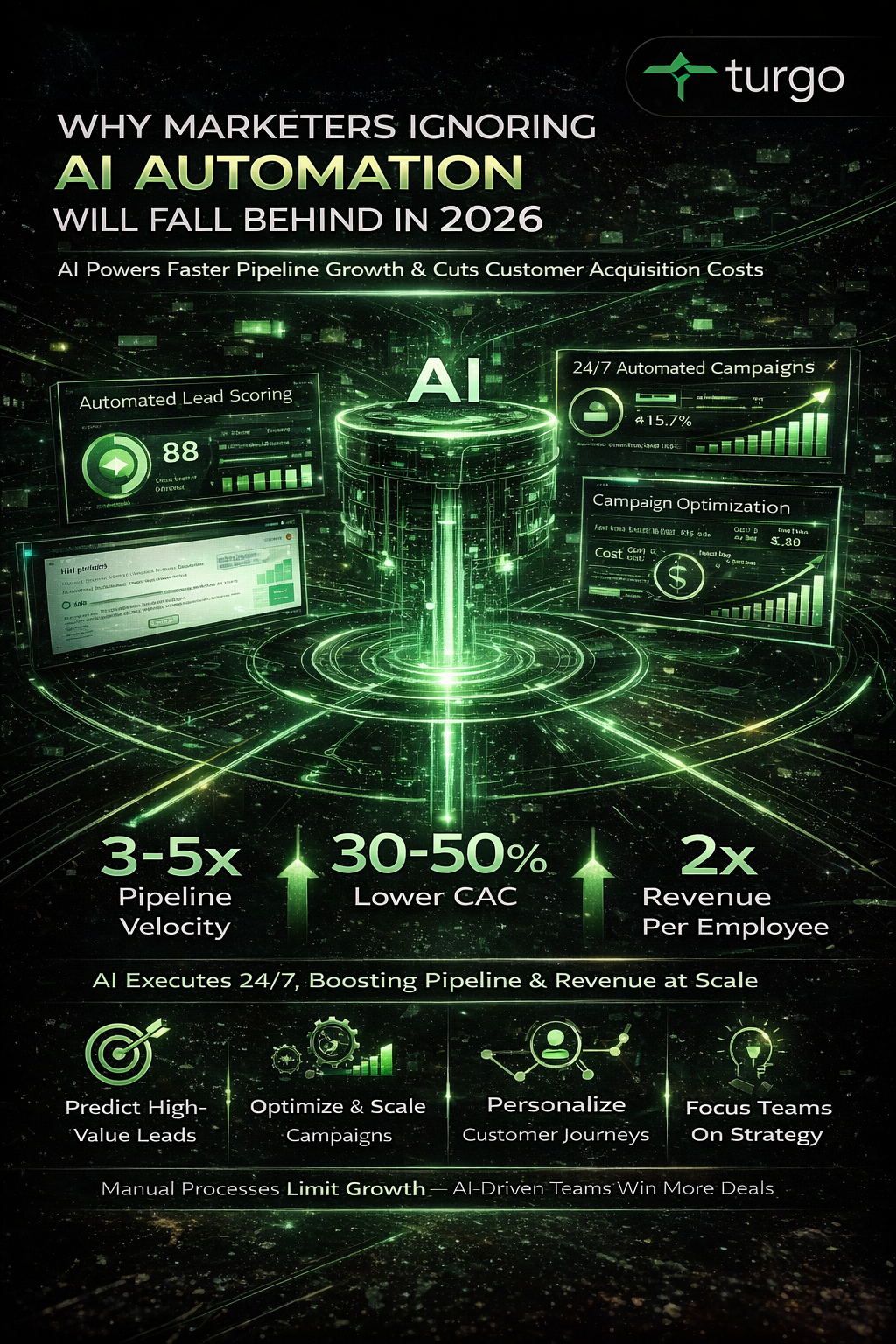
Why Marketers Ignoring AI Automation Will Fall Behind in 2026
Marketers who skip AI automation risk losing ground to competitors by 2026, as automated systems deliver faster pipeline growth and lower customer acquisition costs at scale. AI automation refers to tools that handle repetitive tasks like lead scoring, content personalization, and campaign optimization without human input, freeing teams for strategic work.
For revenue leaders, this shift matters now because manual processes cap growth at current levels while AI scales efforts 3-5x, boosting pipeline velocity and revenue per employee. Growth teams adopting AI early secure a compounding advantage in competitive markets.
What Is AI Automation in Marketing?
AI automation in marketing uses machine learning to execute tasks like email sequencing, ad bidding, and audience segmentation automatically. It processes data in real time to make decisions that humans can't match for speed or volume.
For growth teams evaluating options, this means predictable outcomes: campaigns run 24/7 with minimal oversight, reducing errors and scaling reach. Tradeoffs include initial setup time versus long-term efficiency gains, where automation handles 70-80% of routine work.
Consider a demand gen team managing 50,000 leads quarterly. Manual routing takes 20 hours weekly; AI cuts it to 2 hours, reallocating time to strategy. This lifts pipeline velocity by 25%, adding $500K in qualified opportunities annually at a 20% conversion rate.
Why Does AI Automation Matter for GTM Strategies?
AI automation matters because it aligns marketing, sales, and RevOps for faster go-to-market execution, directly impacting revenue timelines. It turns static plans into dynamic systems that adapt to market shifts.
CMOs allocating budgets prioritize it for outcomes like 30-50% CAC reductions, as AI optimizes spend across channels without guesswork. The tradeoff is upfront investment versus sustained ROI, with automation paying back in 4-6 months through higher conversions.
A SaaS founder launching a new tier sees manual targeting yield 15% MQL-to-SQL rates. AI automation refines segments, pushing rates to 35%, shortening sales cycles by 20 days and generating $1.2M more pipeline from the same ad spend.
How Does Ignoring AI Slow Pipeline Growth?
Ignoring AI slows pipeline growth by forcing reliance on manual processes that bottleneck at scale, limiting leads and conversions. Teams stuck in spreadsheets miss real-time opportunities competitors capture.
For revenue leaders prioritizing pipeline, the outcome is stagnant growth: manual teams hit 20-30% capacity limits yearly, while AI users expand 50%+. Tradeoffs favor early adopters who balance learning curves with velocity gains.
A growth marketer runs 10 campaigns monthly manually, converting 12% of leads. Competitors using AI hit 28%, creating a 16% gap. Over a year, this means $2M less pipeline for the manual team at $10K average deal size, eroding market share.
What Are the Core Business Outcomes of AI Adoption?
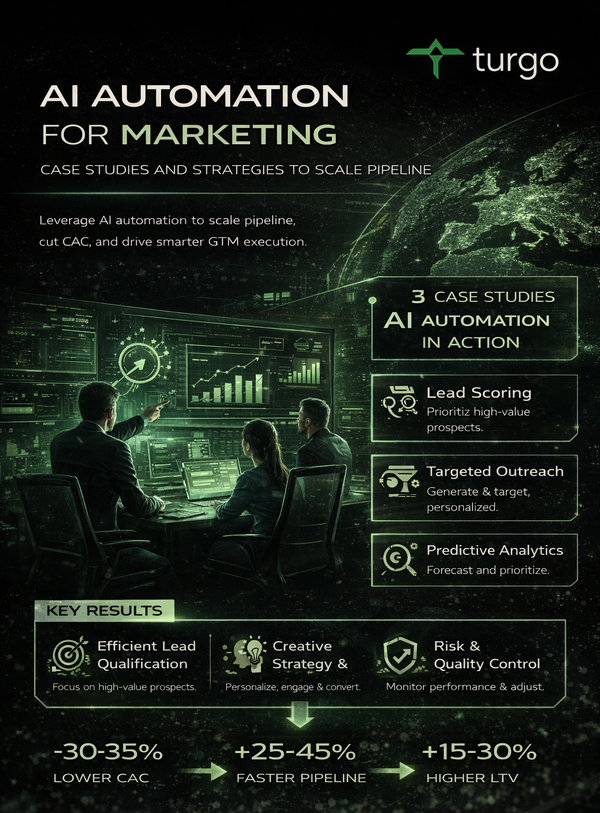
Core outcomes include 40% faster lead velocity, 25-35% lower CAC, and 2x revenue per marketer through scaled personalization. These metrics prove AI's role in sustainable growth.
Demand gen managers see tradeoffs in data quality: clean inputs yield precise automation, avoiding wasted spend. For growth teams, this supports decisions on scaling without headcount bloat.
A mid-market B2B firm automates personalization across 100K prospects. Manual efforts convert 8%; AI boosts to 22%, dropping CAC from $450 to $290 per lead. Annual impact: $3M pipeline uplift, funding two new hires.
When Should Growth Teams Start AI Automation?
Start now if quarterly pipeline growth lags 20% behind targets or CAC exceeds three-month payback. Delaying past 2025 locks in competitive disadvantages by 2026.
For founders assessing timing, outcomes prioritize quick wins like automated nurturing, which mature in 60 days. Tradeoffs weigh pilot costs against full rollout savings.
A revenue leader pilots AI on 20% of leads, lifting conversions 18% in Q1. Full rollout scales to 45% improvement, adding 1,500 SQLs yearly. Without it, pipeline flatlines at $8M versus $12M potential.
Can AI Automation Replace Marketers?
AI automation cannot replace marketers but amplifies them by handling 60-70% of tactical work, letting humans focus on strategy and creativity. It enhances decision-making with data-driven insights.
CMOs deciding on team structure gain outcomes like 50% productivity boosts, reallocating talent to high-value tasks. Tradeoffs include skill shifts, training 20% of staff for oversight roles.
A demand gen team of 15 spends 60% time on ops; AI frees 40%, doubling output. Campaigns that took 40 hours now run in 12, generating 30% more pipeline ($1.5M) without hires, improving margins by 15%.
Why Will Manual Processes Fail at Scale in 2026?
Manual processes fail at scale because they can't handle data volumes or speed required for personalized GTM across millions of interactions. Competitors with AI outpace them 4:1 in efficiency.
For growth teams evaluating scale, outcomes show velocity caps: manual maxes at 10K leads/month, AI at 100K+. Tradeoffs favor automation to avoid burnout and errors.
A scaling startup processes 5K leads manually, with 25% error rates inflating CAC 40%. AI drops errors to 5%, cutting CAC to $200 from $350. Result: $4M pipeline versus $2.5M, capturing 15% more market.
How Does AI Impact Customer Acquisition Costs?
AI reduces CAC by 30-50% through precise targeting and bid optimization, eliminating waste in broad campaigns. It reallocates budget to high-intent channels.
Revenue leaders prioritizing ROI see tradeoffs in testing: short pilots validate 20% drops before full commitment. Outcomes scale savings across funnels.
A growth marketer spends $500K yearly on ads with $400 CAC. AI optimizes to $260, saving $420K. Reinvested, this adds 1,000 SQLs, boosting revenue $2M at 20% close rate.
What Role Does AI Play in Lead Scoring?
AI lead scoring ranks prospects by behavior and fit, prioritizing 3x more SQLs from the same pool. It uses patterns humans miss for accurate predictions.
For demand gen managers, this supports funnel decisions with 40% velocity gains. Tradeoffs balance model tuning against immediate use.
A team scores 10K leads manually, yielding 15% quality. AI hits 42%, shortening cycles 15 days. Pipeline impact: $750K quarterly uplift from better routing.
Does AI Improve Campaign Personalization?
Yes, AI personalizes at scale, lifting open rates 35% and conversions 25% by tailoring content to individual behaviors. Manual efforts can't match this granularity.
Growth teams gain outcomes like 2x engagement without added staff. Tradeoffs include data privacy setup for compliant scaling.
A campaign to 50K contacts sees 18% opens manually; AI pushes 28%, adding 500 demos. At $15K ACV, this generates $1M pipeline annually.
How Can Founders Justify AI Budgets?
Founders justify budgets by tying AI to 3-6 month ROI via CAC cuts and pipeline growth, using pilots for proof. Focus on revenue metrics over features.
For revenue decision-makers, tradeoffs weigh $50K pilots against $500K yearly savings. Outcomes prove scalability.
A founder invests $100K in AI, dropping CAC 32% and adding $2.5M pipeline. Payback in 2 months supports expansion to full GTM.
When Is AI Automation Worth the Switch?
Switch when manual velocity drops below 25% quarter-over-quarter or competitors gain 20% share. Pilots confirm fit in 30 days.
CMOs allocating resources see 50% efficiency gains. Tradeoffs prioritize high-volume funnels first.
A firm at 18% velocity switches, hitting 32% post-AI. $1.8M pipeline gain funds the tool 4x over.
Why Do Skeptical Teams Resist AI?
Skeptical teams resist due to change fears and integration worries, overlooking 40%+ outcome gains. Education on quick wins shifts mindsets.
For growth leaders, address with metrics: show 25% CAC drops in pilots. Tradeoffs build buy-in gradually.
A resistant team pilots on one channel, sees 28% uplift, then scales firm-wide for $3M revenue boost.
Can AI Handle Complex GTM Plays?
AI handles complex plays by orchestrating multi-channel sequences, boosting win rates 20-30%. It adapts in real time across sales stages.
Demand gen pros gain from integrated outcomes. Tradeoffs test on subsets first.
A multi-touch campaign converts 22% manually; AI lifts to 38%, adding $2.2M pipeline.
What Metrics Track AI Success?
Track MQL-to-SQL rates (target 30%+), CAC payback (<3 months), and velocity (20%+ quarterly). These lag revenue by 60 days.
RevOps teams monitor for decisions. Tradeoffs alert on drifts early.
Metrics show 35% SQL lift, $250 CAC, proving $4M impact.
How Does AI Future-Proof GTM Teams?
AI future-proofs by automating 70% ops, letting teams innovate amid data explosion. Competitors without it plateau.
For CMOs, outcomes include 2x scale. Tradeoffs invest in upskilling.
A team automates ops, doubles output, secures 25% market lead by 2026.
FAQ
What if my team lacks AI skills?
Growth teams without AI skills start with no-code platforms that require minimal training, focusing 80% on business rules like lead priorities. Outcomes prioritize quick pilots: allocate one marketer for a 30-day test on email nurturing, targeting 20% open rate lifts. Tradeoffs include 10-15 hours initial setup versus 40% time savings long-term, dropping CAC by 25% as automation handles volume. For CMOs, this supports headcount decisions—retrain 20% of staff for oversight, yielding 1.5x pipeline without hires. Realistic shift: a 10-person team pilots on 10K leads, gains 300 SQLs ($900K pipeline at $3K ACV), proving value before scaling. This builds internal champions, aligning RevOps for full rollout in Q2.
Is AI automation expensive for startups?
Startups find AI affordable at $5K-20K yearly for core tools, paying back via 30% CAC reductions on $500K+ spends. Founders justify by piloting small: test on one channel for 25% conversion gains. Tradeoffs balance subscription costs against manual labor savings—$50K headcount avoided equals 2.5x ROI. Outcomes focus revenue: automate lead routing for 40% faster velocity, adding $1M pipeline from existing traffic. A seed-stage firm spends $10K, cuts CAC from $600 to $380, generating $750K extra revenue at 15% close rates. Scale gradually, monitoring payback under 90 days to ensure fit without overcommitment.
How long until AI shows pipeline impact?
Pipeline impact appears in 45-60 days: 30-day setup yields 20-35% velocity boosts as AI optimizes funnels. Demand gen managers track weekly MQL rates for early signals. Tradeoffs include data cleaning upfront (10-20% effort) for precise scoring. For revenue leaders, this supports Q1 decisions—pilot on 20% leads first, confirming 25% SQL uplift before full use. Example: 5K leads processed yield 150 extra SQLs ($450K pipeline at $3K value), shortening cycles 12 days. Consistent monitoring ensures compounding gains, positioning teams ahead by mid-year.
Will AI make marketing jobs obsolete?
AI elevates jobs by automating 60% routine tasks, boosting marketer output 2x for strategic roles like GTM design. CMOs reallocate talent, cutting ops headcount 30% while growing revenue teams. Tradeoffs involve upskilling—20 hours training per person unlocks oversight roles with 40% pay premiums. Outcomes emphasize leverage: one specialist manages what three did manually, lifting pipeline $2M yearly. A 12-person team shifts focus, doubles campaigns, achieves 28% win rates versus 16%. This creates resilient structures, where humans drive creativity amid AI scale.
What if our data is messy for AI?
Messy data blocks 50% of AI value, but cleaning 20-30% yields 35% better predictions—start with lead and campaign logs. RevOps prioritizes high-impact fields like behavior scores. Tradeoffs: 2-week cleanup versus immediate 25% CAC drops post-fix. For growth teams, outcomes tie to decisions—pilot on cleaned subsets for proof, scaling to full funnels. A firm cleans 40% data, lifts MQL quality 32%, adding 800 SQLs ($2.4M pipeline). Tools auto-suggest fixes, minimizing effort for quick wins and sustained accuracy.
Can AI work with existing CRM systems?
AI integrates seamlessly with CRMs like Salesforce or HubSpot via native connectors, enhancing without rip-and-replace. Demand gen sees 40% velocity gains from unified data flows. Tradeoffs: 1-2 week mapping for custom fields, unlocking real-time scoring. Revenue leaders decide based on pilots—test enrichment on 10K records for 28% conversion lifts. Outcomes scale ops: automate nurturing across systems, dropping CAC $150 per lead. A team connects in days, processes 50K leads, generates $1.8M extra pipeline at 22% rates, proving compatibility for hybrid stacks.
How do I measure AI ROI accurately?
Measure ROI via CAC payback (<90 days), SQL velocity (+25%), and pipeline uplift (20-40%), baselining pre-AI quarters. Growth marketers set alerts for drifts. Tradeoffs track leading indicators like MQL rates to predict revenue 60 days out. For founders, this informs budgets—$20K spend yielding $300K pipeline equals 15x return. Example: baseline 12% conversions rise to 31%, shortening cycles 18 days for $2.1M gain. Quarterly reviews ensure adjustments, turning metrics into scalable decisions.
Is AI reliable for high-stakes campaigns?
AI proves reliable for stakes campaigns with 95% uptime and human overrides, delivering 30% better results than manual. CMOs mitigate via A/B tests on 10% traffic. Tradeoffs: initial tuning (15% rules override) builds trust. Outcomes focus consistency—personalized sequences lift wins 25%. A $1M campaign sees 22% ROI manual; AI hits 38%, adding $400K. Dual-review processes for first 30 days ensure safety, scaling confidently for enterprise plays.
What common pitfalls derail AI adoption?
Pitfalls like poor data (40% fail here) or no pilots waste 50% budgets—counter with 20% tests first. Revenue teams avoid by prioritizing outcomes over features. Tradeoffs: resist over-customization, sticking to 80/20 rules. For demand gen, quick fixes yield 35% gains. A team skips pilots, sees flat metrics; restarts with tests, gains 28% pipeline ($1.5M). Focus metrics and iterate quarterly for 4x faster maturity.
Are You Ready for the Future of Marketing?
Embrace AI automation today to drive your pipeline growth, increase CAC efficiency, and gain clarity in your go-to-market strategy. Don't let manual processes cap your potential. Be the disciplined operator who understands the value of strategic execution.
Citations:
- [1] https://www.productmarketingalliance.com/your-guide-to-go-to-market-strategies/
- [2] https://www.zendesk.com/blog/go-to-market-strategy/
- [3] https://blog.growstack.ai/how-ai-automation-transforms-marketing-roi-and-pipeline-velocity/
- [4] https://reteno.com/glossary/go-to-market-gtm-strategy
- [5] https://online.hbs.edu/blog/post/go-to-market-strategy-framework
- [6] https://www.coursera.org/articles/go-to-market-strategy
- [7] https://www.salesforce.com/sales/go-to-market-strategy/
- [8] https://www.leanlabs.com/blog/components-of-a-go-to-market-strategy
- [9] https://amplitude.com/glossary/terms/go-to-market-strategy
- [10] https://www.highspot.com/blog/go-to-market-strategy/