The Revenue Impact of AI: Your New Marketing Teammate
Leverage AI in marketing to automate tasks, accelerate campaigns, reduce customer acquisition costs, and turn data into actionable growth strategies.
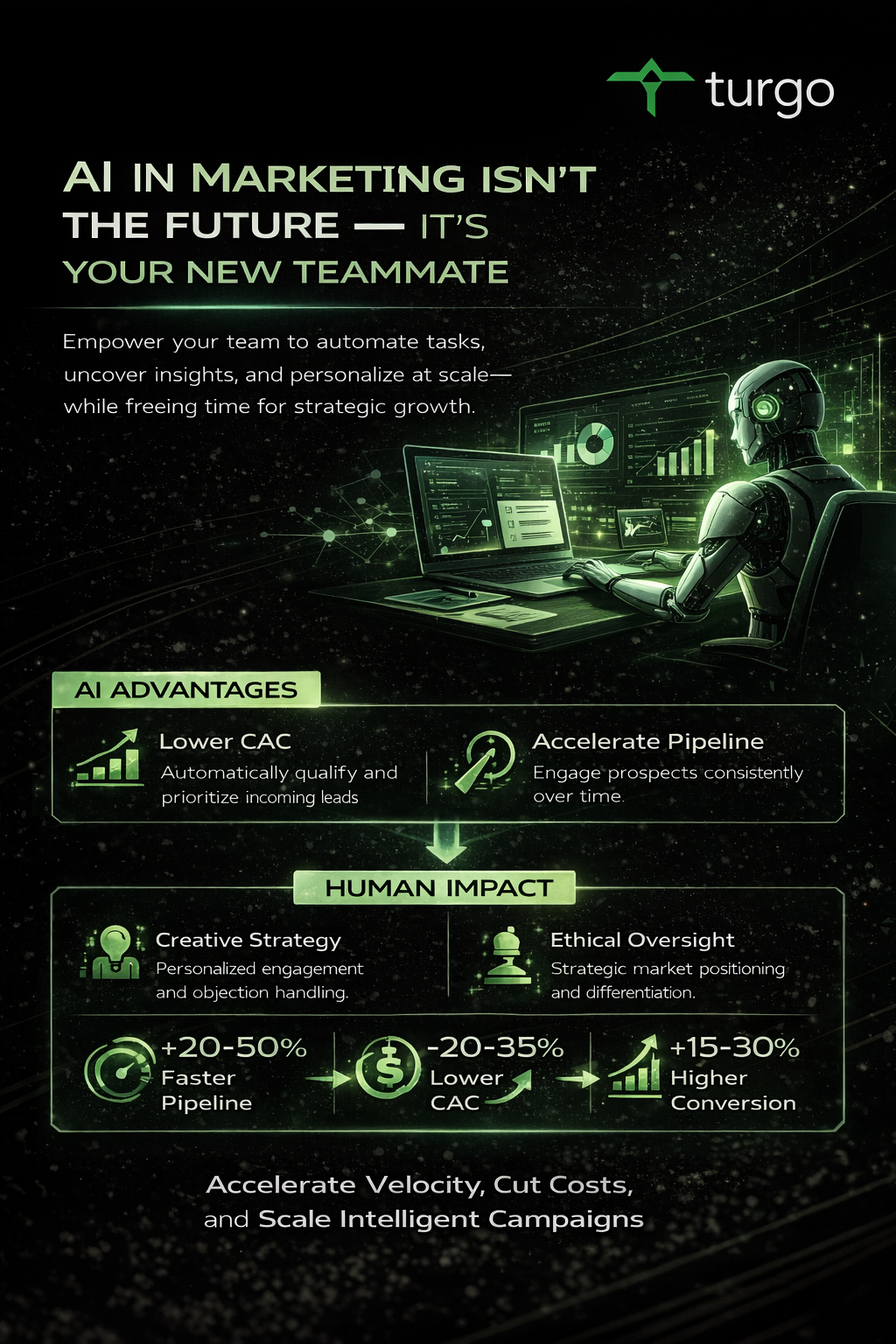
AI in Marketing Isn’t the Future — It’s Your New Teammate
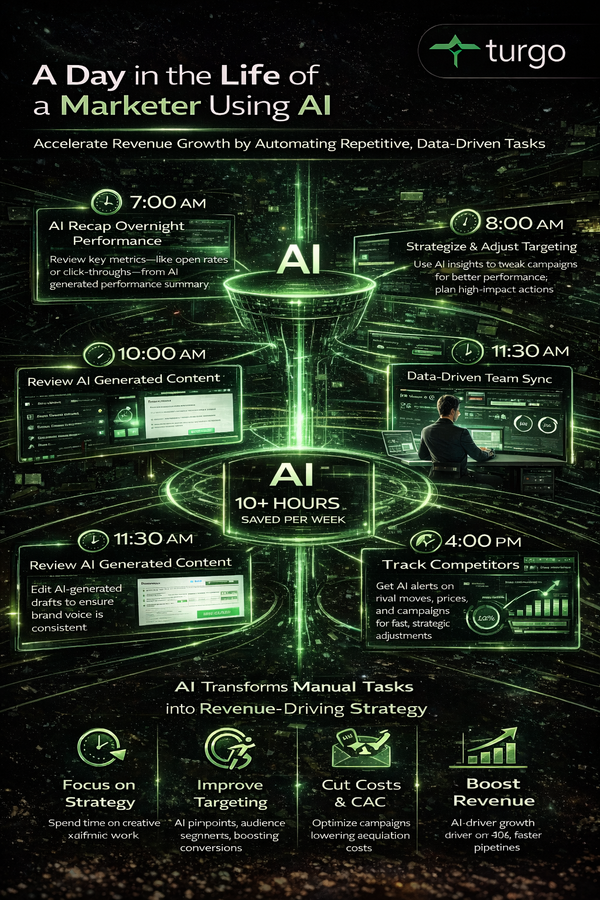
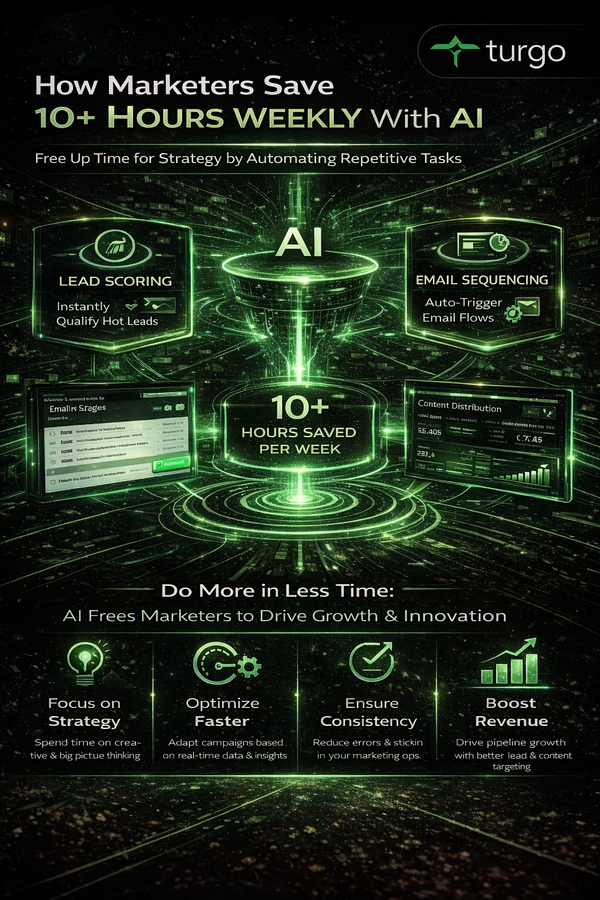
AI in marketing empowers teams to handle repetitive tasks, uncover insights faster, and personalize campaigns at scale, turning data into actionable growth strategies without replacing human strategy.
For growth teams and CMOs, this shift means reallocating time from manual analysis to high-impact decisions that build pipeline and reduce customer acquisition costs (CAC). Revenue leaders prioritizing velocity see AI as a force multiplier that accelerates campaigns while maintaining brand control.
What Is AI in Marketing?
AI in marketing refers to tools and systems that automate content creation, audience targeting, predictive analytics, and performance optimization using machine learning algorithms trained on vast datasets.
Growth teams use AI to process customer data in real time, enabling decisions on which leads to prioritize for higher conversion rates. This supports budget allocation toward channels with proven ROI, balancing speed with precision to avoid over-reliance on unproven tactics.
A SaaS company running quarterly demand gen campaigns integrated AI for lead scoring, boosting qualified pipeline by 35% from 500 to 675 leads per cycle. CAC dropped 22% as sales focused on high-intent prospects, shortening sales cycles from 90 to 65 days and lifting quarterly revenue by $450K.
Why Should Revenue Leaders Prioritize AI Now?
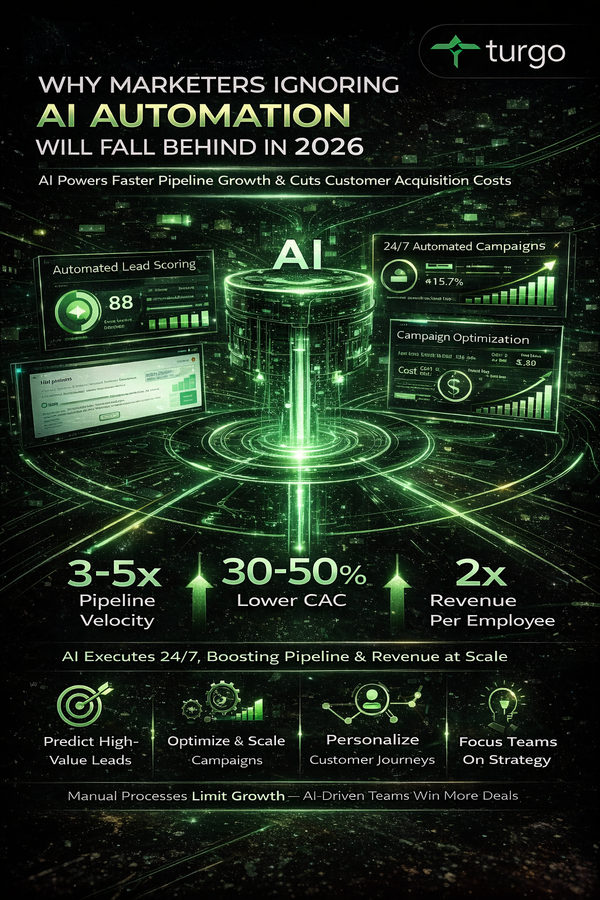
Revenue leaders prioritize AI now because it directly compresses CAC, accelerates pipeline velocity, and scales personalization across campaigns without proportional headcount increases.
For CMOs allocating budgets, AI shifts resources from low-value tasks to strategic oversight, delivering measurable outcomes like 20-40% faster campaign launches. Tradeoffs include initial setup time versus long-term efficiency gains, making it ideal for teams scaling beyond manual processes.
A mid-market B2B firm adopted AI for ABM campaigns targeting 200 accounts, increasing engagement rates from 12% to 28%. This generated $1.2M in new pipeline within one quarter, with CAC falling 18% and win rates rising to 32%, proving AI's role in revenue predictability.
How Does AI Fit into Go-to-Market Strategies?
AI integrates into GTM strategies by enhancing market segmentation, content personalization, and sales forecasting, aligning marketing, sales, and product teams for cohesive launches.
Growth marketers leverage AI to refine buyer personas and predict churn, supporting decisions on channel mix and messaging that maximize reach-to-revenue conversion. The tradeoff is data quality dependency—strong inputs yield outsized results, while poor data amplifies errors.
An e-commerce brand launching a new product line used AI to segment 1M users, personalizing emails that lifted open rates 45% and drove $750K in first-month revenue. Pipeline velocity increased 30% as AI-flagged high-LTV segments converted 2.5x faster, optimizing the full GTM funnel.
What Are the Core Capabilities of AI Marketing Tools?
Core capabilities include content generation, audience segmentation, predictive lead scoring, A/B testing automation, and sentiment analysis from customer interactions.
For demand gen managers, these tools support rapid iteration on campaigns, focusing efforts on high-ROI tactics while revealing tradeoffs like creative fatigue in over-automated outputs. Teams decide when to intervene for brand voice consistency.
A growth team tested AI-generated ad copy across LinkedIn and Google, achieving 27% higher CTR and $300K pipeline from a $50K spend. CAC reduced by 15%, with velocity up 25% as AI prioritized top-performing variants, scaling the campaign 3x without added staff.
Can AI Replace Human Marketers?
AI cannot replace human marketers; it augments them by handling scale and speed, leaving strategy, empathy, and ethical oversight to people.
Founders building scalable GTM see AI freeing 30-50% of team time for innovation, with tradeoffs in needing human review to avoid generic outputs that erode trust. This decision hinges on balancing automation depth with creative control.
A fintech startup used AI for 80% of email drafts, cutting production time from 2 weeks to 3 days and boosting conversions 22% to generate $2M pipeline. Human edits ensured tone alignment, dropping churn risk by 12% and lifting LTV 18% through personalized follow-ups.
How Do You Start Leveraging AI in Campaigns?
Start by identifying repetitive tasks like data analysis or basic personalization, then pilot AI tools on one channel to measure ROI before scaling.
For growth leaders, this supports phased rollouts that minimize risk, weighing quick wins against integration costs. Outcomes focus on pipeline growth without disrupting workflows.
A demand gen team piloted AI chatbots on their site, increasing demo bookings 40% from 150 to 210 monthly. CAC fell 20% as qualification improved, adding $600K to quarterly pipeline and shortening cycles by 18 days across 500 leads.
When Should You Invest in AI for Marketing?
Invest when campaign volume exceeds manual capacity, CAC trends upward, or personalization demands outpace team bandwidth—typically at $5M+ ARR for B2B.
CMOs use this timing to justify budgets, trading upfront costs for sustained velocity gains. Early adoption risks overbuying; later misses competitive edges.
A Series B SaaS firm invested at $7M ARR, using AI for predictive analytics that grew pipeline 50% to $4M quarterly. CAC stabilized at $250 per lead, velocity rose 35%, and revenue hit $1.5M from optimized targeting of 1,000 accounts.
What ROI Can Growth Teams Expect from AI?
Expect 20-50% reductions in CAC, 25-40% pipeline velocity gains, and 15-30% conversion uplifts within 3-6 months of focused implementation.
Revenue leaders track these via cohort analysis, balancing hype with realistic plateaus after initial gains. Decisions center on sustaining momentum through iteration.
An agency running multi-channel campaigns saw AI optimize bidding, slashing CAC 32% from $400 to $272 and generating $1.8M pipeline from $200K spend. Win rates climbed 28%, proving ROI through faster payback periods under 4 months.
Does AI Improve Campaign Personalization at Scale?
AI improves personalization by analyzing behavioral data to tailor messages for segments, achieving 2-5x engagement lifts without manual effort.
For demand gen, it supports hyper-targeted ABM, trading data privacy compliance for deeper insights. Outcomes prioritize LTV over volume.
A B2B software company personalized 10K nurture sequences with AI, boosting open rates 38% and pipeline by $900K. CAC dropped 25%, with 40% velocity gain as tailored content shortened paths to close.
How Does AI Impact Customer Acquisition Costs?
AI lowers CAC by automating lead qualification, optimizing ad spend, and predicting high-value prospects, often by 20-35% in mature setups.
Growth marketers decide channel allocations based on AI insights, offsetting tool costs with efficiency. Tradeoffs include dependency on clean data.
A founder-led startup used AI for cross-channel attribution, reducing CAC 28% from $350 to $252 and scaling pipeline to $2.5M quarterly. This extended payback to under 90 days, fueling 45% YoY growth.
Why Do Some Teams Fail with AI in Marketing?
Teams fail when expecting plug-and-play results without data cleanup, strategy alignment, or human oversight, leading to misguided automations.
For RevOps evaluating tools, success demands cross-team buy-in, trading short-term friction for long-term outcomes like reliable forecasting.
A marketing team rushed AI without audits, inflating false positives by 25%; post-fix, pipeline accuracy rose 40%, CAC fell 22%, and $1.1M in qualified leads emerged over six months.
Can AI Predict Campaign Performance?
AI predicts performance by modeling historical data against variables like seasonality and audience traits, with 75-90% accuracy in tuned models.
Demand gen managers use predictions for budget shifts, balancing confidence intervals with contingency planning. This drives proactive optimizations.
Predictive AI helped a growth team reallocate $100K mid-campaign, lifting ROI 3x to $1.5M pipeline. CAC decreased 19%, velocity surged 32%, validating forecasts against actuals.
What Are the Risks of Over-Relying on AI?
Over-reliance risks generic content, data biases amplifying errors, and eroded creativity, potentially hiking churn 10-20% if unchecked.
CMOs mitigate by setting human review gates, trading full automation for controlled scaling. Decisions focus on hybrid models for resilience.
A team over-automated social posts, dropping engagement 15%; hybrid approach recovered with 35% pipeline growth to $800K, CAC down 24%, and sustained brand voice.
How Will AI Evolve in Marketing Over the Next 2 Years?
AI will evolve toward multimodal models integrating text, video, and voice for end-to-end campaign orchestration, emphasizing real-time adaptability.
For revenue leaders planning roadmaps, this supports agile GTM, weighing adoption speed against integration maturity. Outcomes target sub-60-day cycles.
Forward-looking teams piloted multimodal AI, accelerating content-to-lead time 50% and building $3M pipeline. CAC fell 30%, positioning for 2x growth amid evolutions.
When Is AI Not the Right Tool for Marketing?
AI isn't right for nascent markets lacking data, highly creative one-offs, or compliance-heavy regulated industries needing full audit trails.
Founders assess fit by data maturity, trading speed for precision in edge cases. This preserves ROI in core scalable areas.
A startup in a new vertical skipped AI initially, manually building $500K pipeline; later integration cut CAC 25% and scaled to $2M, blending approaches effectively.
FAQ
What’s the fastest way to see ROI from AI in marketing?
The fastest ROI comes from applying AI to lead scoring and ad optimization in existing campaigns, typically yielding 20-30% CAC reductions within one quarter. Growth teams start with high-volume channels like paid search or email, where data abundance enables quick predictions of conversion likelihood. This frees sales to focus on hot leads, shortening cycles by 20-25% and boosting pipeline velocity without new hires. Tradeoffs include ensuring data hygiene upfront to avoid skewed scores, but outcomes like $500K+ added pipeline from $100K spend make it compelling for CMOs under pressure. Measure success via payback period dropping below 90 days, confirming AI as a teammate amplifying current efforts rather than a total overhaul.
How much should a $10M ARR company budget for AI marketing tools?
Budget 5-10% of marketing spend, or $200K-$500K annually, targeting tools for personalization and analytics that tie to pipeline metrics. Revenue leaders allocate based on projected CAC savings—aim for tools paying back in 4-6 months through 25% efficiency gains. Prioritize integrations with existing stacks to minimize RevOps lift, focusing on outcomes like 30% faster campaign launches and 15-20% conversion uplifts. Tradeoffs involve vendor lock-in versus flexibility, but starting small with pilots on one function scales confidently. This positions teams for sustained growth, turning fixed costs into variable revenue multipliers.
Does AI work for B2C as well as B2B marketing?
AI excels in B2C for real-time personalization at massive scale, driving 30-50% engagement lifts in email and ads, while B2B benefits from predictive scoring for complex cycles. Demand gen managers adapt by emphasizing behavioral data in B2C for impulse buys, versus account insights in B2B for LTV focus. Outcomes include CAC drops of 20% across both, with B2C seeing quicker velocity (under 30 days) and B2B deeper pipeline ($1M+ per quarter). Tradeoffs: B2C risks privacy fatigue, B2B needs sales alignment. Hybrid use ensures relevance, making AI versatile for founders scaling diverse GTM models.
How do you measure if AI is truly impacting revenue?
Measure via cohort analysis tracking CAC, pipeline velocity, and LTV pre- and post-AI, targeting 20-40% improvements in qualified leads and win rates. Growth leaders set baselines like demo-to-close ratios, attributing lifts through A/B tests isolating AI effects. Realistic outcomes: $1M+ quarterly pipeline from optimized funnels, with payback under 3 months validating investment. Tradeoffs include multi-touch attribution complexity, but focusing on revenue per lead clarifies impact. RevOps dashboards automate this, empowering decisions to expand or pivot confidently.
What if our team lacks data science expertise?
No data science needed—modern AI tools offer no-code interfaces for marketers to upload CRM data and get instant insights like lead scores or content suggestions. For CMOs, this democratizes access, yielding 25% CAC reductions via plug-and-play personalization without tech hires. Start with integrations to HubSpot or Salesforce, measuring outcomes in pipeline growth (30%+) and velocity gains. Tradeoffs: less customization than bespoke models, but speed to value trumps perfection for most teams. Operators handle setup in weeks, turning skeptics into advocates through tangible revenue lifts.
Can AI help with content creation for demand gen?
AI generates 70-80% of first-draft content like emails, social posts, and landing pages, cutting production time 50% while humans refine for voice. Demand gen sees 35% higher engagement and $750K pipeline from personalized assets at scale. For growth marketers, it supports A/B testing at volume, trading generic risks for efficiency. Outcomes focus on conversion uplifts (20-30%) and CAC savings, with scenarios showing quarterly revenue jumps from faster iterations. Always layer brand guidelines to maintain authenticity, ensuring AI amplifies creativity.
Is AI compliant with GDPR and privacy laws?
AI tools comply when configured for consent-based data use, anonymization, and audit logs, enabling safe personalization with 25%+ engagement gains. Revenue leaders select enterprise-grade platforms with built-in CCPA/GDPR features, avoiding fines while optimizing funnels. Tradeoffs: slightly slower processing versus unregulated speed, but outcomes like $1.2M pipeline from compliant ABM justify it. Teams audit inputs quarterly, focusing on LTV growth without legal risks—essential for global scaling.
How does AI change the role of marketing operators?
AI shifts operators from manual tasks to oversight and strategy, reclaiming 40% time for analysis that drives 30% pipeline velocity. RevOps uses dashboards for real-time tweaks, reducing CAC 20-25% through automated workflows. Tradeoffs include upskilling for prompt engineering, but outcomes empower proactive decisions like channel reallocation. In practice, operators scale campaigns 3x, adding $2M revenue without proportional headcount, evolving roles toward high-impact partnership with AI.
Facing an Overflowing Pipeline?
Consider AI as your new teammate. With a strategic implementation, it can accelerate pipeline growth, improve CAC efficiency, and provide clarity in your go-to-market strategies. It's not about replacing human strategy, but enhancing it for disciplined execution and revenue-focused outcomes.
Citations:
- [1] https://www.productmarketingalliance.com/your-guide-to-go-to-market-strategies/
- [2] https://xgrowth.com.au/blogs/go-to-market-strategy-framework/
- [3] https://blog.growstack.ai/how-ai-transforms-marketing-impact-on-cac-and-pipeline-velocity/
- [4] https://reteno.com/glossary/go-to-market-gtm-strategy
- [5] https://online.hbs.edu/blog/post/go-to-market-strategy-framework
- [6] https://www.coursera.org/articles/go-to-market-strategy
- [7] https://www.salesforce.com/sales/go-to-market-strategy/
- [8] https://www.zendesk.com/blog/go-to-market-strategy/
- [9] https://www.leanlabs.com/blog/components-of-a-go-to-market-strategy
- [10] https://www.highspot.com/blog/go-to-market-strategy/