Optimizing Your Marketing OS for Autonomous Decision-Making
A marketing operating system turns GTM strategy into repeatable, automated decisions that scale pipeline without scaling headcount. Learn how to structure targeting, lead scoring, routing, and optimization so your team can reduce overhead, improve CAC, and drive predictable revenue growth
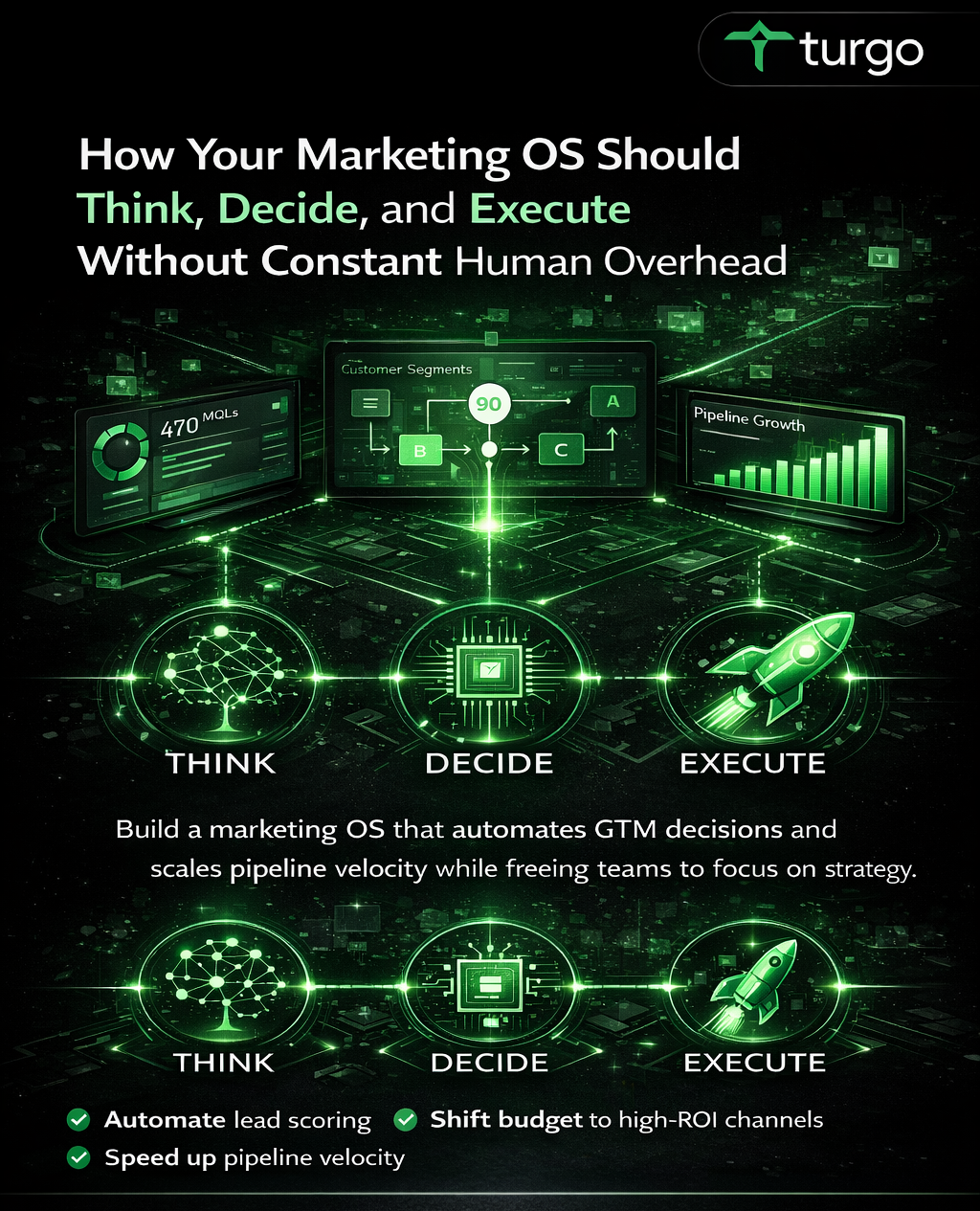
How Your Marketing OS Should Think, Decide, and Execute Without Constant Human Overhead
Meta Description: Build a marketing operating system that automates GTM decisions, reduces manual overhead, and scales pipeline velocity without sacrificing strategic control or revenue quality.
Opening
A marketing operating system is the framework, processes, and decision logic that allow your GTM function to operate with minimal daily human intervention while maintaining strategic alignment and revenue accountability. It's the difference between a team that manually reviews every campaign, lead score, and channel decision versus one where systems make predictable, auditable decisions within guardrails you've set.
For growth teams, founders, and revenue leaders, this distinction matters because human overhead scales linearly with volume—but revenue doesn't have to. The most efficient GTM organizations don't eliminate human judgment; they automate the repetitive decisions, reserve human attention for exceptions and strategy, and build feedback loops that improve decision quality over time.
What Is a Marketing Operating System?
A marketing operating system is the integrated set of processes, metrics, and decision rules that govern how your GTM function identifies prospects, qualifies leads, allocates budget, and measures performance. It combines your go-to-market strategy with operational discipline and automation to create a self-managing system that executes consistently without constant oversight.
The core function of a marketing OS is to translate your GTM strategy into executable, repeatable decisions. Instead of asking "Should we pursue this lead?" or "Which channel should we invest in this week?" every single time, your OS answers these questions automatically based on predefined criteria, historical performance, and real-time signals. This doesn't mean removing human decision-making—it means making human decision-making more strategic and less operational.
For CMOs allocating budget across channels, this means visibility into which decisions are automated and which require human judgment. For revenue leaders prioritizing pipeline, this means predictable lead flow and consistent quality metrics. For founders managing lean teams, this means your GTM function doesn't require proportional headcount growth as you scale.
Why Does Your GTM Strategy Need an Operating System?
Your go-to-market strategy defines what you're trying to achieve: which customers you're targeting, how you'll position your product, what channels you'll use, and what pricing you'll charge. Your marketing OS defines how you'll execute that strategy consistently, at scale, without manual intervention at every step.
Without an operating system, GTM execution becomes fragmented. Marketing runs campaigns independently. Sales follows its own lead qualification logic. Customer success measures retention differently than marketing measures engagement. Each function optimizes locally, creating friction, redundancy, and missed signals. The result is wasted budget, inconsistent customer experience, and revenue that's harder to predict.
A marketing OS creates alignment by establishing shared definitions, automated handoffs, and unified metrics. When marketing and sales agree on what constitutes a qualified lead—and that definition is enforced by your system—you eliminate rework and accelerate pipeline velocity. When your system automatically routes leads based on fit and capacity, you reduce sales friction and improve conversion rates. When your metrics are unified across functions, you can actually measure what's working.
For growth teams evaluating operational efficiency, the ROI of a marketing OS typically appears in three ways: reduced cost per qualified lead (through better targeting and automation), faster sales cycles (through better lead quality and timing), and improved retention (through consistent customer experience). A typical B2B SaaS company implementing a basic marketing OS sees 15–25% improvement in pipeline velocity within 90 days, with CAC declining 10–20% as targeting improves.
How Does a Marketing OS Connect to Your Go-to-Market Strategy?
Your GTM strategy is the strategic blueprint; your marketing OS is the operational engine that executes it. The strategy says "we're targeting mid-market SaaS companies with 50–500 employees in North America." The OS translates that into: account lists, firmographic filters, content themes, channel sequencing, and lead scoring rules that automatically identify and prioritize prospects matching that profile.
The connection works in both directions. Your strategy informs the OS by defining target segments, value propositions, and success metrics. The OS informs your strategy by providing real-time feedback on what's actually working—which segments convert fastest, which messaging resonates, which channels deliver the best CAC. This feedback loop is critical because GTM strategies that aren't grounded in operational reality become theoretical exercises.
For revenue leaders prioritizing pipeline, this means your OS should be instrumented to answer: "Which segments are we actually winning in? Which channels are delivering the best customers? Where is our sales cycle longest, and why?" These answers come from your OS, not from intuition or quarterly reviews. They should inform your next strategy iteration.
What Are the Core Components of a Marketing OS?
A functional marketing OS has five interconnected components: target definition, lead generation and qualification, routing and assignment, measurement and feedback, and optimization and adjustment.
Target definition establishes who you're going after—not just as a persona, but as a specific, data-driven profile. This includes firmographic criteria (company size, industry, geography), technographic signals (tools they use, tech stack), behavioral signals (website visits, content engagement), and intent signals (search behavior, buying signals). Your OS uses these criteria to automatically identify and prioritize prospects.
Lead generation and qualification is where your OS decides which prospects to engage and through which channels. This includes paid advertising (with automated audience targeting), content marketing (with automated distribution), sales outreach (with automated sequencing), and partnerships (with automated lead routing). The OS decides which channel to use based on prospect profile, stage, and historical conversion data.
Routing and assignment determines which sales rep gets which lead, when, and in what sequence. This includes lead scoring (which prospects are sales-ready), capacity management (which reps have bandwidth), and territory alignment (which rep owns which account). Automated routing reduces sales friction and ensures leads reach the right person at the right time.
Measurement and feedback tracks whether your OS is working. This includes lead quality metrics (conversion rates by source and segment), pipeline metrics (velocity, deal size, win rate), and revenue metrics (CAC, LTV, payback period). Your OS should automatically flag when metrics drift outside acceptable ranges.
Optimization and adjustment is where your OS learns and improves. This includes A/B testing (which messaging works better), channel optimization (which channels deliver the best ROI), and scoring model updates (which signals predict conversion). These adjustments should be systematic and data-driven, not reactive.
For CMOs allocating budget across channels, understanding these five components helps you ask the right questions: Is our target definition accurate? Are we generating leads efficiently? Are we routing them effectively? Are we measuring the right things? Are we learning and improving? If any component is weak, your entire OS underperforms.
How Should Your Marketing OS Define Target Segments?
Target definition is the foundation of your marketing OS. If you're targeting the wrong prospects, everything downstream—lead generation, qualification, routing, measurement—becomes inefficient. Your OS should define segments not just by persona, but by measurable, data-driven criteria that predict conversion and revenue.
Effective segment definition combines multiple data layers: firmographic (company size, industry, geography), technographic (tools they use, tech stack maturity), behavioral (engagement with your content, website visits), and intent (search behavior, buying signals, competitive mentions). Your OS should weight these signals based on historical conversion data—if companies with 100–500 employees convert 3x better than smaller companies, that signal should be weighted heavily in your targeting.
For growth teams evaluating segment strategy, the key question is: "Can we measure and automate this?" If your segment definition requires subjective judgment ("they seem like a good fit"), your OS can't execute it consistently. If it's based on measurable criteria ("they have 100–500 employees, use Salesforce, and visited our pricing page in the last 30 days"), your OS can identify and prioritize these prospects automatically.
A typical B2B SaaS company might define 3–5 primary segments, each with specific firmographic, technographic, and behavioral criteria. Your OS should automatically score prospects against these criteria and route them to the appropriate campaign or sales sequence. As you gather conversion data, you should continuously refine these criteria—if one segment converts at 8% and another at 2%, you should shift budget and focus accordingly.
What Role Does Lead Scoring Play in Your Marketing OS?
Lead scoring is the mechanism your marketing OS uses to decide which prospects are sales-ready and which need more nurturing. Without lead scoring, sales teams waste time on unqualified prospects, and marketing doesn't know which campaigns are actually generating pipeline.
A functional lead scoring model combines explicit signals (actions the prospect takes—website visits, content downloads, demo requests) with implicit signals (profile fit—company size, industry, technographic match). Explicit signals indicate intent; implicit signals indicate fit. Your OS should weight these signals based on historical conversion data. If prospects who download your pricing guide convert 5x better than those who download a general whitepaper, that signal should be weighted accordingly.
For revenue leaders prioritizing pipeline, lead scoring directly impacts sales productivity. If your scoring model is accurate, sales reps spend time on high-probability prospects and close deals faster. If your scoring model is inaccurate, sales reps waste time on low-probability prospects and your pipeline stalls. The difference in sales cycle length can be 30–50% depending on scoring accuracy.
A typical lead scoring model might assign points for: company size match (0–20 points), industry match (0–15 points), technographic fit (0–15 points), website engagement (0–20 points), content engagement (0–15 points), and explicit buying signals like demo requests (0–15 points). Prospects scoring above 70 points are routed to sales immediately; prospects scoring 40–70 are nurtured; prospects below 40 are deprioritized. As your OS gathers conversion data, you should continuously adjust these thresholds and weights.
How Should Your Marketing OS Route Leads to Sales?
Lead routing is where your marketing OS hands off to sales. Poor routing creates friction: leads sit in queues, get assigned to the wrong rep, or arrive at the wrong time. Good routing ensures leads reach the right person, with the right context, at the right time.
Your OS should route leads based on three criteria: sales rep territory (which rep owns which account or region), sales rep capacity (which reps have bandwidth), and lead quality (which reps should get the highest-quality leads). Territory-based routing ensures consistency and accountability. Capacity-based routing ensures leads don't pile up with one rep while another is idle. Quality-based routing ensures your best reps work your best opportunities.
For CMOs allocating budget across channels, routing efficiency directly impacts your ability to scale. If your routing is manual, it doesn't scale—you need more people to manage routing as volume increases. If your routing is automated, it scales linearly with volume. The difference in operational overhead can be 30–50% depending on routing automation.
A typical routing system might work like this: A prospect fills out a demo request form. Your OS immediately scores them against your lead scoring model. If they score above 70, the system checks which sales rep owns their territory and has capacity. The lead is automatically assigned to that rep, a notification is sent, and the prospect receives a confirmation email with the rep's calendar link. The entire process takes seconds and requires zero human intervention. If the prospect scores below 70, they're added to a nurture sequence instead.
What Metrics Should Your Marketing OS Track?
Your marketing OS should track metrics across the entire customer journey: awareness, consideration, decision, and retention. But not all metrics are equally important for decision-making. Your OS should focus on metrics that predict revenue and that you can act on quickly.
Leading indicators are metrics that predict future revenue: visitor-to-MQL conversion rate, MQL-to-SQL conversion rate, SQL-to-opportunity conversion rate, opportunity-to-close rate, and average deal size. These metrics tell you whether your funnel is healthy and where friction exists. If your visitor-to-MQL rate drops from 3% to 2.5%, you know you have a problem 60–90 days before it impacts revenue.
Lagging indicators are metrics that measure past revenue: customer acquisition cost, customer lifetime value, payback period, and churn rate. These metrics tell you whether your GTM strategy is working, but they arrive too late to act on. By the time you know your CAC is too high, you've already spent the budget.
For revenue leaders prioritizing pipeline, the key is to monitor leading indicators obsessively and lagging indicators regularly. If your MQL-to-SQL conversion rate drops 15%, you need to know today, not at the quarterly board meeting. Your OS should automatically flag when metrics drift outside acceptable ranges and alert the relevant team.
A typical metric dashboard might track: visitor-to-MQL rate (target: 2–4%), MQL-to-SQL rate (target: 20–30%), SQL-to-opportunity rate (target: 40–60%), opportunity-to-close rate (target: 20–30%), average deal size (target: $50K–$100K), sales cycle length (target: 60–90 days), and CAC (target: 3–6 month payback). Each metric should have a target range and an alert threshold. When a metric drifts outside the alert threshold, your OS should trigger a review and adjustment process.
How Does Your Marketing OS Optimize Channel Performance?
Channel optimization is where your marketing OS learns which channels deliver the best ROI and automatically shifts budget accordingly. Without optimization, you end up funding channels that don't work and starving channels that do.
Your OS should track performance by channel: cost per lead, lead quality (conversion rate), and cost per qualified lead. A channel might generate cheap leads but low-quality leads, resulting in high cost per qualified lead. Another channel might generate expensive leads but high-quality leads, resulting in lower cost per qualified lead. Your OS should optimize for cost per qualified lead, not cost per lead.
For growth teams evaluating channel strategy, the key question is: "Which channels deliver the best customers?" This isn't always obvious. Paid search might generate high volume but low quality. Content marketing might generate low volume but high quality. Partnerships might generate medium volume and medium quality. Your OS should measure all three and allocate budget based on actual performance, not assumptions.
A typical channel optimization process might work like this: You allocate $100K across five channels: paid search ($30K), content marketing ($20K), paid social ($20K), partnerships ($20K), and events ($10K). After 90 days, you measure cost per qualified lead by channel. Paid search delivers $50 cost per qualified lead. Content marketing delivers $30 cost per qualified lead. Paid social delivers $80 cost per qualified lead. Partnerships deliver $25 cost per qualified lead. Events deliver $100 cost per qualified lead. Your OS recommends shifting budget from low-performing channels (paid social, events) to high-performing channels (partnerships, content marketing). Next quarter, you allocate: paid search ($25K), content marketing ($30K), paid social ($10K), partnerships ($30K), events ($5K). This shift should improve your overall cost per qualified lead by 15–25%.
What Is the Role of Automation in Your Marketing OS?
Automation is the mechanism that allows your marketing OS to execute consistently without constant human intervention. But automation isn't about removing humans—it's about removing repetitive decisions and reserving human judgment for strategic decisions.
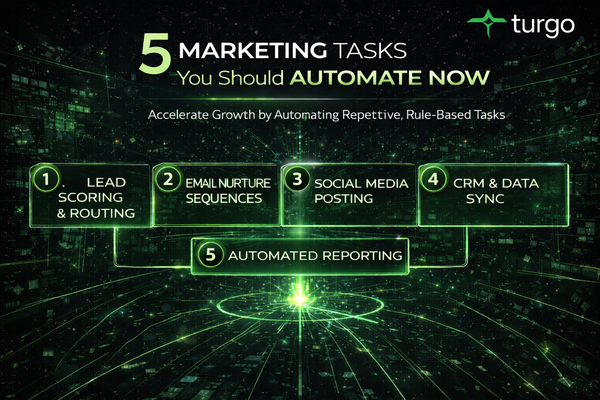
Your OS should automate: lead scoring (based on predefined criteria), lead routing (based on territory and capacity), email sequences (based on prospect behavior and stage), content distribution (based on segment and channel), and performance reporting (based on predefined metrics). These decisions are repetitive, rule-based, and don't require human judgment. Automating them frees your team to focus on strategy, optimization, and exception handling.
Your OS should NOT automate: strategy decisions (which segments to target, which channels to invest in), creative decisions (which messaging resonates, which creative performs best), and exception handling (why did this prospect not convert, what should we do differently). These decisions require human judgment, creativity, and strategic thinking.
For CMOs allocating budget across channels, the key is to understand which decisions are automated and which require human oversight. If your OS is automating lead scoring but not channel optimization, you're leaving money on the table. If your OS is automating everything, you're losing strategic control. The right balance depends on your team's maturity and capacity.
How Should Your Marketing OS Handle Lead Nurturing?
Lead nurturing is where your marketing OS engages prospects who aren't sales-ready yet. Without nurturing, you lose prospects who need more time to evaluate. With poor nurturing, you waste budget on prospects who will never convert.
Your OS should nurture based on prospect profile and behavior. A prospect in a large company who visited your pricing page but didn't request a demo needs different nurturing than a prospect in a small company who downloaded a whitepaper. Your OS should segment prospects by profile and behavior, then deliver targeted nurturing sequences designed to move them toward sales readiness.
For growth teams evaluating nurturing strategy, the key question is: "How many prospects are we losing because they're not sales-ready yet?" If 50% of your prospects aren't sales-ready when they first engage, you need a nurturing strategy. If only 10% aren't sales-ready, nurturing might not be worth the investment.
A typical nurturing sequence might work like this: A prospect downloads a whitepaper but doesn't request a demo (not sales-ready). Your OS adds them to a nurturing sequence: Day 1, they receive a thank-you email with related content. Day 3, they receive an email highlighting customer success stories. Day 7, they receive an email with a case study relevant to their industry. Day 14, they receive an email with a special offer or limited-time promotion. Day 21, they receive a final email with a direct call to action. If they engage with any of these emails (open, click, download), your OS updates their lead score and may move them to sales-ready status. If they don't engage, they're deprioritized but remain in your database for future engagement.
What Is the Relationship Between Your Marketing OS and Sales Enablement?
Sales enablement is the process of equipping your sales team with the tools, content, and information they need to sell effectively. Your marketing OS should integrate with sales enablement to ensure sales reps have the right content at the right time.
When a lead is routed to sales, your OS should provide context: prospect profile, engagement history, content they've consumed, and recommended next steps. This context helps sales reps personalize their outreach and accelerate the sales cycle. Without this context, sales reps waste time researching prospects and guessing at next steps.
For revenue leaders prioritizing pipeline, sales enablement directly impacts sales productivity and win rates. If sales reps have the right content and context, they close deals faster and win more often. If they don't, they waste time and lose deals to competitors. The difference in sales cycle length can be 20–40% depending on enablement quality.
Your OS should provide sales reps with: prospect research (company profile, decision-makers, recent news), engagement history (content consumed, website visits, email opens), recommended messaging (based on prospect profile and stage), and relevant content (case studies, ROI calculators, competitive comparisons). This information should be automatically populated in your CRM so sales reps don't have to search for it.
How Should Your Marketing OS Measure Attribution?
Attribution is the process of crediting marketing touchpoints for revenue. Without attribution, you don't know which marketing activities actually drive revenue, so you can't optimize your budget allocation.
There are multiple attribution models: first-touch (credit the first touchpoint), last-touch (credit the last touchpoint), linear (credit all touchpoints equally), and time-decay (credit recent touchpoints more heavily). Each model tells a different story. First-touch attribution might show that content marketing drives the most revenue, while last-touch attribution might show that paid search drives the most revenue. Both are true, but they answer different questions.
For CMOs allocating budget across channels, the key is to choose an attribution model that aligns with your business model and decision-making process. If you're trying to understand which channels drive awareness, use first-touch attribution. If you're trying to understand which channels drive conversion, use last-touch attribution. If you're trying to understand the full customer journey, use multi-touch attribution.
Your OS should track attribution across the entire customer journey: which touchpoint drove initial awareness, which touchpoints drove consideration, which touchpoint drove the decision. This data should inform your budget allocation. If content marketing drives 40% of first touches but only 10% of last touches, it's driving awareness but not conversion. You might increase content marketing budget to drive more awareness, or you might shift budget to channels that drive conversion.
What Role Does Feedback Play in Your Marketing OS?
Feedback is the mechanism that allows your marketing OS to learn and improve. Without feedback, your OS executes the same strategy indefinitely, even if it's not working. With feedback, your OS continuously improves.
Your OS should collect feedback from multiple sources: sales reps (which leads are high quality, which are low quality), customers (why did you choose us, what almost stopped you), and prospects (why didn't you convert, what would have changed your mind). This feedback should inform your lead scoring model, your targeting criteria, and your messaging.
For growth teams evaluating feedback mechanisms, the key question is: "How do we systematically collect and act on feedback?" If feedback is anecdotal and reactive, it doesn't improve your OS. If feedback is systematic and proactive, it continuously improves your OS. The difference in performance can be 20–30% over 12 months.
A typical feedback mechanism might work like this: Every quarter, your OS generates a report on lead quality by source and segment. Sales reps are asked to rate leads as high quality, medium quality, or low quality. This feedback is aggregated and compared to your lead scoring model. If leads from a particular source are consistently rated low quality, your OS recommends reducing investment in that source or adjusting your targeting criteria. If leads from a particular segment are consistently rated high quality, your OS recommends increasing investment in that segment.
How Does Your Marketing OS Scale as Your Company Grows?
Scalability is the ultimate test of a marketing OS. A system that works for a 10-person team might break at 50 people. A system that works at $5M ARR might break at $50M ARR. Your OS should be designed to scale without proportional increases in overhead.
The key to scalability is automation and standardization. As your company grows, you should automate more decisions and standardize more processes. You should also modularize your OS so that different teams (demand generation, sales development, customer success) can operate independently while remaining aligned.
For founders managing lean teams, scalability is critical because you don't have the budget to hire proportionally as you grow. If your GTM function requires one person per $1M ARR, you'll need 50 people at $50M ARR. If your GTM function requires one person per $5M ARR (because it's automated and standardized), you'll need only 10 people at $50M ARR. The difference in cost is $4M per year.
A typical scaling path might look like this: At $1M ARR, you have 2 people doing GTM (marketing and sales). Everything is manual. At $5M ARR, you have 5 people doing GTM. You've automated lead scoring and lead routing. At $20M ARR, you have 12 people doing GTM. You've automated lead nurturing, channel optimization, and performance reporting. At $50M ARR, you have 20 people doing GTM. You've automated almost everything except strategy and optimization. Your OS is now handling 2.5x more volume with only 10x more people, instead of 50x more people.
What Are Common Pitfalls in Building a Marketing OS?
The most common pitfall is building an OS that's too rigid. You define rules and processes, then refuse to change them even when they stop working. A good OS should be rigid enough to enforce consistency but flexible enough to adapt to changing market conditions.
The second common pitfall is building an OS that's too complex. You try to automate everything, resulting in a system that's hard to understand, hard to maintain, and hard to change. A good OS should be as simple as possible while still achieving your goals.
The third common pitfall is building an OS without feedback mechanisms. You implement a system, then never measure whether it's working or adjust it based on results. A good OS should have built-in feedback loops that continuously improve performance.
For revenue leaders prioritizing pipeline, the key is to start simple and iterate. Don't try to build a perfect OS on day one. Build a basic OS that automates the most impactful decisions, measure the results, and iterate based on what you learn. Over time, your OS will become more sophisticated and more effective.
How Should Your Marketing OS Integrate with Your CRM?
Your CRM is the system of record for customer and prospect data. Your marketing OS should integrate tightly with your CRM to ensure data consistency and enable automation.
Your OS should automatically populate CRM fields based on prospect behavior: lead score, lead source, engagement history, and recommended next steps. Sales reps should be able to see this information in their CRM without leaving the system. Your OS should also automatically update CRM records based on sales activity: when a lead is contacted, when a meeting is scheduled, when an opportunity is created.
For CMOs allocating budget across channels, CRM integration is critical because it enables accurate attribution and performance measurement. Without CRM integration, you can't track which marketing activities drive which opportunities and which revenue. With CRM integration, you can measure the full customer journey and optimize your budget allocation accordingly.
What Is the Difference Between a Marketing OS and a Marketing Automation Platform?
A marketing automation platform (MAP) is a tool that executes marketing campaigns: email sequences, landing pages, lead scoring, and reporting. A marketing OS is the strategic framework and decision logic that determines how you use that tool.
You can have a sophisticated MAP but a poor OS (you're executing campaigns efficiently but targeting the wrong prospects). You can have a simple MAP but a sophisticated OS (you're targeting the right prospects but executing campaigns inefficiently). Ideally, you have both: a sophisticated OS and a sophisticated MAP that work together.
For growth teams evaluating tools, the key question is: "Does this tool help us execute our OS, or does it distract us from building an OS?" A good tool should enable your OS, not replace it. If you're spending more time configuring the tool than thinking about strategy, you've chosen the wrong tool or you're using it wrong.
FAQ
What's the minimum viable marketing OS for an early-stage startup?
A minimum viable marketing OS includes three components: target definition (who are you going after), lead scoring (which prospects are sales-ready), and lead routing (which sales rep gets which lead). You don't need sophisticated automation or complex processes. You need clear definitions, consistent rules, and feedback loops. Start with a simple spreadsheet-based system if necessary. As you grow, you can add sophistication. The key is to establish the discipline of systematic decision-making from day one. This foundation will scale as you add tools and people.
How often should we update our marketing OS?
Your marketing OS should be reviewed quarterly and updated based on performance data and market feedback. Some components (like lead scoring weights) might change monthly as you gather new data. Other components (like target segments) might change annually as your market evolves. The key is to establish a regular review cadence and make data-driven changes, not reactive changes. If your OS is working well, don't change it. If it's not working, diagnose why and make targeted adjustments. Avoid the temptation to overhaul your OS constantly—consistency matters.
What's the relationship between our marketing OS and our sales process?
Your marketing OS and sales process should be tightly integrated. Your marketing OS should deliver leads that fit your sales process, and your sales process should provide feedback that improves your marketing OS. If your sales process requires 5 touchpoints before a prospect is ready to talk to sales, your marketing OS should deliver leads that have received those 5 touchpoints. If your sales process is consultative and requires deep discovery, your marketing OS should deliver leads with high engagement and clear intent. The two systems should work together, not against each other.
How do we know if our marketing OS is working?
Your marketing OS is working if: (1) your cost per qualified lead is declining or stable, (2) your sales cycle length is declining or stable, (3) your win rate is improving or stable, (4) your sales team is spending less time on unqualified leads, and (5) your revenue is growing predictably. If any of these metrics is declining, your OS needs adjustment. Start by diagnosing which component is broken: is it targeting, lead generation, lead scoring, routing, or measurement? Once you identify the broken component, you can fix it.
Should we build our marketing OS in-house or buy a platform?
You should build your OS in-house (define the strategy and rules) and buy platforms to execute it (CRM, MAP, analytics). Don't buy a platform and expect it to build your OS for you. Platforms are tools; your OS is strategy. You need to do the strategic work first, then choose tools that enable that strategy. Many companies make the mistake of buying a sophisticated platform, then using it to execute a poor strategy. The result is efficient execution of the wrong thing.
How do we handle exceptions in our marketing OS?
Your OS should handle 80–90% of decisions automatically based on predefined rules. The remaining 10–20% are exceptions that require human judgment. Examples include: a prospect who doesn't fit your target profile but has high intent, a sales rep who is overloaded and can't take more leads, or a channel that is performing anomalously. Your OS should flag these exceptions and route them to the appropriate person for manual review. Don't try to automate everything—some decisions require human judgment and context.
What's the biggest mistake companies make when building a marketing OS?
The biggest mistake is building an OS without involving sales. Marketing defines the OS in isolation, then hands off leads to sales, and sales complains that the leads are low quality. The result is conflict and poor execution. The right approach is to build the OS collaboratively: marketing defines targeting and lead generation, sales defines lead qualification and routing, and both functions agree on metrics and feedback mechanisms. When both functions are invested in the OS, it works better.
How do we measure the ROI of our marketing OS?
The ROI of your marketing OS is the difference between your current performance and your performance before the OS. If your cost per qualified lead was $100 before the OS and $75 after, your OS saved you $25 per lead. If you generate 1,000 qualified leads per year, your OS saved you $25,000 per year. If your OS cost $50,000 to build and maintain, your ROI is 50% in year one and 500% in year two (assuming the OS continues to save $25,000 per year). Most companies see positive ROI within 6–12 months of implementing a basic OS.
Can we use AI to improve our marketing OS?
Yes. AI can improve your marketing OS in several ways: predictive lead scoring (using historical data to predict which prospects will convert), predictive content recommendations (recommending which content to send to which prospect), predictive channel optimization (recommending which channels to invest in), and anomaly detection (flagging when metrics drift outside normal ranges). The key is to use AI to augment human decision-making, not replace it. AI should provide recommendations and insights; humans should make final decisions. Start with simple AI applications (predictive lead scoring) and expand from there.
How do we ensure our marketing OS stays aligned with our GTM strategy?
Your OS should be reviewed whenever your GTM strategy changes. If you decide to target a new segment, your OS needs to be updated to reflect that. If you decide to launch a new product, your OS needs to be updated to handle that. The key is to establish a regular cadence (quarterly or semi-annually) where you review your GTM strategy and your OS together, and make sure they're aligned. If they're not aligned, your OS will execute the wrong strategy efficiently, which is worse than executing the right strategy inefficiently.
Ready to Reduce GTM Overhead Without Losing Strategic Control?
Evaluate how your current marketing systems make decisions, route leads, and optimize budget. A structured marketing OS can help you scale pipeline predictably while keeping human focus on strategy, not repetition.
citations:
- [1] https://www.productmarketingalliance.com/your-guide-to-go-to-market-strategies/
- [2] https://www.productplan.com/glossary/go-to-market-strategy/
- [3] https://blogs.turgo.ai/building-an-ai-powered-content-engine-for-marketers/
- [4] https://www.coursera.org/articles/go-to-market-strategy
- [5] https://reteno.com/glossary/go-to-market-gtm-strategy
- [6] https://online.hbs.edu/blog/post/go-to-market-strategy-framework
- [7] https://www.salesforce.com/sales/go-to-market-strategy/
- [8] https://www.leanlabs.com/blog/components-of-a-go-to-market-strategy
- [9] https://amplitude.com/glossary/terms/go-to-market-strategy
- [10] https://www.highspot.com/blog/go-to-market-strategy/