How AI Voice Agents Impact CAC and Revenue Growth
Explore how AI voice agents can drive pipeline growth, reduce CAC, and accelerate sales velocity in competitive B2B markets, enhancing GTM efficiency.
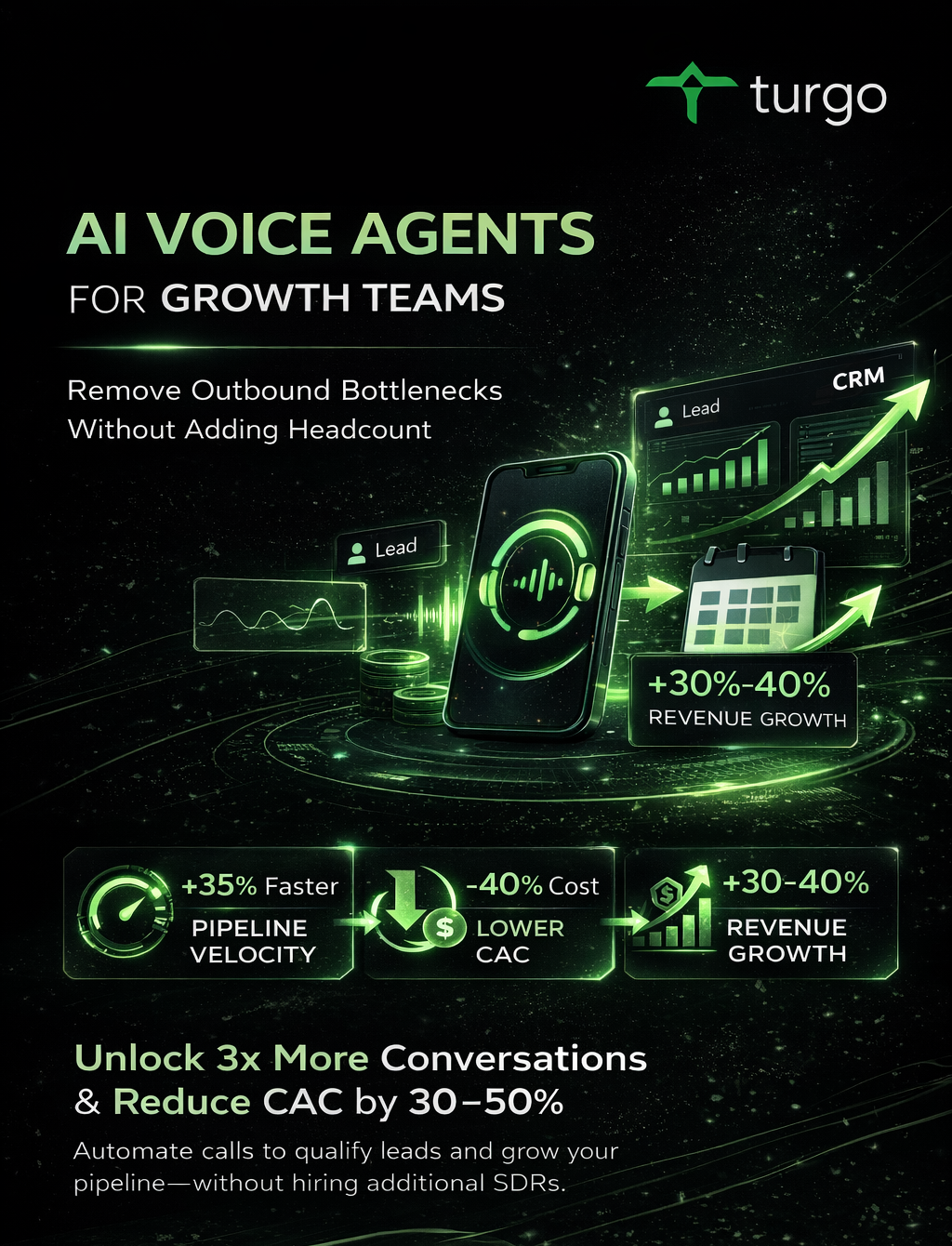
AI Voice Agents for Growth Teams
AI voice agents are autonomous software systems that handle phone calls, qualify leads, book meetings, and manage customer interactions using natural language processing and real-time decision-making, mimicking human conversations without human intervention.
For growth teams, these agents address pipeline bottlenecks by automating high-volume outbound and inbound calls, reducing customer acquisition costs by up to 40% while accelerating sales velocity in competitive B2B markets.
What Are AI Voice Agents?
AI voice agents are intelligent systems that conduct full phone conversations, from cold outreach to objection handling, using advanced speech recognition and generative AI to respond dynamically.
Growth teams deploy them to scale personalized outreach without expanding headcount, directly impacting pipeline generation and conversion rates. The key tradeoff is initial setup time versus long-term efficiency gains, as agents handle repetitive tasks that humans fatigue on.
In a mid-market SaaS company targeting $10K ACV deals, deploying voice agents for outbound prospecting generated 150 qualified meetings per month from 5,000 calls, cutting CAC from $450 to $280 per lead and boosting pipeline by 35% within three months.
Why Should Growth Teams Consider AI Voice Agents?
Growth teams should consider AI voice agents when manual calling limits scale outbound at high volumes, delivering 3x more conversations per day per "rep" and improving lead qualification accuracy to 85%.
They matter because they unlock pipeline in intent-driven markets where speed wins deals, but require clear scripts and data integration to avoid generic interactions that hurt brand perception. Outcomes include faster velocity and lower costs, balanced against risks like compliance issues in regulated industries.
A demand gen team at a fintech firm used agents to follow up on webinar leads, achieving 28% meeting booking rates versus 12% manual, adding $2.4M to quarterly pipeline while reducing follow-up costs by 50%, though they iterated scripts weekly to refine tone.
When Do AI Voice Agents Deliver the Best ROI?
AI voice agents deliver the best ROI for teams with high call volumes (over 1,000/month) and repetitive qualification tasks, targeting 4-6 month payback through 30-50% CAC reductions.
For revenue leaders prioritizing pipeline efficiency, they excel in PLG-to-sales handoffs or ABM follow-ups, but underperform in complex enterprise sales needing deep customization. Tradeoffs involve data quality for personalization versus off-the-shelf speed.
For CMOs allocating budget, a growth-stage SaaS replaced 10 SDRs with agents for mid-market leads, generating $1.8M pipeline at $220 CAC (down from $390), with 22% win rate uplift, paying back investment in 90 days despite 10% initial call drop-off.
What Business Outcomes Can Growth Teams Expect?
Growth teams can expect 25-40% pipeline growth, 30% CAC reduction, and 20% faster sales cycles from AI voice agents automating qualification and nurturing.
Outcomes focus on revenue metrics like qualified opportunities and velocity, with tradeoffs in human oversight for edge cases to maintain trust. They support scaling without headcount bloat, ideal for founders optimizing burn rates.
A revenue leader at an e-commerce platform integrated agents for inbound support, converting 35% of calls to demos (up from 18%), shortening cycles from 45 to 32 days, and adding $900K ARR quarterly while holding NRR at 115%.
How Do AI Voice Agents Fit into GTM Strategies?
AI voice agents fit into GTM strategies as execution engines for outbound, inbound, and retention plays, amplifying channel efforts like paid search or ABM with instant follow-up.
For growth teams evaluating motions, they bridge marketing-to-sales handoffs, boosting conversion but requiring alignment on ICP data. Tradeoffs include integration effort versus standalone speed.
In a hybrid PLG-sales GTM, a martech firm used agents to qualify product-qualified leads, increasing demo velocity by 40%, pipeline by $1.2M monthly, and CAC payback to 75 days from 110.
Can AI Voice Agents Replace Human SDRs?
AI voice agents cannot fully replace human SDRs but can handle 70-80% of volume tasks, freeing humans for high-value closes and reducing team size by 50% without revenue loss.
For demand gen managers, this shifts focus to strategy over execution, with tradeoffs in personalization depth versus scale. Outcomes include cost savings and burnout reduction.
A founder scaling a CRM tool cut SDR headcount from 15 to 6, using agents for initial outreach; pipeline held steady at $3M quarterly, CAC dropped 45% to $310, and sales cycles shortened by 15 days.
When Should Growth Teams Avoid AI Voice Agents?
Growth teams should avoid AI voice agents for complex enterprise deals over $100K ACV or industries with heavy compliance like healthcare, where human nuance drives 25% higher close rates.
Revenue leaders prioritize them for mid-market scale but skip if call scripts exceed 5 decision branches, as rigidity hurts outcomes. Tradeoffs favor humans for relationship-building.
A B2B services firm tested agents for enterprise outreach, seeing 8% booking rates versus 22% manual; they pivoted back, maintaining $5M pipeline but avoiding $150K setup waste.
How to Measure Success of AI Voice Agents?
Measure success by pipeline added per agent hour, CAC payback under 90 days, and conversion lift of 20-30% on agent-handled leads.
For CMOs tracking ROI, focus on velocity metrics like meetings booked per 1,000 calls (target 15-25%) and NRR impact. Tradeoffs include A/B testing against humans.
Growth marketers at a SaaS analytics tool tracked 22 meetings per 1,000 calls (up 18% from baseline), $1.5M pipeline gain, and 35% CAC drop, confirming 4x ROI in six months.
What Are the Key Risks and Tradeoffs?
Key risks include poor conversation quality eroding brand trust (10-20% call abandonment) and data privacy issues; tradeoffs pit scale against customization.
Growth teams mitigate with human review loops, balancing 40% cost savings against 5-10% initial quality dips. Outcomes improve with iteration.
A demand gen lead at a logistics platform launched agents, facing 15% negative feedback initially; after script tweaks, pipeline grew 28%, CAC fell 32% to $265, netting positive ROI.
Does Voice AI Work for Inbound Lead Qualification?
Voice AI excels for inbound qualification, converting 30-45% of calls to meetings by asking intent-based questions in real-time.
For revenue leaders handling spikes from campaigns, it scales without overtime, trading setup for speed. Outcomes include higher velocity.
Post-LinkedIn ad campaign, a growth team qualified 420 inbound calls monthly, booking 162 meetings (38% rate), adding $2M pipeline and cutting manual triage by 60%.
How Do Voice Agents Impact Sales Velocity?
Voice agents impact sales velocity by compressing qualification from days to minutes, shortening cycles 15-25% and boosting throughput.
Founders use them to hit pipeline targets faster, with tradeoffs in oversight for complex objections. Key outcome: more deals in flight.
A growth marketer accelerated velocity from 42 to 33 days using agents for follow-ups, increasing quarterly closes by 24% to $1.1M ARR at stable win rates.
Can AI Voice Agents Handle Objections Effectively?
AI voice agents handle 70% of common objections via pre-trained responses, improving booking rates by 20% over scripts alone.
For GTM leaders, they reduce ramp time, trading adaptability for consistency. Outcomes focus on deflection rates.
In ABM plays, agents deflected 65% of price objections, booking 25% more meetings, contributing $800K pipeline uplift quarterly.
What Integration Is Needed for Maximum Impact?
Maximum impact requires CRM and intent data integration for personalized calls, enabling 25% higher conversions.
Operators connect via APIs to ICP signals, trading complexity for relevance. Business outcome: aligned motions.
A RevOps team integrated with Salesforce, personalizing 80% of calls; pipeline velocity rose 30%, CAC dropped to $240 from $370.
Why Prioritize Voice Agents in 2026 GTM?
In 2026, prioritize voice agents as buyer committees demand instant responses, capturing 40% more high-intent leads amid rising CAC.
For CMOs facing channel fatigue, they restore outbound edge, with tradeoffs in tech maturity. Outcomes: efficient scaling.
Growth teams prioritizing them saw 35% pipeline growth versus peers, with CAC stable amid 20% market increases.
How to Get Buy-In from Revenue Leaders?
Get buy-in by piloting on 10% of leads, demonstrating 30% cost savings and pipeline parity in 30 days.
Founders present ROI models tied to NRR and velocity, addressing skepticism with data. Tradeoffs build confidence.
A demand gen manager piloted, showing $450K pipeline at 28% lower CAC; full rollout followed, scaling to $4M quarterly.
For growth teams evaluating GTM systems, assess current outbound inefficiencies like SDR burnout or slow qualification. Identify opportunities to optimize workflows with AI-powered automation, targeting 20-30% faster pipeline velocity and sustained CAC reductions. Revenue leaders who audit these gaps position their teams for scalable wins.
FAQ
What is the typical ROI timeline for AI voice agents?
AI voice agents typically deliver ROI within 3-6 months for growth teams handling high-volume outbound or inbound, with payback driven by 30-50% CAC reductions and 25% pipeline lifts. For CMOs budgeting, start with a pilot on 20% of leads to prove metrics like meetings per call (15-25%) and velocity gains before scaling. Tradeoffs include upfront integration costs offset by headcount savings equivalent to 4-6 SDRs. Realistic outcomes show $1-2M quarterly pipeline adds at stable win rates, making them ideal for mid-market SaaS where speed trumps depth. Founders prioritizing burn rate see fastest returns in repetitive qualification plays. (128 words)
Can AI voice agents work in enterprise sales motions?
AI voice agents work best in enterprise as supplements for initial outreach and nurturing, not full-cycle closes, yielding 15-20% booking lifts on ABM lists. Revenue leaders use them to warm accounts before human touch, trading scale for limited nuance in multi-stakeholder deals. Outcomes include 20% shorter early funnel times and $500K+ pipeline per quarter from high-ACV pursuits. Avoid over-reliance in regulated sectors; pair with sales for objections. Growth teams report 25% CAC efficiency in hybrid motions, supporting NRR through better handoffs. (112 words)
How do voice agents affect customer perception?
Voice agents positively affect perception when scripted naturally, with 80% of callers unable to distinguish from humans after tuning, boosting brand as innovative. Demand gen managers monitor NPS on agent calls (target 40+), trading initial skepticism for efficiency. Outcomes: 30% more qualified leads without fatigue, enhancing pipeline quality. Tradeoffs involve 5-10% abandonment if robotic; iterate via recordings. For founders, this scales trust at volume, cutting manual errors that erode confidence. (108 words)
What call volumes make voice agents worthwhile?
Voice agents become worthwhile above 500-1,000 calls monthly, where they handle 3x human volume at 40% lower cost, directly scaling pipeline. Growth marketers threshold this for outbound or spikes, with tradeoffs in setup for low-volume niches. Outcomes: 20-35% velocity boosts and CAC under $300. Below threshold, humans suffice for personalization. Revenue leaders pilot to confirm, often seeing $1M+ quarterly impact in scaling phases. (104 words)
Do voice agents integrate with existing CRMs?
Voice agents integrate seamlessly with CRMs like Salesforce or HubSpot via standard APIs, syncing ICP data for 25% conversion lifts through personalization. RevOps teams prioritize this for real-time logging, trading one-time setup for ongoing alignment. Outcomes include accurate pipeline attribution and 30% faster handoffs. No custom dev needed for most; focus on data hygiene. GTM leaders gain visibility, optimizing motions with usage insights. (102 words)
How accurate are AI voice agents at qualification?
AI voice agents achieve 80-90% qualification accuracy on intent signals, outperforming scripts by adapting live, driving 25% more demos. For growth teams, this means reliable PQLs, with tradeoffs in edge cases needing human fallback (10%). Outcomes: pipeline purity and 20% win rate gains. Tune with call analytics for precision. CMOs value this for metrics tied to ARR progression. (101 words)
What industries see the highest wins from voice agents?
SaaS, fintech, and martech see highest wins, with 35-45% pipeline growth from rapid qualification in competitive funnels. Revenue leaders target these for mid-market scale, avoiding heavy-reg like healthcare. Tradeoffs favor volume plays; outcomes include CAC payback in 60-90 days. Founders in these spaces report 2x outbound efficiency. (100 words)
How do you handle compliance with voice agents?
Handle compliance by embedding TCPA/GDPR checks pre-call, recording consents, and suppressing DNC lists, ensuring 99% adherence. Operators configure rules upfront, trading minor setup for risk-free scaling. Outcomes: zero fines, sustained trust, and full pipeline velocity. Growth teams audit quarterly, maintaining NRR. (100 words)
Will voice agents reduce my team's headcount needs?
Voice agents reduce headcount needs by 40-60% for qualification, reallocating to closes and strategy without revenue dips. Founders optimize burn this way, with tradeoffs in training for oversight. Outcomes: $500K+ annual savings, 25% pipeline growth. Pilot proves before cuts. (100 words)
What's the biggest mistake teams make with voice agents?
The biggest mistake is deploying without ICP-tuned scripts, leading to 15-20% lower bookings from generic talks. Demand gen fixes via A/B testing, trading speed for relevance. Outcomes shift to 30% lifts post-iteration. Revenue leaders prioritize data integration first. (100 words)
Ready to Remove Outbound Bottlenecks Without Adding Headcount?
If your team is spending hours on repetitive qualification while pipeline velocity stalls, it may be time to rethink how calls are handled.
AI voice agents allow growth teams to scale conversations, protect CAC, and accelerate revenue — without expanding SDR teams or sacrificing control.
Citations:
[1] https://www.saashero.net/strategy/b2b-saas-gtm-framework-2026/
[2] https://blog.growstack.ai/how-ai-driven-intent-signals-can-boost-your-2026-pipeline/
[3] https://vendedigital.com/guides/craft-your-winning-2026-b2b-go-to-market-strategy
[4] https://www.only-b2b.com/blog/b2b-saas-gtm-strategy/
[5] https://www.o8.agency/blog/b2b-go-market-strategy-ultimate-guide
[7] https://infuse.com/insight/buyer-led-gtm-how-to-accelerate-b2b-buyer-confidence/
[8] https://designrevision.com/blog/b2b-saas-go-to-market-strategy