How AI Transforms Marketing: Impact on CAC and Pipeline Velocity
Discover how AI amplifies marketing operations, accelerating pipeline growth, reducing CAC, and optimizing GTM strategy while enhancing team productivity and strategic control.
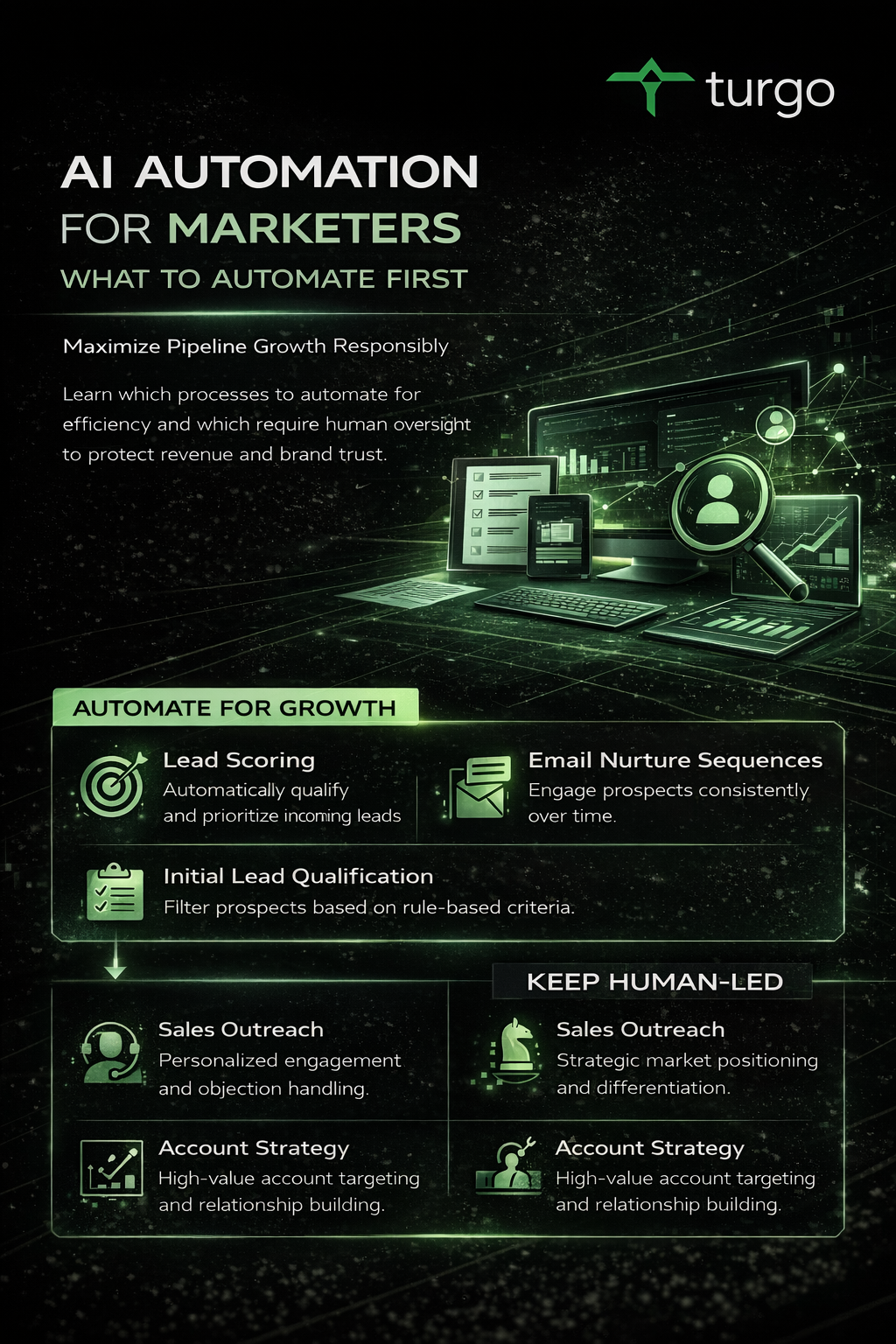
AI-Powered Marketing: Building Modern GTM Strategies
Meta Description: Learn how AI transforms marketing operations, accelerates pipeline growth, and reduces customer acquisition costs while maintaining strategic control and team alignment.
What Is AI-Powered Marketing and Why Does It Matter Now?
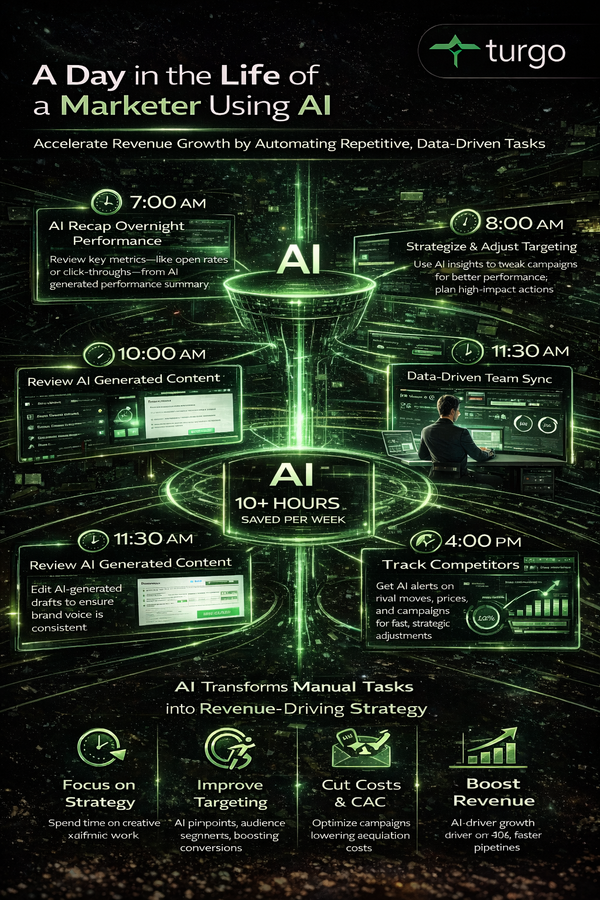
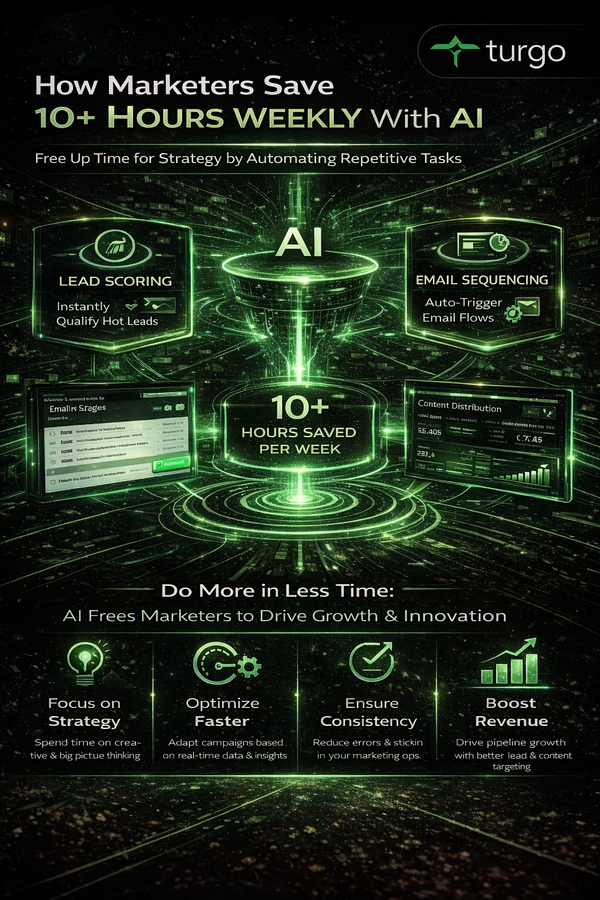
AI-powered marketing refers to the integration of machine learning, automation, and intelligent systems into core marketing operations—from audience targeting and content creation to lead scoring and campaign optimization. It's not about replacing marketers; it's about amplifying their decision-making capacity and freeing them from repetitive work so they can focus on strategy, positioning, and revenue impact.
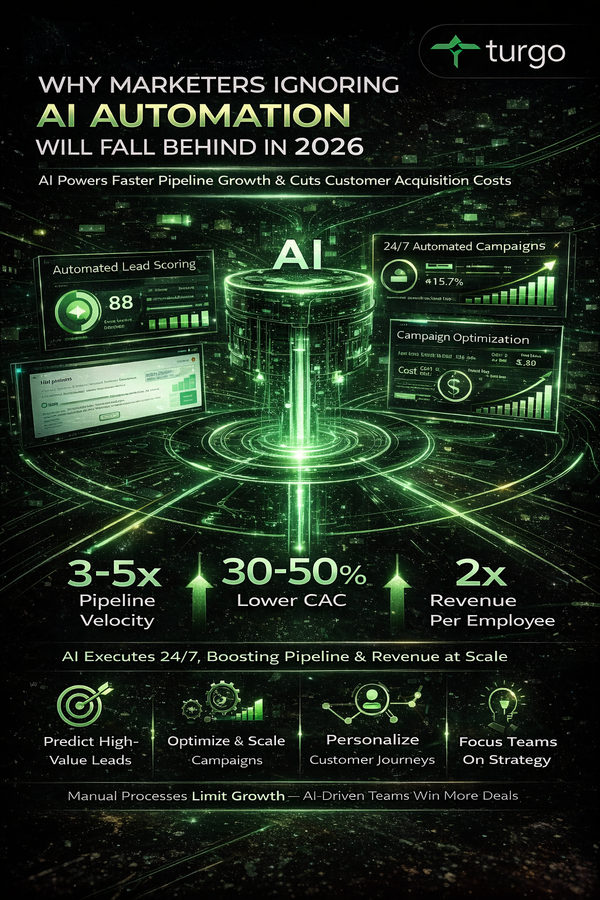
For growth teams evaluating their competitive position in 2026, AI adoption has shifted from optional to foundational. Teams that integrate AI into their go-to-market strategy are seeing measurable improvements in pipeline velocity, conversion rates, and cost per acquisition. The question is no longer whether to adopt AI, but how to implement it in ways that align with your GTM framework, customer journey, and revenue goals.
How Does AI Fit Into Your Go-to-Market Strategy?
A go-to-market strategy is your end-to-end plan for introducing a product, reaching your target audience, and scaling revenue. AI doesn't replace this framework—it optimizes every component of it. AI enhances market definition by analyzing customer behavior patterns at scale. It strengthens customer analysis by identifying psychographic signals and decision-making triggers that manual research misses. It accelerates product-market fit validation by processing feedback loops faster. And it sharpens competitive positioning by monitoring competitor messaging and market shifts in real time.
For CMOs allocating budget, the strategic question becomes: which GTM components will yield the highest ROI when augmented by AI? The answer depends on your current bottleneck. If your bottleneck is lead volume, AI-driven demand generation and content distribution will move the needle fastest. If your bottleneck is conversion quality, AI-powered lead scoring and sales enablement will compress your sales cycle. If your bottleneck is efficiency, AI automation of repetitive tasks will free up team capacity for higher-value work.
A B2B SaaS company with a $5M ARR target and a 90-day sales cycle might deploy AI to: (1) identify high-intent accounts using behavioral signals, (2) personalize outreach at scale across 500+ target accounts, and (3) automate lead scoring so sales focuses only on accounts with 70%+ conversion probability. The result: 35% faster pipeline progression and 20% lower CAC within 6 months.
What Problems Does AI Actually Solve in Marketing Operations?
AI solves three critical problems that constrain growth teams: information overload, decision latency, and resource scarcity. Marketing teams today generate and consume more data than ever—website behavior, email engagement, social signals, intent data, CRM records—but lack the bandwidth to synthesize it into actionable insights. AI processes this data in real time and surfaces the signals that matter most.
Decision latency is the time between identifying an opportunity and acting on it. A demand generation manager might notice that a particular account cluster is showing high engagement, but by the time they've analyzed the data and briefed the sales team, the buying window has closed. AI collapses this latency by automatically flagging high-intent signals and triggering workflows instantly.
Resource scarcity is the persistent constraint: you have more campaigns to run, more content to produce, more accounts to nurture, and fewer people to do it. AI doesn't eliminate the need for skilled marketers, but it multiplies their output. One content strategist using AI tools can produce 3–4x more assets while maintaining quality. One demand gen manager can manage 2–3x larger account lists with higher precision.
A mid-market B2B company with 8 marketing professionals and a $20M revenue target might use AI to: (1) automate lead scoring across 2,000+ inbound leads monthly, (2) generate personalized email sequences for 50+ account-based marketing campaigns, (3) analyze competitor messaging and recommend positioning adjustments weekly. Without AI, this would require 4–5 additional headcount. With AI, the existing team operates at 3x capacity.
How Does AI Improve Customer Targeting and Segmentation?
Customer targeting and segmentation are foundational to any GTM strategy. Traditional segmentation relies on demographic and firmographic data—company size, industry, revenue, location. AI-powered segmentation adds behavioral and intent signals: which accounts are actively researching solutions, which are expanding budgets, which are showing signs of churn risk, which are most likely to convert within 90 days.
AI analyzes patterns across thousands of data points—website visits, content consumption, email engagement, social activity, job changes, funding announcements, earnings calls—to predict which accounts are in active buying cycles. This transforms targeting from static lists into dynamic, real-time signals. Instead of targeting "all mid-market SaaS companies in North America," you target "mid-market SaaS companies in North America that have shown 8+ intent signals in the last 30 days and match your ideal customer profile."
The business impact is direct: higher conversion rates, shorter sales cycles, and lower CAC. A revenue leader prioritizing pipeline quality will see AI-powered targeting reduce wasted outreach by 40–50%, meaning sales teams spend less time on unqualified prospects and more time on accounts with genuine buying intent. For a team with a $3M quota and a $500 CAC, this translates to 200–300 additional qualified opportunities annually.
Can AI Generate High-Quality Marketing Content at Scale?
Content generation is one of the most visible applications of AI in marketing. Large language models can draft blog posts, email sequences, social media copy, product descriptions, and sales collateral in minutes. The question for growth leaders isn't whether AI can generate content—it clearly can—but whether that content drives business outcomes.
The answer is nuanced. AI excels at generating first drafts, variations, and high-volume content that would otherwise require significant manual effort. It's particularly effective for: (1) email sequences and nurture campaigns, where personalization and volume matter more than originality; (2) product descriptions and technical documentation, where clarity and consistency are priorities; (3) social media content and blog outlines, where speed and frequency drive visibility; (4) sales collateral and one-pagers, where templates and customization are the norm.
AI struggles with original strategic thinking, brand voice consistency, and content that requires deep domain expertise or contrarian positioning. The most effective approach is hybrid: AI generates the foundation, human strategists refine positioning and messaging, and AI scales the output across channels and segments.
A demand generation team managing 12 campaigns simultaneously might use AI to: (1) generate 50+ email subject line variations and test them across segments, (2) create 100+ social media posts from 10 core campaign messages, (3) draft 20+ blog post outlines based on competitor analysis and keyword research. The team then selects the strongest variations, refines messaging, and publishes. Result: 3x more content volume, 2x faster production cycle, same or higher engagement rates.
Why Does Lead Scoring Matter More With AI?
Lead scoring is the process of ranking prospects based on their likelihood to convert. Traditional lead scoring relies on explicit signals: form submissions, email opens, demo requests. AI-powered lead scoring incorporates implicit signals: browsing behavior, content consumption patterns, account-level buying signals, and predictive models trained on your historical conversion data.
The strategic value is clear: sales teams have limited capacity, so they must focus on the highest-probability opportunities. AI-powered scoring ensures that sales focuses on accounts with 70%+ conversion probability rather than 30% probability. This compresses sales cycles, improves close rates, and reduces the cost of sales.
For revenue leaders, the tradeoff is simple: invest in AI-powered lead scoring infrastructure, and your sales team's productivity increases by 25–40%. A sales team with a 30% close rate and a 60-day sales cycle might improve to a 40% close rate and a 45-day cycle by focusing exclusively on AI-qualified leads. For a $10M quota, this means $2–3M additional revenue from the same headcount.
How Does AI Personalization Impact Conversion Rates?
Personalization is the practice of tailoring messaging, offers, and experiences to individual prospects based on their characteristics, behavior, and context. AI enables personalization at scale by generating unique variations of messaging for different segments, accounts, and individuals.
Traditional personalization is limited by time and resources: a sales development representative might personalize 20–30 outreach messages daily. AI can generate 500+ personalized variations in minutes, each tailored to a specific account's industry, company size, use case, and recent activity. The result is higher engagement and conversion rates because messaging resonates more deeply with each prospect's situation.
The business impact depends on your baseline conversion rate and the quality of personalization. For teams with low baseline engagement (5–10% email open rates, 1–2% click rates), AI-powered personalization can improve these metrics by 30–50%. For teams with already-strong engagement (20%+ open rates, 5%+ click rates), improvements are more modest (10–20%) because the baseline is already optimized.
A B2B marketing team running an account-based marketing campaign to 100 target accounts might use AI to: (1) generate personalized email sequences for each account based on their industry, recent news, and company size; (2) create custom landing pages that reference each account's specific use case; (3) tailor ad messaging to each account's buyer persona and pain points. Result: 40% higher email open rates, 60% higher landing page conversion rates, 25% shorter sales cycle.
What Role Does Predictive Analytics Play in GTM?
Predictive analytics uses historical data and machine learning to forecast future outcomes: which leads will convert, which customers will churn, which accounts will expand, which campaigns will succeed. This transforms marketing from reactive (responding to what happened) to proactive (anticipating what will happen).
For growth teams, predictive analytics answers critical GTM questions: Which accounts should we prioritize for expansion? Which customers are at risk of churn? Which campaigns will deliver the highest ROI? Which new markets are most likely to succeed? These answers inform resource allocation, budget decisions, and strategic priorities.
The business impact is significant but requires clean data and realistic expectations. Predictive models are probabilistic, not deterministic—they identify trends and patterns, not certainties. A model that predicts churn with 80% accuracy is valuable, but it's not perfect. The key is using predictions to inform decisions, not replace human judgment.
A customer success team managing 500 customers might use predictive analytics to: (1) identify 50 customers with 70%+ churn risk and proactively engage them with retention campaigns; (2) identify 100 customers with 60%+ expansion probability and route them to account expansion specialists; (3) forecast quarterly revenue based on pipeline velocity and historical conversion rates. Result: 15–20% reduction in churn, 25–30% increase in expansion revenue, more accurate revenue forecasting.
How Should You Approach AI Implementation Without Disrupting Current Operations?
AI implementation is not a big-bang migration. The most successful approach is incremental: identify your highest-impact bottleneck, pilot an AI solution, measure results, and scale if successful. This minimizes risk and allows your team to build confidence and competency gradually.
The typical implementation roadmap is: (1) audit current processes and identify bottlenecks; (2) select one high-impact use case (e.g., lead scoring, email personalization, content generation); (3) pilot the solution with a subset of data or a single campaign; (4) measure results against baseline metrics; (5) refine the solution based on results; (6) scale to full operations; (7) move to the next use case.
This approach requires clear ownership, realistic timelines, and honest measurement. Many AI implementations fail not because the technology doesn't work, but because organizations underestimate the change management required. Your team needs training, processes need to be redesigned, and success metrics need to be redefined.
A marketing organization with 20 people and $50M in revenue might implement AI in this sequence: Month 1–2, pilot AI-powered lead scoring with 500 inbound leads; Month 3–4, measure impact and refine model; Month 5–6, scale to all inbound leads (2,000+ monthly); Month 7–8, pilot AI-powered email personalization for nurture campaigns; Month 9–10, scale to all nurture campaigns; Month 11–12, pilot AI-powered content generation for social media. By end of year, the team has 3 AI systems in production, each delivering measurable ROI.
What Metrics Should You Track to Measure AI Impact?
Measuring AI impact requires defining clear baseline metrics before implementation, then tracking changes over time. The most relevant metrics depend on your use case, but generally fall into three categories: efficiency metrics (how much faster or cheaper), effectiveness metrics (how much better results are), and business outcome metrics (how much revenue or pipeline impact).
For lead scoring, relevant metrics are: lead volume processed, time to score, sales productivity (opportunities per rep), conversion rate, and sales cycle length. For content generation, relevant metrics are: content volume produced, production time per asset, engagement rates, and cost per asset. For personalization, relevant metrics are: email open rates, click rates, conversion rates, and CAC.
The critical discipline is isolating AI's impact from other variables. If you implement AI-powered lead scoring and sales productivity increases by 20%, is that because of better lead quality, or because you hired two new sales reps, or because you launched a new product? Rigorous measurement requires control groups, clear attribution, and honest analysis.
A demand generation team implementing AI-powered account targeting might track: (1) baseline: 500 accounts targeted monthly, 5% conversion rate, 90-day sales cycle, $2,000 CAC; (2) after AI implementation: 800 accounts targeted monthly (higher volume due to better prioritization), 8% conversion rate (better quality), 70-day sales cycle (faster), $1,500 CAC (lower cost). The business impact: 60% more pipeline, 60% higher conversion, 22% faster cycle, 25% lower CAC.
How Does AI Change the Role of Marketing Teams?
AI doesn't eliminate marketing jobs; it transforms them. Repetitive, tactical work—data entry, basic copywriting, campaign setup, report generation—becomes automated. Strategic, creative, and analytical work—positioning, messaging, campaign strategy, insights, relationship building—becomes more valuable and more central to the role.
For CMOs and growth leaders, this means your team composition needs to shift. You need fewer people doing tactical execution and more people doing strategic thinking. You need people who understand data and can interpret AI outputs. You need people who can manage AI tools and workflows. You need people who can think critically about what AI should and shouldn't do.
The transition is not painless. Some team members will embrace AI and thrive in new roles. Others will resist or struggle to adapt. The most successful organizations invest in training, create clear career paths for people moving into new roles, and are honest about which roles will change or disappear.
A marketing team of 10 people might evolve from: 4 demand gen specialists, 3 content creators, 2 analysts, 1 manager → 2 demand gen specialists (focused on strategy and optimization), 1 content strategist (focused on positioning and quality), 2 AI/data specialists (managing tools and workflows), 2 analysts (focused on insights and attribution), 2 managers (focused on strategy and team development), 1 new role: AI operations manager. The team is smaller but more strategic.
What Are the Risks and Limitations of AI in Marketing?
AI is powerful but not magical. Understanding its limitations is critical to using it effectively. The primary risks are: (1) data quality issues—AI models are only as good as the data they're trained on; (2) bias—AI can amplify existing biases in your data or decision-making; (3) over-reliance—using AI to make decisions without human judgment; (4) privacy and compliance—using customer data in ways that violate regulations; (5) cost—AI tools and infrastructure require investment.
Data quality is the most common failure point. If your CRM data is incomplete, your lead scoring model will be inaccurate. If your historical conversion data is biased toward certain customer types, your predictive models will be biased. The solution is investing in data quality before implementing AI.
Bias is subtle but serious. If your historical data shows that you've converted more customers from certain industries or company sizes, your AI model will prioritize those segments, potentially missing opportunities in underrepresented segments. The solution is understanding your data, testing for bias, and adjusting models accordingly.
Over-reliance is the temptation to let AI make decisions without human oversight. AI is a tool for augmenting human decision-making, not replacing it. A sales leader should never let an AI system automatically disqualify leads without human review. A CMO should never let an AI system automatically allocate budget without strategic input.
How Do You Choose the Right AI Tools for Your GTM Stack?
The AI tool landscape is crowded and confusing. There are hundreds of vendors offering AI-powered solutions for marketing, sales, and revenue operations. Choosing the right tools requires clarity about your specific problem, your technical requirements, and your budget.
The evaluation framework is: (1) problem clarity—what specific problem are you solving? (2) integration—does the tool integrate with your existing stack (CRM, marketing automation, analytics)? (3) ease of use—can your team use it without extensive training? (4) cost—what's the total cost of ownership, including implementation and training? (5) support—does the vendor provide adequate support and documentation? (6) security and compliance—does the tool meet your data security and compliance requirements?
Most organizations make the mistake of evaluating tools before clarifying their problem. They see a shiny new AI tool and try to fit it into their workflow, rather than identifying their bottleneck and finding a tool that solves it. The result is wasted budget and tool sprawl.
A growth team evaluating AI tools for lead scoring might compare: (1) native lead scoring in your existing marketing automation platform (lowest cost, limited features); (2) dedicated lead scoring platform (higher cost, more features, requires integration); (3) custom AI model built on your data (highest cost, most customized, requires data science expertise). The right choice depends on your team's technical capability, budget, and the complexity of your scoring logic.
What Does AI-Driven GTM Look Like in Practice?
An AI-driven GTM strategy integrates AI into every component of your go-to-market framework: market definition, customer analysis, product-market fit, competitive analysis, pricing, distribution, marketing, and sales.
Market definition becomes dynamic: instead of static market research, you continuously monitor market trends, customer sentiment, and competitive activity using AI-powered market intelligence tools. Customer analysis becomes real-time: instead of annual buyer persona updates, you continuously update personas based on actual customer behavior and feedback. Product-market fit validation becomes faster: instead of quarterly surveys, you continuously analyze customer feedback, usage patterns, and churn signals to identify fit gaps. Competitive analysis becomes continuous: instead of annual competitive reviews, you monitor competitor messaging, pricing, and product changes in real time.
Distribution becomes optimized: instead of guessing which channels will work, you use AI to predict which channels will deliver the highest ROI for each segment. Marketing becomes personalized and efficient: instead of one-size-fits-all campaigns, you deliver personalized experiences at scale. Sales becomes data-driven: instead of gut-feel prioritization, sales focuses on accounts with the highest conversion probability.
A B2B SaaS company implementing AI-driven GTM might operate like this: (1) AI continuously monitors 5,000 target accounts for buying signals; (2) when an account shows 5+ signals, it's automatically routed to sales with a personalized briefing; (3) sales uses AI-powered insights to personalize outreach; (4) marketing uses AI to generate personalized content for each account; (5) customer success uses AI to predict churn and expansion; (6) leadership uses AI-powered dashboards to monitor pipeline, conversion, and revenue in real time. Result: 40% faster pipeline progression, 30% higher conversion rates, 25% lower CAC, 20% higher customer lifetime value.
When Should You Invest in AI Versus Building Internal Capability?
This is a critical decision for revenue leaders: should you buy AI tools from vendors, or build custom AI models internally? The answer depends on your technical capability, budget, and strategic priorities.
Buying AI tools is faster and lower-risk. You get immediate capability without building internal expertise. The tradeoff is less customization and ongoing vendor dependency. Building internal capability is slower and higher-risk but gives you more control and customization. The tradeoff is requiring data science expertise and ongoing investment.
Most organizations follow a hybrid approach: buy tools for standard use cases (lead scoring, email personalization, content generation) and build custom models for proprietary use cases (churn prediction, expansion probability, market opportunity sizing). This balances speed, cost, and customization.
A $100M revenue company might allocate budget like this: 60% on buying AI tools ($500K annually), 30% on building internal capability ($250K annually for data science team), 10% on training and change management ($80K annually). A $10M revenue company might allocate: 80% on buying AI tools ($50K annually), 20% on training and change management ($12K annually), and defer building internal capability until revenue scales.
How Does AI Impact Sales and Marketing Alignment?
Sales and marketing alignment is notoriously difficult. Marketing generates leads, sales complains they're low quality. Sales closes deals, marketing doesn't learn from the data. AI creates new opportunities for alignment by providing shared visibility into pipeline, lead quality, and conversion drivers.
AI-powered lead scoring creates a shared definition of a qualified lead. Instead of marketing and sales arguing about lead quality, they agree on the criteria that predict conversion (based on historical data), and AI applies those criteria consistently. AI-powered insights give sales visibility into why certain accounts are high-probability, which helps them prioritize and personalize. AI-powered attribution gives marketing visibility into which campaigns and messages actually drive revenue, which helps them optimize.
The result is better alignment, faster feedback loops, and more efficient pipeline generation. Marketing understands what sales needs, sales understands what marketing can deliver, and both teams optimize for shared outcomes (pipeline, conversion, revenue).
A B2B company with 20 sales reps and a $20M quota might implement AI-powered alignment like this: (1) define lead quality criteria based on historical conversion data; (2) implement AI lead scoring that applies these criteria consistently; (3) give sales visibility into lead scores and the signals driving them; (4) give marketing visibility into which leads convert and why; (5) monthly alignment meetings where both teams review data and optimize. Result: 30% more qualified leads, 20% higher conversion rates, 25% faster sales cycle, better team morale.
What's the Future of AI in Marketing and GTM?
The trajectory is clear: AI will become more integrated, more autonomous, and more strategic. Today, AI is primarily used for tactical optimization (lead scoring, email personalization, content generation). Tomorrow, AI will be used for strategic decision-making (market entry decisions, product positioning, pricing optimization, resource allocation).
The organizations that will win are those that integrate AI into their GTM strategy early, build internal capability and culture around AI-driven decision-making, and maintain human judgment and strategic thinking at the center of their operations. AI is a tool for amplifying human capability, not replacing it.
For growth leaders, the imperative is clear: start now, start small, measure rigorously, and scale what works. The competitive advantage goes to organizations that can move faster, make better decisions, and execute more efficiently. AI is the lever that enables all three.
FAQ
What's the difference between AI-powered marketing and marketing automation?
Marketing automation handles repetitive workflows—sending emails on a schedule, assigning leads to sales reps, updating CRM records. AI-powered marketing goes further by making intelligent decisions within those workflows: predicting which leads are most likely to convert, personalizing messages based on individual behavior, optimizing send times and content variations. Automation is about efficiency; AI is about effectiveness. You can have automation without AI, but the most powerful systems combine both. A marketing automation platform might send an email to everyone who downloads a whitepaper. An AI-powered system sends different emails to different segments based on their predicted conversion probability and past behavior. The result is higher engagement and conversion rates.
How long does it take to see ROI from AI implementation?
It depends on the use case and your baseline metrics. Lead scoring typically shows ROI within 2–3 months because the impact is direct and measurable. Email personalization shows ROI within 1–2 months. Content generation shows ROI immediately in terms of productivity, but business impact (engagement and conversion) takes 2–3 months to measure. The key is defining clear baseline metrics before implementation, then tracking changes over time. Most organizations see measurable ROI within 90 days if they implement correctly. If you're not seeing ROI within 90 days, either the use case wasn't the right priority, or the implementation needs adjustment.
Do I need a data science team to implement AI?
Not necessarily. Many AI tools are designed for non-technical users and don't require data science expertise. Lead scoring tools, email personalization platforms, and content generation tools can be implemented by marketing teams with minimal technical support. However, if you want to build custom AI models or integrate AI deeply into your operations, you'll need data science expertise. The practical approach is: start with vendor tools that don't require data science, measure results, and only invest in building internal capability if the ROI justifies it.
What's the biggest risk of AI in marketing?
The biggest risk is over-reliance on AI without human judgment. AI is probabilistic, not deterministic. It identifies patterns and makes predictions, but it's not always right. If you let AI make decisions without human oversight, you'll make mistakes. A lead scoring model might incorrectly disqualify a high-value prospect. A content generation tool might produce off-brand messaging. A personalization engine might send the wrong message to the wrong person. The solution is treating AI as a tool for augmenting human decision-making, not replacing it. Always have a human in the loop for important decisions.
How do I measure the impact of AI on my marketing team's productivity?
Track three metrics: (1) output volume—how much content, how many campaigns, how many leads processed; (2) time per unit—how long does it take to produce one piece of content, score one lead, run one campaign; (3) quality—engagement rates, conversion rates, customer satisfaction. Compare these metrics before and after AI implementation. For example, if your team produces 50 pieces of content monthly and it takes 4 hours per piece, that's 200 hours monthly. With AI, you might produce 150 pieces in 150 hours (1 hour per piece). That's 3x productivity improvement. But if quality drops 50%, the net impact is negative. The goal is improving both productivity and quality.
Should I replace my marketing automation platform with an AI-native platform?
Not necessarily. Most organizations are better off keeping their existing marketing automation platform and adding AI tools on top of it. Your marketing automation platform is the system of record for campaigns, leads, and customer data. Replacing it is risky and expensive. Instead, integrate AI tools that work with your existing platform. For example, use an AI lead scoring tool that integrates with your CRM, or an AI content generation tool that integrates with your email platform. This approach is faster, lower-risk, and more cost-effective than ripping and replacing your entire stack.
How do I handle privacy and compliance when using AI?
Privacy and compliance are critical. When you use AI tools, you're often sending customer data to third-party vendors. Make sure you understand: (1) what data is being sent; (2) how it's being used; (3) where it's being stored; (4) what security measures are in place; (5) whether it complies with your regulations (GDPR, CCPA, etc.). Get legal and security review before implementing any AI tool. Most reputable vendors have security certifications and compliance documentation. Don't assume compliance; verify it.
What's the best way to train my team on AI tools?
Start with the basics: what is AI, what can it do, what can't it do, how does it work in your specific tools. Then move to hands-on training: have team members use the tools, experiment with different inputs, see how outputs change. Finally, move to optimization: how do we use this tool to improve our metrics. Most AI tool vendors provide training and documentation. Use it. Also, allocate time for your team to experiment and learn. The first month of using a new AI tool is about learning; don't expect full productivity immediately.
How do I know if an AI tool is actually working or just a shiny object?
Define success metrics before implementation. What will success look like? More leads? Higher conversion rates? Faster sales cycle? Lower CAC? Once you've defined success, measure it. Compare metrics before and after implementation. If metrics improve, the tool is working. If metrics don't improve, either the tool isn't right for your use case, or the implementation needs adjustment. Don't fall in love with tools; fall in love with results. If a tool isn't delivering results, move on to something else.
What's the biggest mistake organizations make with AI?
The biggest mistake is implementing AI without clarity about the problem you're solving. Organizations see a shiny new AI tool and try to fit it into their workflow, rather than identifying their bottleneck and finding a tool that solves it. The result is wasted budget and tool sprawl. Before you implement any AI tool, ask: What problem am I solving? How will I measure success? What's the expected ROI? If you can't answer these questions clearly, don't implement the tool. Start with your highest-impact bottleneck and solve that first.
Ready to Optimize Your GTM Strategy with AI?
Take a strategic approach to AI integration, focusing on pipeline growth and CAC efficiency. Start with your most impactful bottleneck, measure your results rigorously, and scale what works. The competitive advantage goes to organizations that move faster, make better decisions, and execute more efficiently. It's not about the shiny new tool - it's about the results.
Citations:
- [1] https://xgrowth.com.au/blogs/go-to-market-strategy-framework/
- [2] https://reteno.com/glossary/go-to-market-gtm-strategy
- [3] https://blog.growstack.ai/how-ai-automation-decisions-affect-your-revenue-pipeline/
- [4] https://online.hbs.edu/blog/post/go-to-market-strategy-framework
- [5] https://www.coursera.org/articles/go-to-market-strategy
- [6] https://trailhead.salesforce.com/content/learn/modules/go-to-market-planning/develop-a-go-to-market-strategy
- [7] https://www.zendesk.com/blog/go-to-market-strategy/
- [8] https://www.leanlabs.com/blog/components-of-a-go-to-market-strategy
- [9] https://www.mural.co/blog/what-is-go-to-market-strategy
- [10] https://www.highspot.com/blog/go-to-market-strategy/