How AI-Native Marketing Transforms Revenue Velocity and ROI
Master the art of a go-to-market strategy to drive predictable revenue growth, streamline pipeline velocity, and optimize customer acquisition costs, even with lean teams.
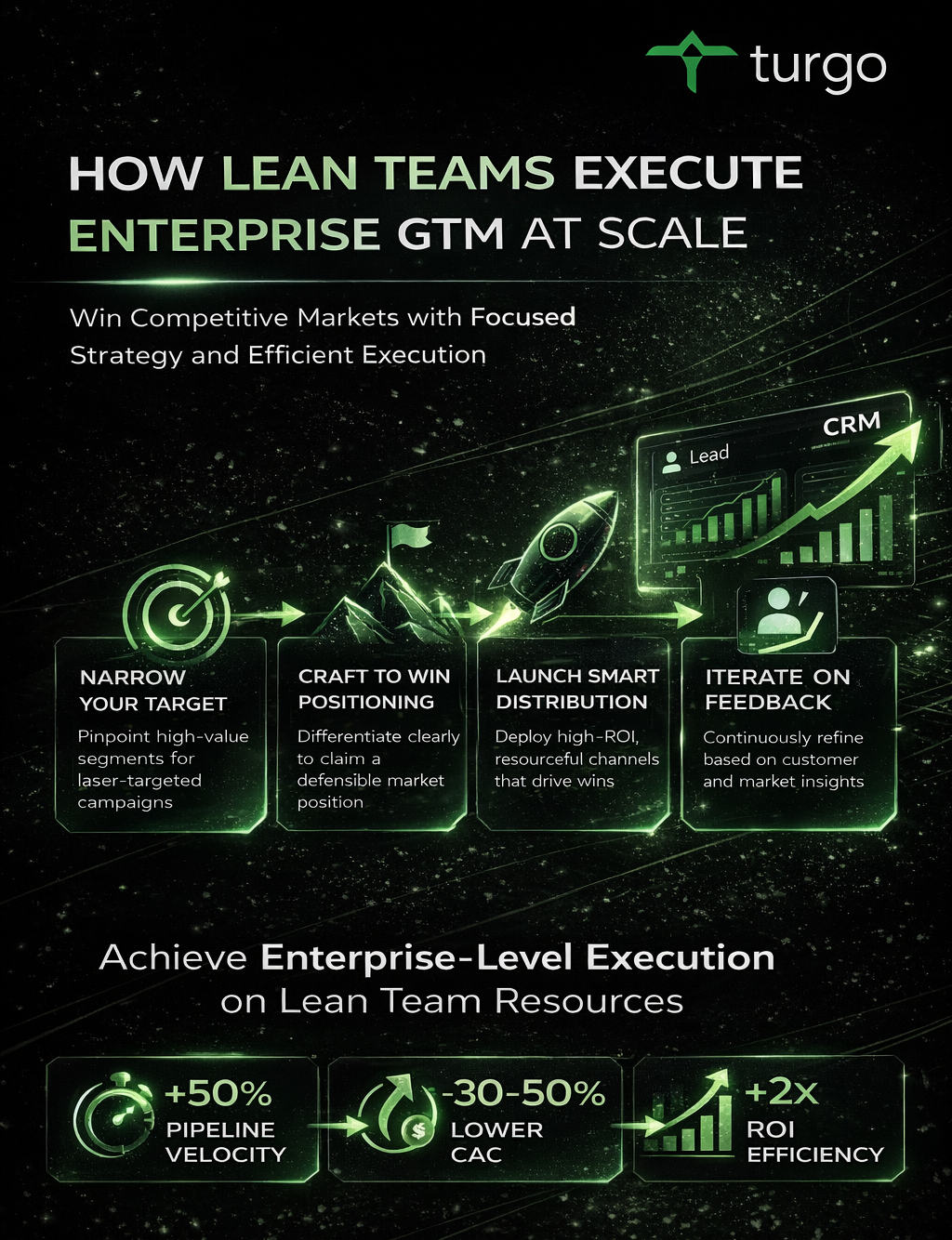
How Lean Teams Execute Enterprise GTM at Scale
Meta Description: Learn how small marketing teams leverage modern strategies to run sophisticated go-to-market campaigns that compete with enterprise resources and drive measurable pipeline growth.
What Is a Go-to-Market Strategy and Why Does It Matter Now?
A go-to-market (GTM) strategy is a comprehensive plan that outlines how a product or service will be positioned, priced, promoted, and distributed to a target audience. It fuses together product, marketing, sales, and customer intelligence into a fully aligned value proposition and action plan for launching and scaling products.
For growth teams and revenue leaders, a GTM strategy is no longer optional—it's the operational backbone that separates predictable revenue growth from reactive firefighting. Without it, marketing and sales operate in silos, budgets scatter across ineffective channels, and pipeline velocity stalls. With it, even lean teams can execute campaigns that rival enterprise-level sophistication.
What Are the Five Essential Elements Every GTM Strategy Must Include?
A complete GTM strategy rests on five foundational pillars: market definition, customer identification, distribution model, product messaging and positioning, and pricing strategy.
Market definition answers which markets you're targeting and why they matter to your business. Customer analysis goes beyond demographics to include psychographics, pain points, and decision-making processes. Distribution channels detail how you'll reach customers—direct sales, partners, or online platforms. Product messaging articulates what you're selling and its unique value compared to competitors. Pricing strategy outlines your pricing model, tiered offerings, and promotional approaches.
For a lean marketing team launching an enterprise SaaS product, this might mean: targeting mid-market companies in healthcare (market definition), focusing on operations directors struggling with manual workflows (customer analysis), selling through direct sales and self-serve trials (distribution), emphasizing time savings and compliance (messaging), and pricing at $5,000–$15,000 annually with volume discounts (pricing). This alignment ensures every dollar spent reinforces the same value narrative.
How Do You Identify and Segment Your Target Market Effectively?
Market identification begins with understanding the size of your potential market, its growth rate, and key trends. Segmentation then divides that market into groups based on behavioral and demographic data, allowing your team to tailor messaging and channels to each segment's specific pain points.
The goal is focus, not breadth. A lean team cannot serve everyone equally. By narrowing your target to the segment most likely to buy and most profitable to serve, you concentrate limited resources where they generate the highest return. This is especially critical for early-stage companies competing against established players with larger budgets.
Consider a B2B marketing automation platform: instead of targeting "all marketing teams," segment into (1) demand generation teams at companies with $50M+ revenue, (2) marketing operations teams at high-growth startups, and (3) enterprise marketing departments. Each segment has different pain points, buying cycles, and channel preferences. A lean team picks one or two segments, dominates them, and expands only after proving repeatable success.
Why Does Customer Pain Point Analysis Drive Better Campaign Decisions?
Understanding customer pain points—the specific problems your product solves—is foundational to every subsequent GTM decision. Pain points inform product positioning, messaging, channel selection, and even pricing strategy.
When you know your customer's pain points deeply, you can craft messaging that resonates emotionally and rationally. You can choose channels where those customers already spend time. You can prioritize features that matter most to them. Without this clarity, campaigns feel generic and conversion rates suffer.
A lean team running an enterprise campaign might discover that their target customers struggle with three core pain points: (1) manual data entry consuming 20+ hours weekly, (2) lack of visibility into pipeline health, and (3) difficulty proving marketing ROI to finance. Every campaign element—email subject lines, landing page copy, demo talking points, case studies—now directly addresses one of these three problems. This coherence drives higher engagement and faster sales cycles.
What Role Does Competitive Analysis Play in GTM Success?
Competitive analysis examines direct and indirect competitors, their strengths and weaknesses, and how your offering differentiates itself. This informs positioning, messaging, pricing, and channel strategy.
For lean teams, competitive analysis is not about copying competitors—it's about finding white space where you can win. Identify what competitors do well (and don't try to beat them there), identify what they neglect (and own that space), and identify where customer sentiment is shifting (and lead there).
A lean team entering a crowded market might discover that competitors focus heavily on feature richness and enterprise support, but customers increasingly value simplicity and speed-to-value. By positioning as "the simple alternative" and emphasizing 30-minute setup over 90-day implementations, the lean team carves out a defensible position without outspending larger competitors.
How Should You Define Your Ideal Customer Profile and Buyer Personas?
An ideal customer profile (ICP) describes the company characteristics most likely to buy and benefit from your product. Buyer personas describe the individual decision-makers within those companies—their roles, goals, pain points, and buying preferences.
Lean teams must be ruthlessly specific here. A vague ICP ("mid-market B2B companies") wastes resources. A precise ICP ("Series B SaaS companies with $2M–$10M ARR, 50–200 employees, in the sales or marketing function") enables focused outreach and higher conversion rates.
For each persona, document: job title, primary responsibilities, key pain points, success metrics they care about, preferred communication channels, and typical buying cycle length. A demand generation manager at a growth-stage startup has different priorities, budget authority, and buying timeline than a CMO at an enterprise. Messaging, channel strategy, and sales approach must reflect these differences.
What Is the Relationship Between Value Proposition and Campaign Messaging?
Your value proposition is the core reason a customer should choose your product over alternatives. Campaign messaging translates that value proposition into language that resonates with each customer segment and persona.
A strong value proposition is specific, measurable, and customer-centric. Instead of "powerful marketing automation," try "reduce manual campaign setup from 8 hours to 30 minutes." Instead of "enterprise-grade security," try "SOC 2 Type II certified, meeting healthcare compliance requirements." Specificity builds credibility and makes the value tangible.
For a lean team running multiple campaigns, consistency in core messaging is critical. All campaigns—email, landing pages, ads, sales collateral—should reinforce the same 2–3 core value propositions. This repetition builds brand recall and conversion. A team might emphasize speed in demand generation campaigns, compliance in healthcare campaigns, and ROI in finance-focused campaigns—but all three campaigns reference the same underlying product strengths.
How Do You Choose the Right Distribution Channels for Your Target Audience?
Distribution channels are the specific methods you use to reach and sell to customers: direct sales, self-serve, partnerships, resellers, or online platforms. The right channels depend on your target customer's buying preferences, your product's complexity, and your team's capacity.
Lean teams cannot execute across all channels equally. Instead, identify the 2–3 channels where your target customers are most receptive and where your team can build repeatable processes. Depth in a few channels beats shallow presence in many.
For an enterprise SaaS product, a lean team might choose: (1) direct outbound sales to identified prospects (high touch, high conversion), (2) self-serve trials for inbound leads (low touch, high volume), and (3) strategic partnerships with complementary vendors (leverage partner reach). This mix balances high-touch and low-touch approaches, maximizing pipeline while keeping team size manageable.
What Pricing Strategy Maximizes Revenue Without Overcomplicating Operations?
Pricing strategy outlines your pricing model (per-seat, usage-based, value-based), tiered offerings, volume discounts, and promotional approaches. For lean teams, simplicity is an advantage—complex pricing confuses buyers and strains operations.
A simple pricing structure (e.g., Starter at $500/month, Professional at $2,000/month, Enterprise custom) is easier to communicate, easier for sales to execute, and easier for finance to forecast. It also reduces buyer decision paralysis. Avoid excessive tiers, conditional discounts, or complex usage-based models unless your product genuinely requires them.
A lean team might discover that 80% of their target customers fit into two tiers, with only 5% requiring custom enterprise pricing. By focusing on those two tiers and handling enterprise as an exception, the team simplifies messaging, sales processes, and billing operations. This allows the team to scale without proportionally increasing operational complexity.
Why Does the Planning Phase Make or Break Your Campaign Execution?
The planning phase establishes the foundational elements of your GTM strategy: objectives, target market, value proposition, competitive analysis, pricing strategy, and success metrics. This phase determines whether subsequent execution is focused or scattered.
Many lean teams skip or rush planning, eager to launch campaigns. This is a critical mistake. A week spent in planning prevents weeks of wasted execution. During planning, align marketing and sales on target segments, messaging, and success metrics. Identify resource constraints and prioritize accordingly. Define what success looks like before you launch.
A lean team planning a product launch might spend two weeks mapping: (1) which customer segments to target first, (2) which pain points to emphasize in messaging, (3) which channels to activate, (4) what conversion metrics indicate success, and (5) what resources are required. This clarity prevents mid-campaign pivots and ensures the entire team moves in the same direction.
How Do You Build a Pre-Launch Checklist That Prevents Campaign Failures?
Before launching any campaign, ensure you've completed critical preparation: develop marketing materials, train sales teams, set up tracking systems, establish customer support processes, and define success metrics.
A pre-launch checklist is your insurance policy against preventable failures. It ensures sales is ready to handle inbound leads, marketing materials are on-brand and accurate, analytics are tracking the right metrics, and customer support understands the product and target customer.
For a lean team launching an enterprise campaign, the checklist might include: (1) sales collateral (one-pager, case study, ROI calculator), (2) sales training on key objections and value propositions, (3) landing page and email templates, (4) CRM setup with lead scoring rules, (5) analytics dashboard tracking pipeline velocity and CAC, (6) support documentation for common questions, and (7) defined success metrics (e.g., 5% conversion rate, 30-day sales cycle). Checking each box before launch prevents last-minute scrambling.
What Metrics Should a Lean Team Prioritize to Measure GTM Success?
Key performance indicators (KPIs) measure whether your GTM strategy is working. For lean teams, focus on metrics that directly impact revenue: customer acquisition cost (CAC), conversion rates, pipeline velocity, and customer lifetime value (LTV).
Leading indicators (like visitor-to-MQL conversion rate or trial-to-paid percentage) predict future revenue problems and allow you to course-correct quickly. Lagging indicators (like churn rate or CAC) confirm whether your strategy worked, but by then it's too late to adjust. Lean teams should monitor both, but prioritize leading indicators for agility.
A lean team might track: (1) cost per marketing-qualified lead (leading indicator), (2) trial-to-paid conversion rate (leading indicator), (3) average sales cycle length (leading indicator), and (4) customer acquisition cost (lagging indicator). If the trial-to-paid rate drops from 25% to 20%, that's a signal to improve onboarding or product messaging—before revenue suffers. If CAC rises above acceptable thresholds, that's confirmation that something broke and needs investigation.
How Do You Align Sales and Marketing Around a Unified GTM Strategy?
Sales and marketing alignment means both teams agree on target customers, messaging, success metrics, and lead definitions. Misalignment is expensive: marketing generates leads that sales ignores, or sales complains that leads are low quality.
Alignment happens through shared goals and regular communication. Define what constitutes a marketing-qualified lead (MQL) together. Agree on messaging and positioning. Set shared revenue targets. Hold weekly or bi-weekly sync meetings to discuss pipeline, conversion rates, and customer feedback. When both teams own the same outcomes, they naturally coordinate.
A lean team might establish: (1) shared definition of MQL (e.g., "visited pricing page + downloaded case study + company size $50M–$500M revenue"), (2) weekly pipeline review where marketing and sales discuss conversion rates and bottlenecks, (3) monthly win/loss analysis where sales shares customer feedback that informs marketing messaging, and (4) shared revenue target ($500K pipeline by quarter-end). This alignment ensures marketing generates the right leads and sales follows up effectively.
Can a Lean Team Compete with Enterprise Marketing Budgets?
Yes, but not by trying to outspend them. Lean teams win by being more focused, more agile, and more efficient. They pick narrower target segments, concentrate resources there, and iterate quickly based on results.
Enterprise teams have larger budgets but also larger bureaucracies. They move slowly, test broadly, and often lack focus. A lean team can test a hypothesis, measure results, and iterate in the time it takes an enterprise team to get approval for a campaign. This speed is a competitive advantage.
A lean team with a $50K monthly marketing budget might allocate: $20K to direct outbound sales development (highest ROI), $15K to targeted paid ads to their ICP, $10K to content and SEO, and $5K to events or partnerships. An enterprise team with a $500K budget might spread it across 10 channels, each underfunded. The lean team's concentrated approach generates higher conversion rates and lower CAC, despite the smaller budget.
What Role Does Customer Feedback Play in Refining Your GTM Strategy?
Customer feedback—from sales conversations, support tickets, customer interviews, and win/loss analysis—reveals whether your messaging resonates, whether you're targeting the right customers, and whether your product solves the problems you claim.
Lean teams should systematically collect and act on feedback. After every sales call, ask: Did the customer understand our value proposition? What objections came up? What pain points mattered most? After every customer onboarding, ask: Did the product meet expectations? What surprised them? What would they tell a peer? This feedback directly informs messaging refinements, positioning adjustments, and even product prioritization.
A lean team might discover through customer interviews that their messaging emphasizes "automation" but customers actually care most about "visibility into pipeline health." This insight prompts a messaging shift: all campaigns now lead with visibility, not automation. The same product, repositioned, resonates more strongly with the target customer. This kind of refinement is only possible through systematic feedback collection.
How Should You Sequence Your GTM Execution to Maximize Impact?
GTM execution should follow a logical sequence: planning → pre-launch preparation → soft launch to early adopters → full campaign launch → optimization based on results. This sequence reduces risk and allows you to course-correct before scaling.
A soft launch to a small segment (e.g., 100 target accounts) reveals what works and what doesn't before you commit full budget. You can test messaging, refine sales processes, and identify product issues at small scale. Once you've proven the model works, you scale to broader segments.
A lean team launching an enterprise campaign might: (1) spend two weeks planning and preparing, (2) launch to 50 target accounts with direct outreach (soft launch), (3) measure conversion rates and gather feedback, (4) refine messaging and sales process based on results, (5) expand to 200 accounts, (6) measure again and optimize, and (7) finally scale to full market. This staged approach prevents wasting budget on a broken strategy and builds confidence as you scale.
What's the Difference Between a GTM Strategy and a Marketing Plan?
A GTM strategy is the overarching plan for how you'll reach, acquire, and serve customers across all functions (product, marketing, sales, support). A marketing plan is the specific tactics marketing will execute to support that strategy: campaigns, channels, content, and messaging.
Think of GTM strategy as the "what and why"—what customers you're targeting, why they matter, what value you're delivering, and how you'll reach them. Marketing plan is the "how"—which campaigns you'll run, which channels you'll use, what content you'll create, and what budget you'll allocate.
A lean team's GTM strategy might be: "Target mid-market SaaS companies with $2M–$10M ARR, emphasize time savings and compliance, sell through direct sales and self-serve trials, price at $5K–$15K annually." The marketing plan supporting that strategy might be: "Run LinkedIn outbound campaign to 500 target accounts, create three case studies emphasizing time savings, launch webinar series on compliance, allocate $30K to paid search targeting 'workflow automation' keywords."
How Do You Maintain GTM Momentum as Your Team Scales?
As your team grows, GTM strategy must evolve. Early-stage teams focus on finding product-market fit with a narrow segment. Growth-stage teams expand to adjacent segments. Mature teams optimize unit economics and expand internationally.[6]
The risk is losing focus as you scale. New team members don't understand the original strategy. Budget spreads across new channels. Messaging becomes inconsistent. To prevent this, document your GTM strategy clearly, communicate it regularly, and update it intentionally as conditions change.
A lean team that grew from 3 to 15 people might establish: (1) quarterly GTM strategy reviews where the team revisits target segments, messaging, and metrics, (2) a shared GTM playbook documenting target customer profiles, messaging frameworks, and sales processes, (3) monthly all-hands meetings where leadership reinforces strategy and shares results, and (4) clear decision-making frameworks so new team members understand how to prioritize. This structure maintains alignment as the team scales.
Ready to Build Your Enterprise-Level GTM Strategy?
A go-to-market strategy is the operational foundation that separates predictable revenue growth from reactive chaos. For lean teams competing against larger competitors, a clear, focused GTM strategy is your greatest advantage. It allows you to concentrate limited resources where they generate the highest return, move faster than larger organizations, and build repeatable, scalable processes.
Start with the fundamentals: define your target market precisely, understand your customer's pain points deeply, craft messaging that resonates, choose distribution channels strategically, and measure what matters. Then iterate based on results. The teams that win are not the ones with the biggest budgets—they're the ones with the clearest strategy and the discipline to execute it.
Ready to build your GTM strategy? Start by mapping your target customer, defining your core value proposition, and identifying your top three distribution channels. Document these decisions, align your team around them, and measure your progress weekly. This clarity and discipline is what separates high-performing lean teams from those that struggle.
FAQ
What's the minimum viable GTM strategy for an early-stage startup?
An early-stage startup needs clarity on three things: (1) who you're selling to (target customer profile), (2) what problem you solve (core value proposition), and (3) how you'll reach them (primary distribution channel). You don't need a 50-page document. A one-page GTM strategy that answers these three questions is enough to start. As you learn from customers, refine each element. The goal is to move from guessing to learning. Document your assumptions, test them with real customers, and update your strategy based on what you learn. Most early-stage teams fail because they're unclear on these three things, not because they lack a detailed plan.
How often should you update your GTM strategy?
Your GTM strategy should be reviewed quarterly and updated as conditions change. However, some elements change faster than others. Your target customer and core value proposition might stay stable for 12+ months. Your messaging, channels, and tactics might shift quarterly based on market feedback and competitive changes. Your metrics and KPIs should be reviewed monthly. The key is distinguishing between strategic changes (which are rare and significant) and tactical adjustments (which are frequent and normal). A lean team should have a quarterly GTM review where leadership assesses whether the strategy is still working and what needs to change.
What's the biggest GTM mistake lean teams make?
The biggest mistake is trying to do everything at once. Lean teams have limited resources, so they must choose. They must pick a narrow target segment, focus on a few distribution channels, and concentrate budget there. Instead, many lean teams spread themselves thin: targeting too many segments, activating too many channels, and diluting their message. This results in low conversion rates, high CAC, and slow growth. The winning lean teams are ruthlessly focused. They pick one segment, dominate it, and expand only after proving repeatable success.
How do you measure whether your GTM strategy is working?
Measure leading indicators that predict future revenue: cost per marketing-qualified lead, trial-to-paid conversion rate, sales cycle length, and win rate. If these metrics are healthy, revenue will follow. If they're declining, revenue problems are coming. Set acceptable ranges for each metric (e.g., "trial-to-paid should be 20%+") and track them weekly. If a metric drifts outside the acceptable range, investigate and fix it immediately. Don't wait for monthly reviews to spot problems. Leading indicators give you early warning and time to course-correct.
Should a lean team focus on inbound or outbound sales?
The answer depends on your target customer and product complexity. If your target customer is actively searching for solutions (e.g., "marketing automation software"), inbound (content, SEO, paid search) can work. If your target customer doesn't know they have a problem or doesn't actively search for solutions, outbound (direct sales, cold email) is more effective. Most lean teams benefit from a mix: outbound to generate initial pipeline quickly, and inbound to create a scalable, repeatable channel over time. Start with outbound to validate your positioning and messaging, then invest in inbound to scale.
How do you handle competitive pressure when you're a lean team?
Lean teams can't compete on budget or feature breadth, so they must compete on focus and speed. Identify a narrow segment where you can be the best-in-class solution. Dominate that segment before competitors notice. Build deep relationships with customers in that segment so switching costs are high. Move faster than larger competitors—test new messaging, new channels, and new tactics weekly, not quarterly. Larger competitors are slower to move, so your speed is your advantage. Use it.
What's the relationship between product and GTM strategy?
Your product and GTM strategy must align. If your product is simple and self-serve, your GTM strategy should emphasize inbound and self-serve trials. If your product is complex and requires customization, your GTM strategy should emphasize direct sales and implementation support. If your product is best-in-class on a specific feature, your GTM strategy should emphasize that feature in messaging. Too many teams build a product and then try to force-fit a GTM strategy that doesn't match. Instead, your GTM strategy should reflect your product's actual strengths and the way customers actually want to buy it.
How do you prioritize between customer acquisition and customer retention?
Both matter, but the priority depends on your stage. Early-stage teams should prioritize acquisition—prove you can find and convert customers profitably. Growth-stage teams should balance acquisition and retention—you can't grow if customers churn. Mature teams should prioritize retention—it's cheaper to keep a customer than acquire a new one. For a lean team, the math is simple: if your CAC is $5,000 and your customer LTV is $10,000, you have a healthy unit economics and should focus on acquisition. If your LTV is $8,000, you need to improve retention before scaling acquisition. Know your unit economics and let them guide your priorities.
Can you run a successful GTM strategy without a dedicated GTM leader?
Yes, but it requires discipline. Someone must own the GTM strategy—typically the CMO, VP of Sales, or VP of Revenue. That person is responsible for defining the strategy, communicating it, measuring results, and updating it based on feedback. Without a clear owner, GTM strategy becomes everyone's responsibility and no one's responsibility. It gets neglected. For a lean team, the GTM owner might spend 20% of their time on strategy and 80% on execution. As the team grows, this ratio shifts. But from day one, someone must own it.
What's the fastest way to validate a GTM strategy?
Run a small pilot with your target customer. Pick 50 target accounts, reach out directly, and measure response rates and conversion rates. This takes 2–4 weeks and costs minimal budget. If response rates are strong (10%+) and conversion rates are healthy (5%+), your positioning and messaging are likely working. If response rates are weak, your targeting or messaging needs adjustment. Use this pilot to refine your strategy before scaling. This is much faster and cheaper than launching a full campaign and discovering your strategy doesn't work.
Ready to Turn Focus into Competitive Advantage?
Enterprise execution isn’t about budget—it’s about alignment, clarity, and disciplined iteration.
Build your GTM system around measurable outcomes and scale with confidence.
Citations:
- [1] https://www.productmarketingalliance.com/your-guide-to-go-to-market-strategies/
- [2] https://blog.growstack.ai/how-ai-voice-agents-impact-cac-and-revenue-growth/
- [3] https://xgrowth.com.au/blogs/go-to-market-strategy-framework/
- [4] https://www.zendesk.com/blog/go-to-market-strategy/
- [5] https://www.coursera.org/articles/go-to-market-strategy
- [6] https://www.salesforce.com/sales/go-to-market-strategy/
- [7] https://reteno.com/glossary/go-to-market-gtm-strategy
- [8] https://www.leanlabs.com/blog/components-of-a-go-to-market-strategy
- [9] https://amplitude.com/glossary/terms/go-to-market-strategy
- [10] https://www.highspot.com/blog/go-to-market-strategy/