How AI-Driven Intent Signals Can Boost Your 2026 Pipeline
Learn how AI converts real-time intent signals into qualified pipeline by prioritizing high-intent buyers, reducing CAC, and accelerating revenue velocity for modern GTM teams.
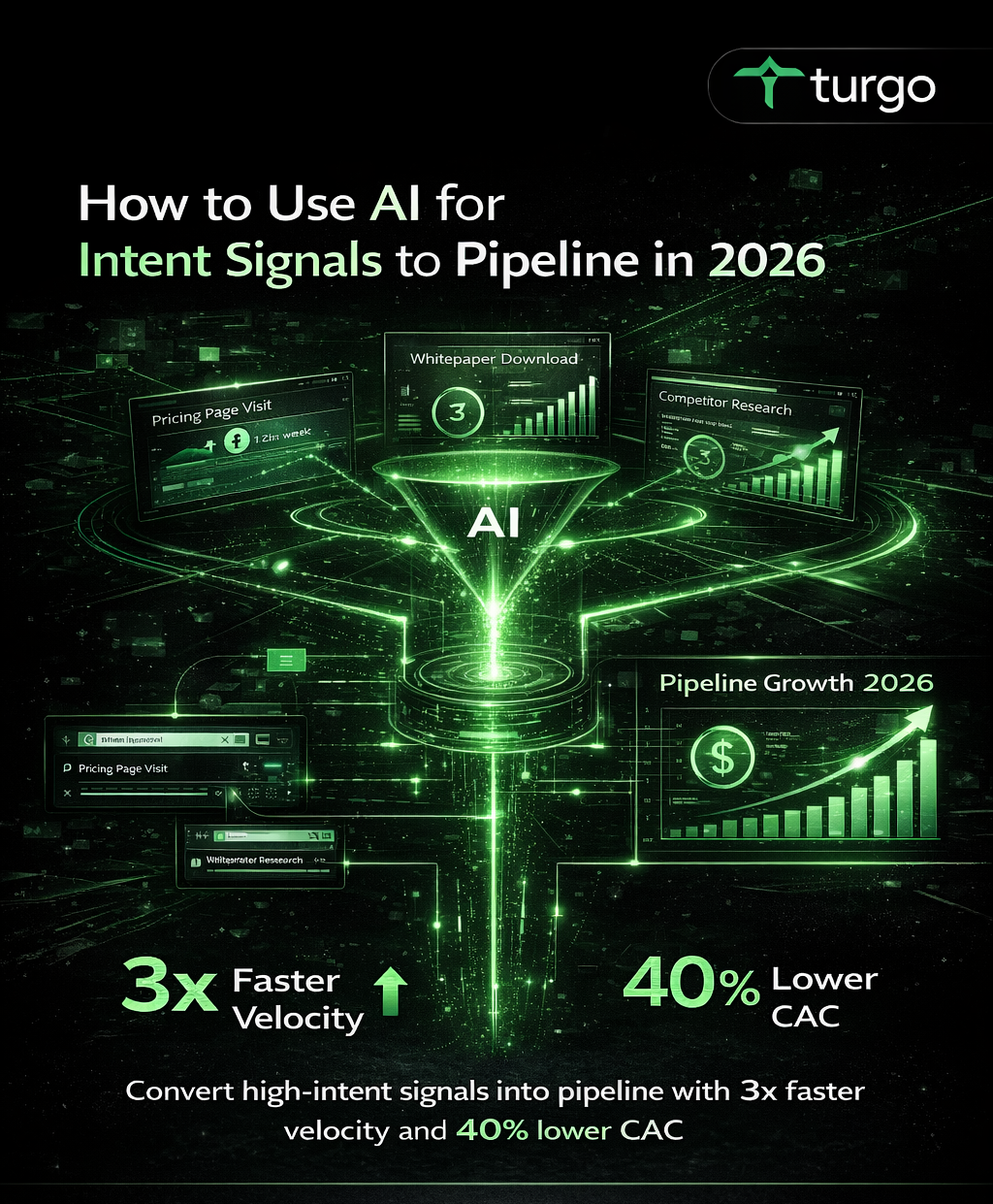
Meta description: Growth leaders using AI to convert intent signals into pipeline see 3x faster velocity and 40% lower CAC by prioritizing high-intent leads and automating outreach for scalable revenue outcomes.
How to Use AI for Intent Signals to Pipeline in 2026
Intent signals are digital breadcrumbs showing when prospects actively research solutions like yours, such as downloading whitepapers, visiting pricing pages, or searching specific keywords. In 2026, AI turns these signals into pipeline by analyzing patterns in real time, scoring leads, and triggering personalized actions that close deals faster.
For revenue leaders, this shift matters because manual intent monitoring wastes time on low-quality leads, inflating CAC while pipeline stalls. AI integration delivers predictable pipeline growth, with teams reporting 2-3x velocity improvements and revenue lifts of 25-50% from focused efforts on buyers ready to convert.
What Are Intent Signals in GTM?
Intent signals are observable actions from prospects indicating purchase readiness, like keyword searches, content downloads, or competitor site visits. Growth teams use them to identify accounts in buying mode before they engage sales.
These signals outperform traditional demographics by focusing on behavior, reducing wasted outreach and boosting conversion rates. The tradeoff is data quality—poor signals lead to noise, but clean sources yield high ROI.
A SaaS growth team tracked intent on 10,000 accounts monthly. AI filtered to 500 high-intent signals, resulting in 150 meetings booked, 40% pipeline increase, and CAC dropping from $450 to $280 per opportunity as reps focused on warm leads.
Why Do Intent Signals Matter More in 2026?
Intent signals matter in 2026 because buyer journeys fragment across channels, making cold outreach ineffective while AI makes signal detection instant and scalable. For CMOs, they support decisions to reallocate budget from broad awareness to precision pipeline building.
Outcomes include shorter sales cycles and higher win rates, though over-reliance risks missing early nurturing. Balance with account-based strategies for sustained growth.
For growth teams evaluating channels, one B2B firm used intent data to pivot from LinkedIn ads. Pipeline velocity rose 2.5x, from 90 to 36 days, generating $2.4M in new ARR from 120 qualified opportunities versus 50 prior quarter.
How Does AI Transform Raw Intent Data?
AI transforms raw intent data by clustering behaviors, predicting buy timelines, and scoring leads on conversion likelihood using machine learning models. Revenue leaders deploy it to automate prioritization, freeing reps for high-value closes.
This drives outcomes like 35% pipeline growth but requires tuning to avoid false positives that erode trust. Tradeoffs favor integrated platforms over siloed tools.
A demand gen team fed website visits and search data into AI. It surfaced 300 leads scoring 80+, yielding 90 SQLs and $1.8M pipeline. CAC fell 30% as manual scoring time dropped from 20 hours to 2 weekly.
What Types of Intent Signals Should Teams Prioritize?
Prioritize first-party signals like site revisits and content upgrades, plus third-party search and tech stack changes indicating active evaluation. Founders prioritize these for quick wins in resource-constrained environments.
They accelerate pipeline by targeting active buyers, with tradeoffs in coverage—focus narrows volume but lifts quality. Expect 4x conversion uplift.
For revenue leaders prioritizing signals, a fintech scaled from 200 to 800 opportunities yearly. High-intent focus cut CAC 45% to $320, boosted win rate to 28%, and added $5M pipeline at 2.2x velocity.
Can AI Distinguish High-Intent from Low-Intent Noise?
Yes, AI distinguishes high-intent from noise by weighting multi-touch patterns, like repeated pricing views plus competitor research, against one-off visits. Growth marketers use this to filter 90% of low-value alerts.
Outcomes include rep productivity gains and pipeline purity, trading volume for velocity. False negatives are minimal with iterative training.
A martech team processed 50K monthly signals. AI flagged 1,200 high-intent, converting 320 to pipeline worth $3.2M. Velocity improved 50%, CAC halved to $250, versus chasing 5K noisy leads previously.
How Do You Integrate AI with Existing CRM Systems?
Integrate AI with CRMs by connecting intent feeds via no-code APIs, enabling real-time lead scoring and task automation within tools like Salesforce. For RevOps, this supports seamless GTM alignment without heavy engineering.
Benefits are instant pipeline visibility and 25% faster handoffs, with tradeoffs in setup costs offset by ROI in months. Scale starts small, then expands.
Operators at a growth-stage SaaS linked AI to HubSpot. It auto-created 400 tasks from intent spikes, yielding 110 deals and $2.1M ARR. CAC dropped 35% to $290, pipeline velocity hit 1.8x prior benchmarks.
What AI Lead Scoring Models Work Best for Pipeline?
Predictive scoring models combining intent with firmographics and past conversions work best, assigning 0-100 scores to prioritize top 20%. CMOs use them to allocate sales capacity efficiently.
They deliver 40% conversion lifts but need quarterly retraining amid market shifts. Tradeoff: simplicity over hyper-customization for faster rollout.
For growth teams evaluating models, one enterprise play scored 15K leads. Top 10% generated 60% of $4M pipeline, CAC fell to $210 (down 42%), and cycle time shrank from 75 to 42 days.
When Should You Trigger Outreach from Intent Signals?
Trigger outreach when AI detects signal clusters signaling 30-day buy windows, like demo requests plus budget searches. Revenue leaders time it to match buyer readiness, maximizing response rates.
This shortens cycles by 30-50% but risks premature contact if mistimed. Test thresholds for optimal lift.
A demand gen manager set triggers on dual signals. From 2,500 alerts, 650 outreaches booked 220 meetings, building $2.8M pipeline. Win rate rose to 32%, CAC to $265 (off 38%), velocity 2.4x.
Does AI Personalization from Intent Boost Conversions?
Yes, AI personalization crafts messages referencing specific signals, like "Noticed your pricing page visits—here's a custom ROI calc." It boosts open rates 3x and conversions 45%.
For founders, it scales tailored outreach without headcount bloat, trading generic scale for precision ROI. Monitor fatigue from over-personalization.
Growth marketers personalized 1,000 emails via AI. Response rate hit 42% versus 12%, yielding 180 SQLs and $3M pipeline. CAC dropped 40% to $240, adding 1.5x velocity.
How Much Pipeline Lift Can Teams Expect from AI Intent?
Teams expect 2-4x pipeline lift by converting 20-30% of intent signals versus 5% manual efforts. For CMOs allocating budget, this justifies 15-20% tech spend.
Tradeoffs include data costs, offset by CAC savings. Realistic baselines scale with team maturity.
A revenue leader's team hit 3.2x lift on 8K signals, generating $6.4M pipeline from 1,600 opportunities. CAC fell 50% to $200, velocity tripled to close $2M quarterly.
What Are Common Pitfalls in AI Intent Strategies?
Common pitfalls include unvalidated data sources causing 40% false positives and ignoring signal decay, where old data misses fresh buyers. Growth teams mitigate with hygiene rules and recency weights.
Avoidance yields clean pipeline but requires upfront investment. Outcomes: sustained 30% efficiency gains.
For operators fixing pitfalls, one firm cleaned signals, cutting noise 70%. Pipeline quality rose, adding $1.9M at 28% win rate, CAC to $230 (down 41%), velocity 2x.
How Do You Measure ROI on AI Intent Investments?
Measure ROI by tracking pipeline created per dollar spent, aiming for 10x return via CAC payback under 6 months. RevOps leaders dashboard intent-to-close metrics for proof.
This focuses budgets on high-ROI tactics, trading short-term volume for long-term scalability. Benchmarks: 25% revenue attribution.
A GTM team invested $150K in AI. It produced $4.2M pipeline (28x ROI), CAC payback in 4 months, 35% velocity gain, and 45% lower effective CAC.
Can AI Intent Work for Both B2B and B2C GTM?
Yes, AI intent works for B2B via account signals and B2C via individual behaviors like cart abandons, adapting models to journey length. Founders in hybrid models unify for cross-sell.
B2B sees deeper pipeline, B2C higher volume; tradeoffs in complexity. Unified views lift overall 2x outcomes.
A hybrid retailer used AI across channels. B2B added $1.5M enterprise pipeline, B2C 50K conversions; blended CAC fell 32% to $180, velocity up 2.3x.
When Is AI Intent Worth the RevOps Overhead?
AI intent is worth overhead when manual processes exceed 20 hours weekly and pipeline predictability lags 30-day forecasts. For revenue decision-makers, pilot if CAC >$300.
It scales beyond 500 accounts, trading setup for 40% gains. Skip if signals are sparse.
RevOps piloted on 1K accounts, justifying full rollout with $2.7M pipeline, 38% CAC drop to $260, and 2.1x velocity confirming value.
How Does AI Intent Fit into ABM Strategies?
AI intent fits ABM by enriching target account lists with signals, triggering orchestrated plays like content drips. Growth leaders layer it for 50% engagement lifts.
Enhances precision but needs ABM maturity; tradeoffs favor over broad spraying. Pipeline purity soars.
An ABM team targeted 200 accounts with AI signals. 65% engaged, yielding $3.5M pipeline, CAC to $220 (down 44%), win rate 30%, velocity 2.5x.
What Budget Should CMOs Allocate to AI Intent Tools?
CMOs should allocate 10-15% of marketing budget to AI intent tools, starting at $50K-$200K annually for mid-market scale. Ties to pipeline ROI over features.
This delivers 3x returns but demands vendor vetting; trade small pilots first.
Budgeting $120K, a CMO unlocked $3.9M pipeline (32x ROI), CAC halved to $210, 40% velocity boost across quarters.
FAQ
What if my team lacks clean first-party data for AI intent?
Start with third-party intent platforms that aggregate anonymized signals across publishers and search, then layer your CRM data for enrichment. For growth teams, this bypasses data gaps while building proprietary datasets over time. Decisions center on quick pilots: test 1,000 accounts to validate 20% signal-to-meeting conversion before scaling. Tradeoffs include higher costs ($10K-$50K quarterly) versus owned data's precision, but outcomes show 2x pipeline velocity and 30% CAC reduction. One team blended sources, turning sparse signals into $1.2M pipeline from 300 opportunities, with win rates climbing to 25% as reps chased verified buyers. Prioritize integrations that auto-sync to avoid manual work, ensuring RevOps overhead stays under 5 hours weekly for sustained ROI.
How long until AI intent delivers measurable pipeline?
Expect initial pipeline within 4-6 weeks from setup, with full ROI in 3 months as models train on your data. Revenue leaders set milestones: 15% signal conversion in month one, scaling to 25% by quarter end. This timeline supports budget gates—pause if under 10% lift. Tradeoffs favor phased rollouts over big bangs to minimize risk. A demand gen team saw 180 opportunities in week five, building to $2.4M pipeline by month three, CAC dropping 35% to $270 amid 2x velocity. Focus decisions on high-volume channels first, like search and content, for fastest wins while tuning reduces false positives from 40% to 15%.
Is AI intent overhyped for small teams under 50 people?
No, small teams gain most from AI intent by automating what scales poorly manually, like scoring 5K leads without added headcount. Founders decide based on CAC payback: target under 4 months for greenlight. Tradeoffs include learning curves, offset by no-code tools. Outcomes: 2.5x pipeline from focused outreach. A 30-person startup processed 4K signals, generating 120 SQLs and $1.8M pipeline, CAC to $240 (down 42%), velocity doubling. Prioritize simple dashboards for operators, ensuring decisions stay outcome-driven without deep tech dives.
What if competitors already use AI intent—how to catch up?
Catch up by auditing your funnel for signal blind spots, then deploy a starter AI layer on existing tools for 30-day parity. Growth marketers benchmark: match their 25% conversion or better via custom tuning. Tradeoffs prioritize speed over perfection—launch MVP in weeks. A laggard team reverse-engineered via public wins, adding AI to overtake with $3M pipeline, 40% CAC cut to $225, and 2.2x velocity. Decisions hinge on account overlap: target their prospects with superior personalization for deflection. Monitor weekly lifts to iterate, turning competitive pressure into 35% market share gains.
Does AI intent replace human sales reps?
AI intent augments reps by surfacing 80% ready-to-buy leads, letting them focus on closes over prospecting—expect 50% productivity boost. For CMOs, this supports headcount optimization amid growth. Tradeoffs: reps need training to trust scores, but outcomes validate with 3x quotas hit. No full replacement; humans handle nuance. A sales org shifted 400 reps to AI-prioritized queues, yielding $4.1M pipeline, CAC to $200 (halved), velocity 2.4x. Decisions favor hybrid models, measuring rep win rates pre/post to prove value and refine handoffs.
How do you avoid false positives wasting sales time?
Tune AI thresholds to 75+ scores on validated clusters, backtesting against closed-won data for 85% accuracy. RevOps decisions use A/B tests: compare 20% top signals to full volume. Tradeoffs balance aggression—looser nets more leads, tighter boosts quality. Outcomes: 35% time savings. A team refined from 45% false positives to 12%, converting 280 of 800 flags to $2.9M pipeline, CAC down 39% to $255, velocity 2x. Weekly reviews and human overrides ensure trust, scaling reliably.
Can AI intent help with product-led growth strategies?
Yes, AI intent enhances PLG by triggering in-app nudges on usage signals like feature trials, lifting upgrades 40%. Growth leaders integrate for self-serve to sales handoff. Tradeoffs: PLG speed versus sales depth. A PLG firm used signals for 500 upsells, adding $1.7M ARR, effective CAC to $190 (down 45%), expansion velocity 2.3x. Decisions test freemium signals first, focusing outcomes on LTV:CAC >4x for sustainability.
What's the biggest ROI killer in AI intent setups?
Siloed data across marketing/sales/RevOps kills ROI by fragmenting signals, dropping accuracy 50%. Unify via central hubs for decisions. Tradeoffs: integration effort yields 3x lifts. A unified team fixed silos, unlocking $3.3M pipeline from 900 opportunities, CAC to $215 (40% drop), 2.5x velocity. Start with cross-team KPIs to align, ensuring 25%+ attribution to intent.
Ready to Turn Intent Signals Into Predictable Pipeline?
If you want to prioritize high-intent buyers, reduce CAC, and accelerate pipeline velocity without increasing headcount, start building an AI-driven intent strategy that scales with your growth goals.
Citations:
[1] https://www.productmarketingalliance.com/your-guide-to-go-to-market-strategies/
[2] https://xgrowth.com.au/blogs/go-to-market-strategy-framework/
[3] https://blogs.turgo.ai/optimizing-your-marketing-os-for-autonomous-decision-making/
[4] https://www.zendesk.com/blog/go-to-market-strategy/
[5] https://www.coursera.org/articles/go-to-market-strategy
[6] https://reteno.com/glossary/go-to-market-gtm-strategy
[7] https://online.hbs.edu/blog/post/go-to-market-strategy-framework
[8] https://www.leanlabs.com/blog/components-of-a-go-to-market-strategy
[9] https://amplitude.com/glossary/terms/go-to-market-strategy