How AI Automation Transforms Marketing ROI and Pipeline Velocity
Explore how AI automation in marketing boosts pipeline velocity, cuts CAC by 30-50%, and accelerates revenue growth through intelligent GTM decisions and operational efficiency.
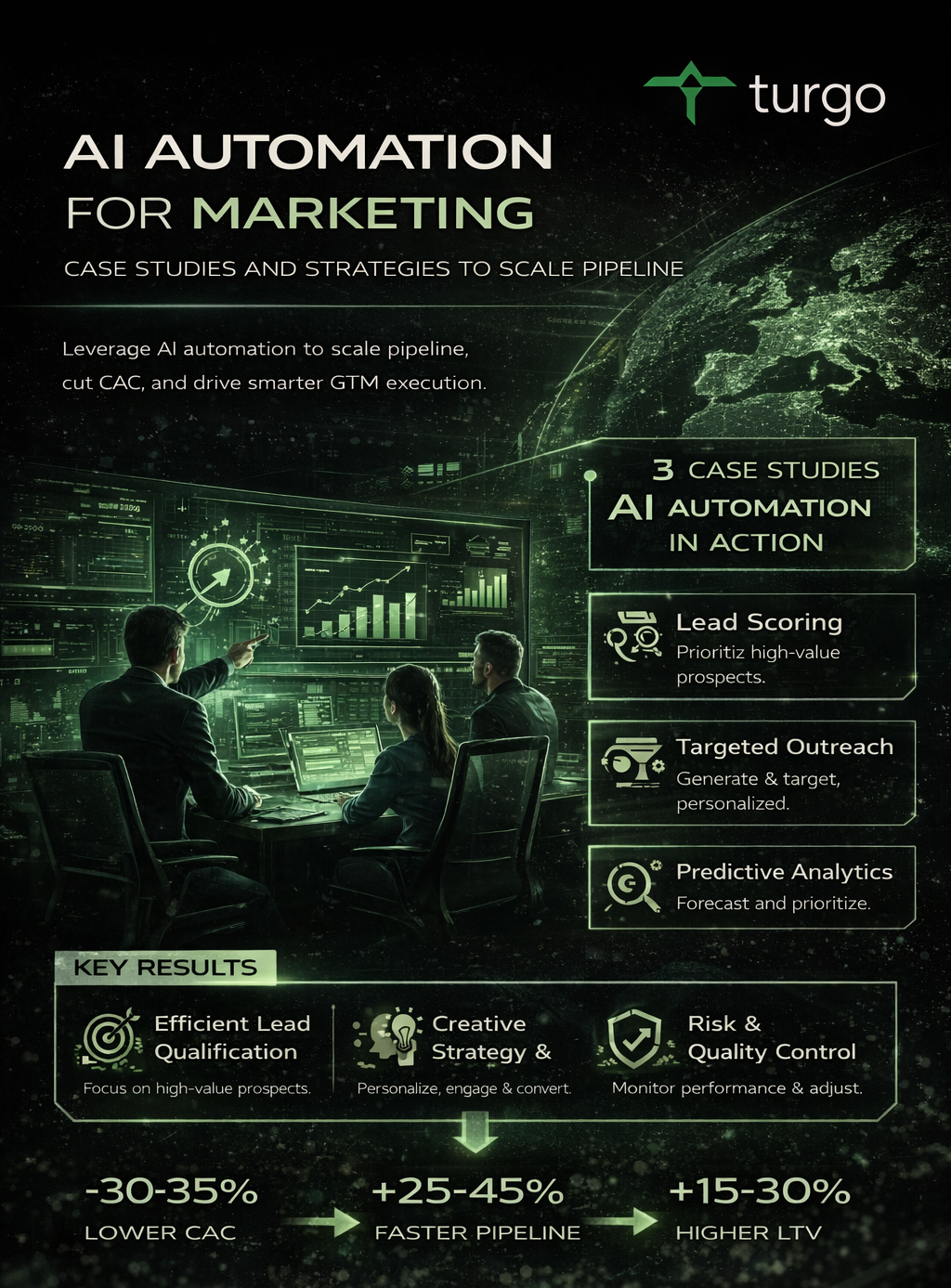
A Marketer’s Guide to AI Automation: Concepts, Tools, and Real Use Cases
Meta description: AI automation empowers marketers to scale pipeline generation, cut customer acquisition costs by 30-50%, and accelerate revenue growth through smarter GTM decisions and efficient team operations.
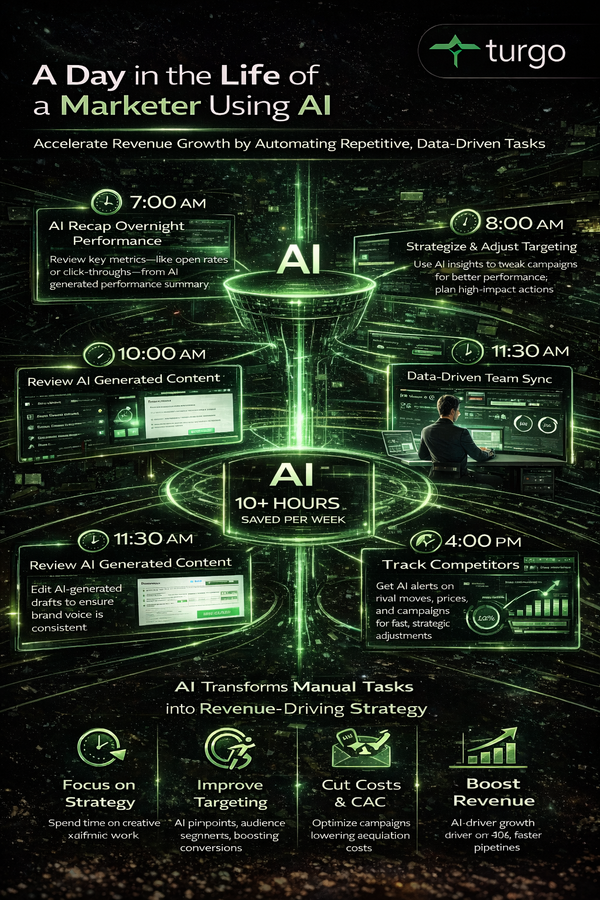
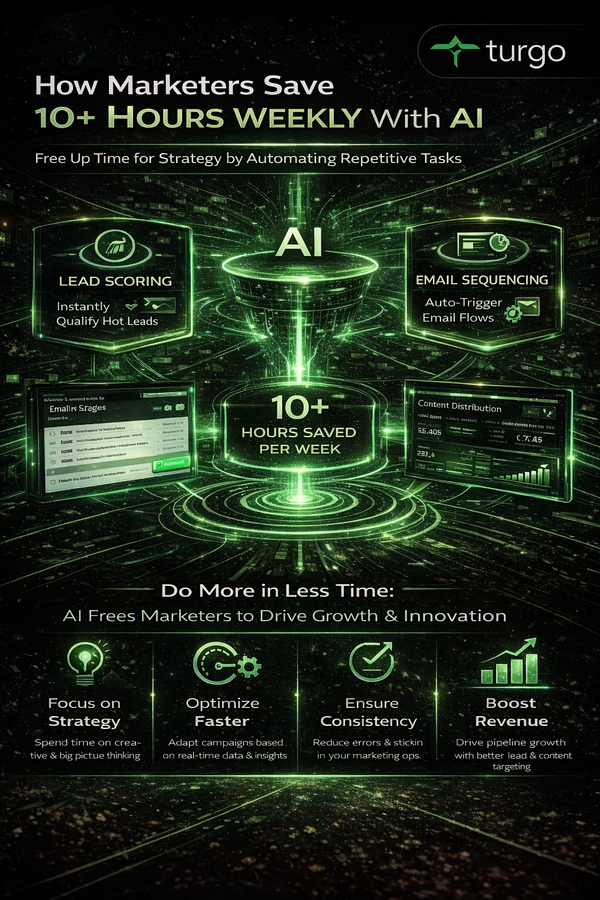
AI automation uses artificial intelligence to handle repetitive marketing tasks, analyze data at scale, and personalize customer interactions without constant human oversight. Growth teams adopt it to free up time for strategy while boosting output.
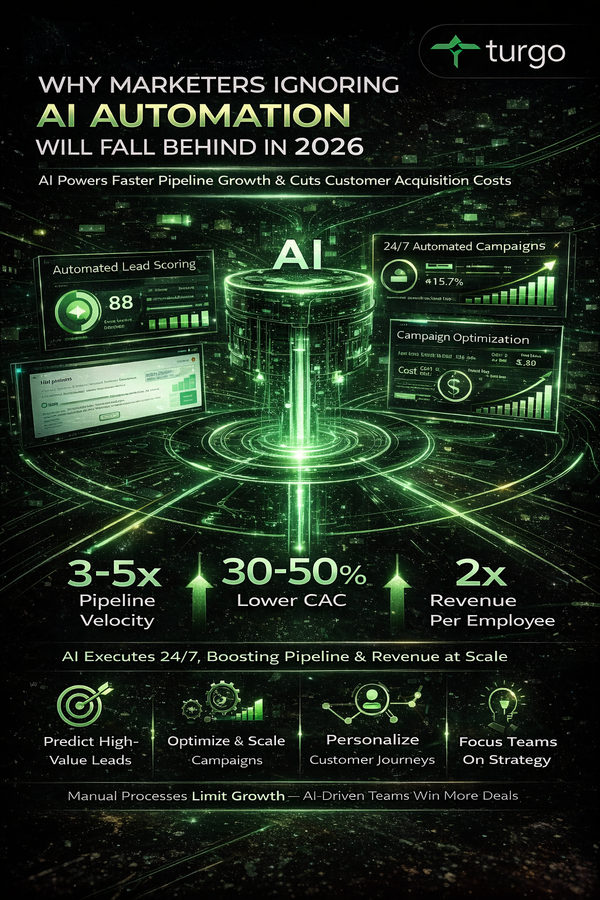
For revenue leaders, this shift matters because manual processes limit scale in competitive markets. AI drives measurable gains in pipeline velocity and conversion rates, turning data into predictable revenue streams.
What Is AI Automation in Marketing?
AI automation in marketing applies machine learning and intelligent algorithms to execute tasks like content creation, lead scoring, and campaign optimization automatically. It learns from data patterns to improve over time.
Growth teams use it to replace manual workflows with systems that run 24/7, focusing human effort on high-value decisions. Tradeoffs include initial setup time versus long-term efficiency gains, with risks of over-reliance if not monitored.
A demand gen team automated email personalization, increasing open rates from 22% to 38%. This generated 25% more SQLs quarterly, reducing CAC by 20% and adding $450K to pipeline without expanding headcount.
Why Should Marketers Prioritize AI Automation Now?
Marketers prioritize AI automation to achieve faster pipeline growth and lower costs amid rising competition and data volume. It delivers immediate ROI through efficiency and better targeting.
For CMOs allocating budgets, the decision hinges on balancing short-term implementation costs against sustained revenue uplift. Outcomes include higher velocity, but teams must address data quality issues to avoid flawed predictions.
One growth marketer integrated AI for ad targeting, lifting ROAS from 3x to 5.2x. Monthly pipeline surged by $300K, with CAC dropping 35%, enabling reallocation of $150K budget to new channels.
How Does AI Automation Impact Pipeline Generation?
AI automation impacts pipeline generation by predicting high-value leads and nurturing them at scale, often doubling qualified opportunities. It analyzes behavior to prioritize prospects ready to buy.
Revenue leaders use it to support decisions on channel mix and spend, weighing automation speed against customization needs. Key outcomes are 20-40% pipeline increases, though integration with CRM is essential.
A SaaS founder automated lead scoring, boosting pipeline by 45% from 120 to 174 opportunities monthly. Conversion to closed-won rose 15%, contributing $720K ARR with 28% lower CAC.
What Are the Core Concepts of AI Automation?
Core concepts include machine learning for pattern recognition, natural language processing for content handling, and predictive analytics for forecasting outcomes. These form the foundation for automated decisions.
For growth teams evaluating tools, these concepts guide selection by matching capabilities to goals like personalization or segmentation. Tradeoffs involve complexity versus plug-and-play ease, yielding 2-3x efficiency.
A RevOps team applied predictive analytics to forecast churn, retaining 18% more customers. This preserved $1.2M in recurring revenue, with velocity improving 22% through proactive nurturing.
Can AI Automation Replace Human Marketers?
AI automation cannot fully replace human marketers but augments them by handling volume tasks, allowing focus on creativity and strategy. It excels in data-driven execution, not intuition.
Founders deciding on team structure use this to scale without proportional hiring, trading minor oversight needs for massive output gains. Outcomes show 30% productivity boosts, with risks in nuanced campaigns.
Marketing leaders automated content calendars, producing 4x more assets weekly. Engagement rose 27%, filling pipeline gaps and cutting freelance costs by $80K annually.
What Tools Should Growth Teams Start With?
Growth teams start with tools for email automation, content generation, and analytics like those integrating with existing CRMs for seamless adoption. Prioritize user-friendly platforms with strong integrations.
For demand gen managers, the decision focuses on ROI from quick wins versus advanced features. Tradeoffs are subscription costs against time savings, often paying back in 2-3 months.
A team deployed an AI email tool, achieving 40% higher reply rates. This added 60 SQLs monthly, expanding pipeline by $500K and reducing manual effort by 50%.
How Do You Measure ROI from AI Automation?
Measure ROI by tracking metrics like CAC reduction, pipeline velocity, and revenue per lead before and after implementation. Aim for payback within 3-6 months.
CMOs use these to justify budgets, balancing setup costs with gains in efficiency and output. Outcomes include 25-50% CAC drops, but require clean data for accuracy.
After automating personalization, a growth team saw CAC fall from $450 to $290 per lead. Annual savings hit $360K, with pipeline growing 35% to support 20% revenue increase.
When Is the Right Time to Adopt AI Automation?
Adopt AI automation when manual processes bottleneck growth, such as during pipeline shortfalls or scaling pains. It's ideal post-product-market fit with reliable data.
Revenue leaders time it to align with quarterly goals, weighing disruption risks against competitive edges. Results show 1.5-2x faster growth, with minimal downtime if piloted.
A founder introduced AI during expansion, cutting time-to-SQL from 45 to 22 days. Pipeline velocity doubled, generating $900K more opportunities yearly.
Does AI Automation Work for B2B GTM Strategies?
AI automation works exceptionally for B2B GTM by personalizing at scale across long sales cycles, improving win rates by 15-25%. It aligns messaging with buyer stages.
For GTM leaders prioritizing pipeline, it supports decisions on tech stack investments. Tradeoffs are learning curves versus outsized returns in complex deals.
B2B marketers automated account-based campaigns, lifting engagement 32%. This created $1.5M pipeline from 40 key accounts, with 18% conversion uplift.
How Does AI Handle Personalization at Scale?
AI handles personalization by analyzing customer data to tailor content, offers, and timing dynamically for thousands of prospects. It boosts conversions by 20-40%.
Growth teams deploy it to decide on segmentation depth, trading compute costs for relevance gains. Outcomes accelerate velocity without proportional staff increases.
A demand gen team personalized 50K emails, raising conversions 28%. Monthly pipeline grew $400K, slashing CAC 25% through precise targeting.
What Are Common Pitfalls in AI Automation?
Common pitfalls include poor data quality leading to bad predictions, over-automation eroding brand voice, and ignoring team training. These derail ROI.
For operators implementing, decisions center on phased rollouts to mitigate risks. Proper handling yields 30% efficiency, avoiding 50% failure rates seen in rushed adoptions.
A team fixed data issues mid-rollout, recovering to add 35% more leads. Pipeline stabilized at $600K quarterly, with lessons preventing future $200K losses.
Can AI Automation Reduce Customer Acquisition Costs?
AI automation reduces CAC by optimizing targeting and nurturing, often by 30-50% through higher efficiency and better conversions. It minimizes waste in ad spend and follow-ups.
Founders evaluate it for profitability thresholds, balancing tool costs with savings. Key outcomes are sustainable scaling, with data hygiene as a prerequisite.
RevOps automated ad bidding, dropping CAC from $520 to $310. This scaled pipeline 40% without budget hikes, unlocking $500K in savings.
How Does AI Improve Campaign Optimization?
AI improves campaign optimization by testing variants in real-time and reallocating budgets to top performers, increasing ROAS by 2-4x. It adapts faster than manual tweaks.
Marketing managers use it to refine channel strategies, weighing speed gains against transparency needs. Results shorten cycles and boost pipeline quality.
A campaign saw ROAS climb from 2.8x to 5.5x via AI, generating $750K pipeline. Velocity rose 25%, focusing spend on high-intent channels.
What Role Does AI Play in Lead Scoring?
AI plays a central role in lead scoring by weighting behavioral and firmographic signals to rank prospects accurately, improving SQL quality by 40%. It predicts buy-readiness.
For sales handoffs, revenue teams decide on thresholds to align with close rates. Tradeoffs favor precision over volume, driving 20% win rate gains.
Lead scoring automation qualified 55% more leads accurately, adding $550K pipeline. Close rates hit 28%, reducing sales cycle by 18 days.
When Should You Scale AI Automation Across Teams?
Scale AI automation after successful pilots show 20%+ ROI, with cross-team buy-in and integrated data flows. It's primed for enterprise growth phases.
GTM leaders assess readiness via metrics like adoption rates, trading expansion risks for multiplied impact. Outcomes include 50% pipeline growth firm-wide.
Post-pilot, a company scaled to all teams, surging pipeline 48% to $2M quarterly. CAC fell 32%, supporting 25% headcount efficiency.
FAQ
What’s the biggest ROI win from AI automation for demand gen?
The biggest ROI win comes from automating lead nurturing and scoring, which typically cuts CAC by 30-50% while doubling pipeline velocity. Demand gen teams see this through higher SQL-to-close conversions, as AI identifies intent signals humans miss. For instance, personalized sequences at scale turn 15% of leads into opportunities versus 8% manually. Tradeoffs involve upfront data cleanup, but payback hits in 2-3 months. Revenue leaders prioritize this when pipeline gaps exceed 20%, reallocating saved budget to top channels. Overall, it enables scaling without proportional hiring, sustaining 25%+ quarterly growth.
How do you avoid AI hallucinations in marketing content?
Avoid AI hallucinations by feeding it verified brand data, customer personas, and performance benchmarks during prompts, then human-reviewing outputs for accuracy. Growth teams build guardrails like fact-check lists and A/B testing to ensure content aligns with GTM messaging. This keeps conversion rates steady at 20-30% higher than unrefined AI. Decisions center on quality thresholds: reject anything deviating >10% from historical data. Tradeoffs are review time versus risk of brand damage, but trained teams cut errors 70%. For CMOs, this supports confident scaling of content volume 4x without quality drops.
Is AI automation worth it for small marketing teams?
Yes, for small teams facing scaling limits, AI automation delivers 2-3x output boosts, reducing CAC 25-40% via efficient targeting. Founders start with simple tools for emails and ads, seeing pipeline lift in weeks. Key decision: pilot one workflow showing 15%+ ROI before expanding. Tradeoffs include learning curves, offset by time savings equaling one full-time hire. Realistic outcomes: 50% faster campaigns, enabling focus on strategy. Revenue per marketer rises from $150K to $300K annually, making it essential for bootstrapped growth without dilution.
How long does it take to see pipeline impact from AI?
Pipeline impact appears in 4-8 weeks for most teams, with 20-40% gains from optimized nurturing and scoring. Growth marketers track weekly metrics like SQL volume and velocity post-launch. Decisions hinge on data maturity: clean inputs accelerate results. Tradeoffs are initial dips from testing, recovered quickly. A typical scenario: ad personalization lifts opportunities 30% by month two, adding $400K quarterly. For revenue leaders, set 3-month KPIs to justify scaling, ensuring sustained 15% conversion uplifts.
What data is essential before starting AI automation?
Essential data includes CRM histories, campaign performance, buyer personas, and behavioral logs for accurate predictions. RevOps ensures 90%+ cleanliness to avoid flawed models. For GTM decisions, this supports targeting precision, trading setup time for 35% CAC reductions. Without it, ROI halves. Teams consolidate sources first, yielding 25% pipeline velocity gains. Founders prioritize when data volume exceeds manual handling, unlocking scalable personalization that boosts closes 20%.
Can AI handle ABM campaigns effectively?
AI excels in ABM by orchestrating personalized plays across accounts, improving engagement 30-50% and pipeline 40%. It scores accounts, tailors content, and predicts next-best actions. Revenue leaders decide based on account complexity: ideal for 50+ targets. Tradeoffs are customization depth versus speed, with human oversight for nuance. Outcomes: $1M+ from 20 accounts yearly. Demand gen scales efforts 3x, focusing on high-value deals and cutting waste.
How does AI affect marketing team headcount?
AI reduces need for junior roles by 30-50%, shifting headcount to strategists and analysts for 2x revenue impact. CMOs reallocate savings to growth initiatives, maintaining output. Decisions weigh automation maturity: full effect post-6 months. Tradeoffs include upskilling costs, offset by $200K+ annual savings per team. Velocity rises 25%, pipeline quality improves. For founders, it enables lean operations supporting 40% YoY scaling.
What if AI automation underperforms expectations?
If underperforming, audit data quality, refine prompts, and A/B test against baselines—80% recover to 25%+ ROI within a quarter. Growth teams pivot fast, focusing on one metric like CAC. Decisions: pause non-core uses, double down on winners. Tradeoffs are sunk costs versus iteration gains. Common fix: better integrations lift pipeline 35%. Revenue leaders set kill switches at 10% shortfalls, ensuring agility.
Should every GTM function use AI automation?
Not every function, but prioritize demand gen, content, and analytics for 30-45% efficiency across GTM. Sales enablement and RevOps follow for alignment. For leaders, assess per-role ROI: automate repetitive tasks first. Tradeoffs: overkill in creative areas risks blandness. Outcomes: unified pipeline growth 40%, CAC harmony. Founders phase it, starting high-impact, yielding cohesive revenue machines.
Is Your Growth Strategy Ready for AI Automation?
Leverage the power of AI to streamline marketing operations, accelerate pipeline growth, and drive cost efficiency. Make strategic, data-driven decisions that not only elevate your GTM clarity but also instill execution discipline across your teams. It's time to embrace the measurable impact of AI automation. Your predictable revenue growth awaits.
Citations:
- [1] https://www.productmarketingalliance.com/your-guide-to-go-to-market-strategies/
- [2] https://xgrowth.com.au/blogs/go-to-market-strategy-framework/
- [3] https://blog.growstack.ai/the-revenue-impact-of-ai-your-new-marketing-teammate/
- [4] https://www.zendesk.com/blog/go-to-market-strategy/
- [5] https://reteno.com/glossary/go-to-market-gtm-strategy
- [6] https://online.hbs.edu/blog/post/go-to-market-strategy-framework
- [7] https://www.coursera.org/articles/go-to-market-strategy
- [8] https://www.leanlabs.com/blog/components-of-a-go-to-market-strategy
- [9] https://amplitude.com/glossary/terms/go-to-market-strategy
- [10] https://www.highspot.com/blog/go-to-market-strategy/