How AI Automation Shapes Revenue Outcomes for Marketers
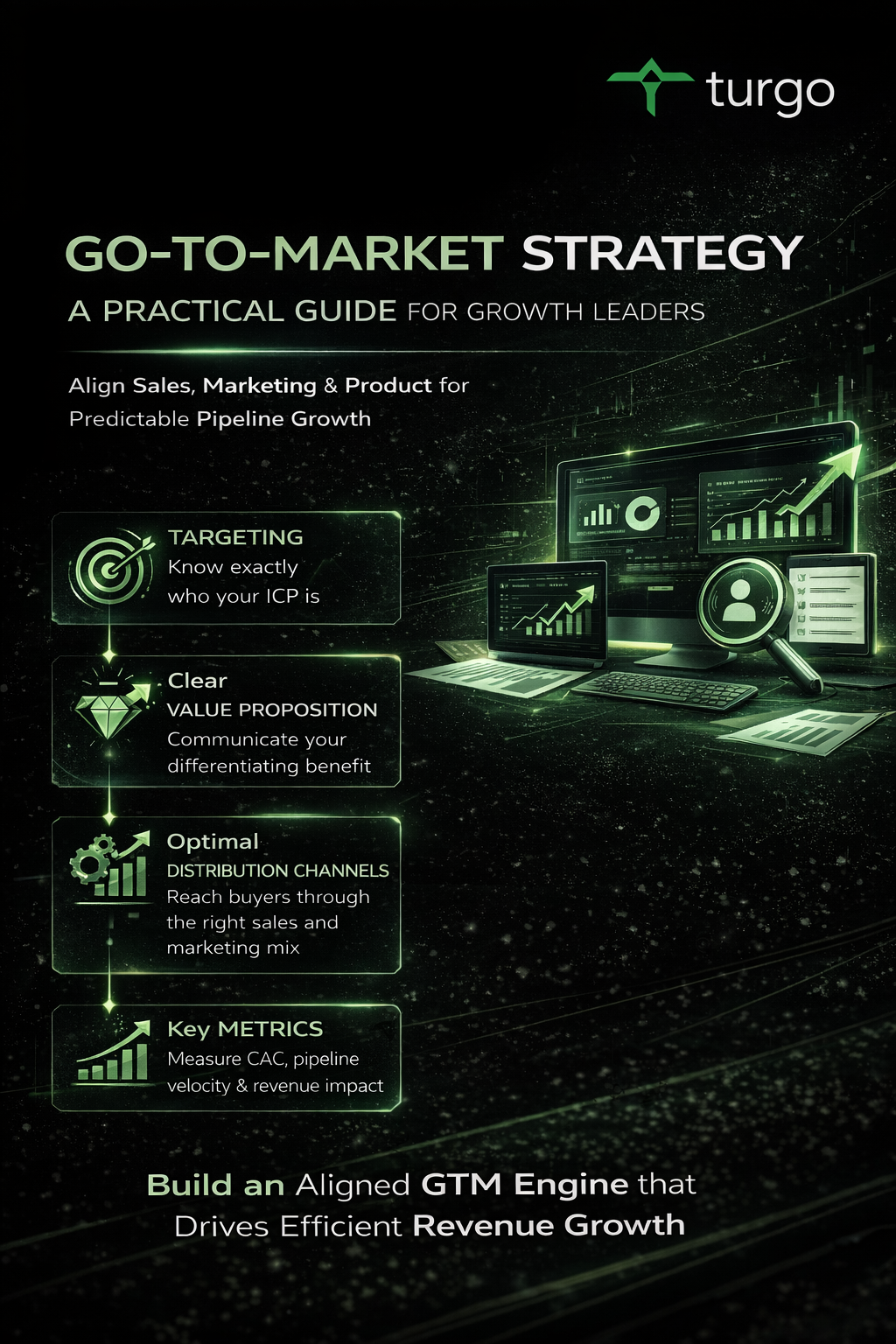
Discover how a well-constructed go-to-market strategy can align sales, marketing, and product teams, accelerate revenue velocity, and fuel predictable pipeline growth in a competitive B2B landscape.
AI Marketing Automation Guide for Growth Teams
Discover how AI marketing automation streamlines campaigns, cuts CAC by 30%, and boosts pipeline velocity to drive scalable revenue growth for CMOs and founders.
AI marketing automation uses artificial intelligence to handle repetitive marketing tasks like email personalization, content generation, and lead scoring without constant human input. It learns from data patterns to predict customer behavior and optimize campaigns in real time.
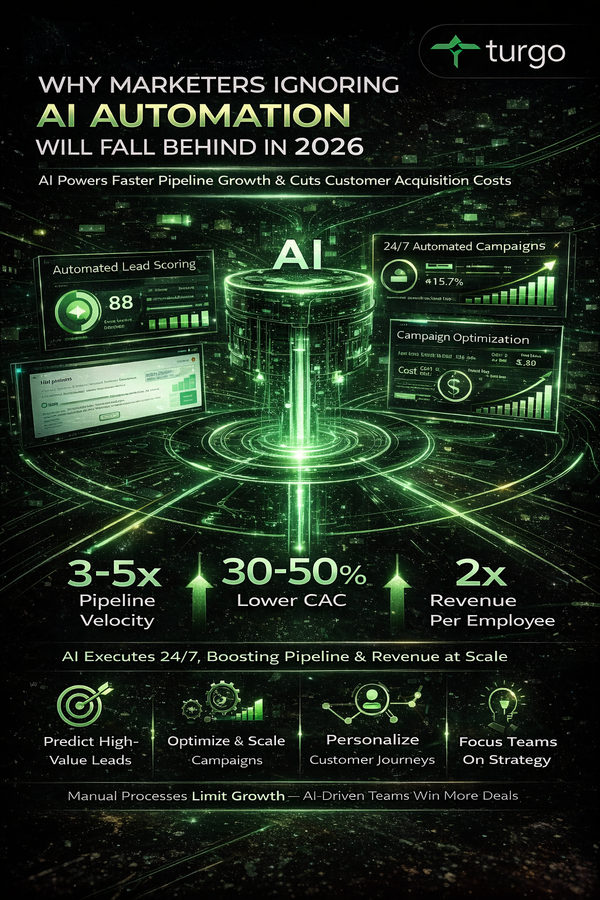
For revenue leaders, this matters because manual processes slow pipeline growth and inflate costs in competitive markets. AI automation accelerates deal velocity, improves conversion rates, and scales efforts across channels, directly impacting revenue outcomes.
What Is AI Marketing Automation?
AI marketing automation is software that applies machine learning to automate and enhance marketing workflows, from lead nurturing to ad optimization. It processes vast datasets to make decisions faster than humans, focusing on high-impact activities.
Growth teams use it to shift from tactical execution to strategic oversight, reducing time spent on routine tasks by up to 50%. The tradeoff is initial setup time versus long-term efficiency gains, with outcomes like lower customer acquisition costs (CAC) and higher ROI on ad spend.
Consider a demand gen team running 10 campaigns monthly. Before AI, they spent 40 hours weekly on segmentation and A/B testing, yielding 200 SQLs at $150 CAC. After implementing AI automation, hours dropped to 15, SQLs rose to 350, and CAC fell to $95, adding $200K in pipeline value quarterly.
Why Should Growth Marketers Adopt AI Automation Now?
Growth marketers adopt AI automation to stay competitive as buyer expectations shift toward personalized, timely experiences across channels. It directly supports decisions on budget allocation by proving measurable lifts in pipeline and revenue.
The key tradeoff is balancing automation speed with human creativity; over-reliance risks generic messaging, but proper integration amplifies both. Outcomes include 20-40% faster campaign cycles and improved attribution accuracy.
A SaaS founder with a $2M annual marketing budget tested AI on email nurturing. Manual efforts generated 15% open rates and 3% conversions, building $500K pipeline yearly. AI personalization boosted opens to 28% and conversions to 6%, expanding pipeline to $1.2M while cutting manual review time by 60%.
How Does AI Marketing Automation Impact Pipeline Growth?
AI marketing automation impacts pipeline growth by automating lead scoring and nurturing, prioritizing high-intent prospects for sales handover. This supports decisions on scaling lead volume without proportional headcount increases.
Tradeoffs involve data quality requirements; poor inputs lead to flawed predictions, but clean data yields precise targeting. Results show 25-50% pipeline increases through better velocity and qualification.
For a growth marketer at a B2B tech firm, manual lead routing created bottlenecks, with 40% of leads going cold and pipeline at $3M quarterly. AI scoring automated prioritization, warming 70% more leads and lifting pipeline to $4.8M, with sales cycle shortening from 90 to 65 days.
What Are the Core Components of AI Marketing Automation?
Core components include predictive analytics for lead scoring, dynamic content personalization, and multi-channel orchestration. Revenue leaders use these to align marketing with sales for cohesive GTM execution.
Tradeoffs pit upfront integration costs against ongoing savings; modular tools allow phased adoption. Outcomes feature 30% CAC reductions and 15-25% conversion uplifts.
A CMO overseeing a $10M demand gen budget integrated AI components into their stack. Previously, disjointed tools yielded $250 CAC and 10% conversion. Unified AI dropped CAC to $175, conversions to 14%, generating $5M additional pipeline in six months.
How Do You Choose the Right AI Tools for Marketing?
Choose AI tools by matching capabilities to specific goals like content creation or ad optimization, prioritizing ease of integration and ROI metrics. For growth teams evaluating options, focus on pipeline impact over feature count.
Tradeoffs include vendor lock-in versus flexibility; start with platforms offering APIs for scalability. Expect 2-3x ROI within quarters through efficiency.
A demand gen manager piloted three tools for a mid-market SaaS. Tool A automated emails, cutting manual work 40% but adding only $100K pipeline. Tool B's predictive scoring built $750K pipeline at 25% lower CAC, becoming the choice and scaling to $3M annual impact.
Can AI Replace Marketing Roles?
AI cannot fully replace marketing roles but augments them by handling data-heavy tasks, freeing strategists for high-value work like GTM planning. For CMOs allocating budget, this supports headcount optimization without losing creativity.
The tradeoff is skill shifts; teams must upskill in AI oversight, yielding higher output per person. Outcomes include 20-35% productivity gains and sustained innovation.
A revenue leader at a scaling startup reduced junior analyst headcount by 30% via AI analytics, redirecting savings to senior strategists. Pipeline grew 45% from $4M to $5.8M quarterly, with team velocity up 50% as focus shifted to revenue-driving decisions.
What Is AI for Content Creation in Marketing?
AI for content creation generates drafts, optimizes headlines, and personalizes assets using natural language models trained on marketing data. It enables demand gen teams to produce volume without quality loss.
Tradeoffs balance speed with editing needs; AI outputs require human refinement for brand voice. Results show 40% faster production and 15% engagement lifts.
For a growth marketer producing 50 assets monthly, manual creation took 80 hours at $120K annual cost, driving 5K leads. AI cut time to 35 hours, costs to $55K, and leads to 8.2K, boosting pipeline by $900K yearly.
How Does AI Improve Lead Scoring Accuracy?
AI improves lead scoring by analyzing behavioral data, firmographics, and intent signals to assign dynamic scores. This helps sales teams focus on prospects with 3x higher close rates.
Tradeoffs involve model training time versus immediate use; hybrid human-AI scoring bridges gaps. Outcomes feature 30% faster sales cycles and 25% win rate increases.
A B2B founder with erratic scoring saw 25% of pipeline wasted on low-fit leads, totaling $1M lost quarterly. AI implementation raised accuracy to 85%, recovering $1.5M pipeline and dropping time-to-close from 75 to 52 days.
When Should You Integrate AI into Existing Marketing Stacks?
Integrate AI when manual processes exceed 30% of team capacity or CAC rises above benchmarks. For revenue leaders prioritizing pipeline, assess during quarterly reviews.
Tradeoffs include disruption risks; pilot on one channel first. Expect 20-40% efficiency gains post-integration.
A CMO at an enterprise firm faced $300 CAC from siloed tools. Integrating AI into CRM during Q3 planning reduced CAC to $210, accelerated pipeline velocity 35%, and added $2.2M in qualified opportunities within a year.
Does AI Marketing Automation Reduce Customer Acquisition Costs?
AI marketing automation reduces CAC by optimizing ad bids, personalizing journeys, and automating low-value tasks. Growth teams see 25-40% drops through precise targeting.
Tradeoffs require quality data; garbage inputs inflate costs short-term. Long-term outcomes include scalable growth at lower unit economics.
Consider operators managing $5M ad spend: manual targeting hit $180 CAC with 12% ROI. AI automation refined audiences, slashing CAC to $115 and lifting ROI to 22%, freeing $1.1M for reinvestment and doubling pipeline.
What Are Common Pitfalls in AI Marketing Automation?
Common pitfalls include over-automation without human oversight, leading to off-brand messaging, and ignoring data privacy. For founders, mitigate by starting small and monitoring KPIs.
Tradeoffs favor iterative rollout over big bang; this ensures alignment. Avoided pitfalls yield 15-30% better outcomes.
A demand gen team automated fully without checks, causing 20% unsubscribe spikes and $400K pipeline loss. Phased approach recovered losses, stabilized at 5% unsubscribes, and grew pipeline 28% to $3.5M quarterly.
How Can AI Personalize Customer Journeys at Scale?
AI personalizes journeys by segmenting users in real time based on behavior and predicting next-best actions. This supports GTM decisions for higher conversion across funnels.
Tradeoffs pit complexity against simplicity; focus on 3-5 key triggers. Results include 20-50% engagement boosts.
RevOps at a growth-stage company manually segmented, achieving 18% conversion. AI scaled personalization to 1M users, hitting 32% conversion, shortening cycles 40%, and expanding $6M pipeline to $10M.
Why Focus on ROI When Implementing AI Tools?
Focus on ROI by tying AI to metrics like LTV:CAC ratio and pipeline velocity before full rollout. CMOs use this for budget justification.
Tradeoffs involve measurement overhead; automate tracking early. Proven ROI sustains adoption, with 3-5x returns common.
A founder invested $200K in AI, tracking against baselines: CAC fell 35% to $140, velocity rose 45%, delivering $1.2M ROI in year one and scaling revenue 60%.
How Does AI Support Multi-Channel Marketing Strategies?
AI supports multi-channel strategies by orchestrating messages across email, ads, and social based on unified customer profiles. It optimizes for cross-channel attribution.
Tradeoffs include channel integration challenges; prioritize high-ROI ones. Outcomes feature 25% higher conversions.
Growth marketers fragmented across channels saw $220 CAC. AI unification dropped it to $155, unified 40% more touchpoints, and grew pipeline from $4.5M to $6.8M quarterly.
Can AI Predict Customer Churn in Marketing Automation?
AI predicts churn by monitoring engagement drops and sentiment, enabling proactive retention campaigns. Revenue leaders use it to protect lifetime value.
Tradeoffs require historical data; early-stage firms bootstrap with proxies. Predictions improve retention 15-30%.
A team with 18% quarterly churn lost $800K ARR. AI alerts reduced it to 9%, recovering $650K ARR and adding $2M to stable pipeline.
What Metrics Matter Most for AI Marketing Success?
Key metrics are pipeline velocity, CAC payback period, and conversion lift from automated vs. manual campaigns. Track weekly for growth teams.
Tradeoffs emphasize leading indicators over lagging; act on drops early. Strong metrics signal 20-50% efficiency.
Operators monitoring velocity saw AI lift it 38% from 60 to 82 days, halving payback from 4 to 2 months and doubling quarterly pipeline to $7M.
FAQ
What’s the biggest ROI win from AI marketing automation?
The biggest ROI win comes from slashing CAC while scaling pipeline, often 25-40% reductions through precise targeting and automation of low-value tasks. For CMOs, this means reallocating budget from inefficient channels to high-growth initiatives, with payback in 3-6 months. Tradeoffs include initial data cleanup, but outcomes like 2-3x faster velocity make it worthwhile. A typical growth team sees $1-2M pipeline uplift annually as manual efforts shift to strategy, ensuring sustainable scaling without headcount bloat. Focus on LTV:CAC ratios above 3:1 post-implementation to validate.
How much time does AI save marketing teams daily?
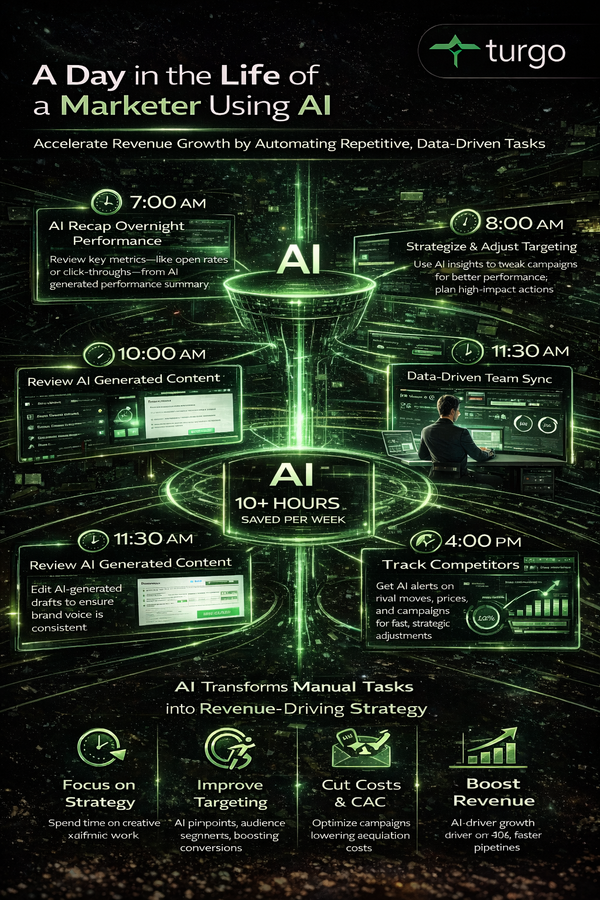
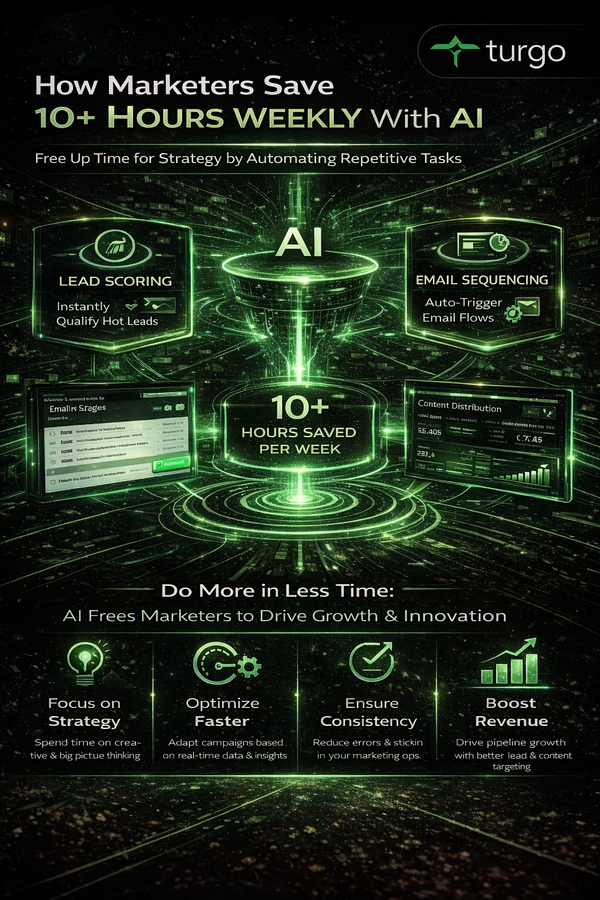
AI saves 20-50% of daily time by automating segmentation, content tweaks, and reporting, freeing 10-20 hours per marketer weekly. Demand gen managers redirect this to pipeline strategy, boosting output without hires. Tradeoffs involve learning curves, but velocity gains compound quickly. In practice, teams handling 50 campaigns monthly cut production from 80 to 40 hours, lifting SQLs 40% and CAC 30%, directly tying to revenue growth. Measure via time-tracking pre- and post-rollout for clear decisions.
Is AI marketing automation worth the setup cost for startups?
Yes, for startups with >$1M ARR, setup costs ($50-150K) yield 3-5x ROI via CAC drops and pipeline scaling. Founders prioritize it when manual processes cap growth at 2x YoY. Tradeoffs like integration hiccups are offset by 30% velocity boosts. Scenarios show $500K pipeline from $100K investment in year one, enabling focus on product-market fit. Skip if under $500K ARR; bootstrap with free tiers first to test waters without overcommitting budget.
Will AI eliminate jobs in demand generation?
No, AI augments demand gen by handling data tasks, letting managers focus on GTM strategy and relationships, increasing productivity 30-50%. Revenue leaders optimize teams this way, avoiding bloat. Tradeoffs require upskilling, but roles evolve to higher-impact ones with better pay. Teams report 25% pipeline growth as juniors become strategists, sustaining innovation. Long-term, it future-proofs careers by emphasizing AI oversight over rote work.
How do you measure success of AI in marketing campaigns?
Measure via pipeline velocity, CAC reduction (target 20-30%), and attribution lift from automated personalization. Growth teams track weekly leading indicators like MQL-to-SQL conversion. Tradeoffs favor dashboards over spreadsheets for real-time insights. A benchmark: 15% engagement rise signals strong fit, correlating to $1M+ quarterly pipeline. Align with revenue goals, adjusting if payback exceeds 90 days.
Can small teams implement AI automation effectively?
Yes, small teams (5-10 people) succeed by starting with one workflow like email nurturing, achieving 25% efficiency in months. Founders focus on plug-and-play tools to avoid dev overhead. Tradeoffs include limited data scale, mitigated by clean inputs. Results: CAC down 28%, pipeline up 35% to $2M quarterly without added staff. Scale gradually, validating ROI before expansion.
What if AI personalization feels too generic?
Refine by layering brand-specific training data and human review loops, ensuring 85%+ relevance. CMOs test via A/B splits, iterating on low performers. Tradeoffs balance automation speed with quality gates. Outcomes: 20-40% conversion lifts over generic blasts, adding $750K pipeline. Monitor feedback metrics quarterly to sustain authenticity at scale.
How does AI handle data privacy in marketing?
AI tools comply via anonymization and consent-based processing, reducing breach risks while enabling personalization. RevOps enforce GDPR/CCPA mappings pre-launch. Tradeoffs prioritize vetted platforms over custom builds. Success shows 15% churn drops from trusted journeys, bolstering $3M+ ARR. Audit quarterly to align with regs and build buyer trust.
When is the best time to scale AI across channels?
Scale after piloting one channel yields 20%+ lift, typically 3-6 months in. Revenue leaders time it with budget cycles for max impact. Tradeoffs manage integration costs; phase by ROI. Expect 30% CAC drop firm-wide, growing pipeline 50% to $8M quarterly. Delay if data maturity lags.
Does AI work for B2C marketing as well as B2B?
Yes, AI excels in B2C for real-time ad personalization and churn prediction, driving 25-45% engagement in high-volume funnels. Growth marketers adapt models for behavioral data. Tradeoffs include noisier signals, offset by volume. B2C teams see CAC halve to $40, pipeline equivalent in LTV rising 40%, matching B2B outcomes adjusted for scale.
Is Your GTM Strategy Driving Predictable Revenue Growth?
To ensure your go-to-market strategy is robust and efficient, it should be data-driven, customer-informed, and aligned with your product roadmap. Remember, a well-executed strategy can accelerate pipeline growth, optimize customer acquisition cost, and provide a clear path to revenue generation. Stay focused, measure relentlessly, and adjust as needed for optimal execution.
Citations:
- [1] https://www.vationventures.com/glossary/go-to-market-strategy-definition-explanation-and-use-cases
- [2] https://www.productmarketingalliance.com/your-guide-to-go-to-market-strategies/
- [3] https://blog.growstack.ai/how-ai-native-marketing-transforms-revenue-velocity-and-roi/
- [4] https://xgrowth.com.au/blogs/go-to-market-strategy-framework/
- [5] https://reteno.com/glossary/go-to-market-gtm-strategy
- [6] https://www.coursera.org/articles/go-to-market-strategy
- [7] https://www.salesforce.com/sales/go-to-market-strategy/
- [8] https://www.leanlabs.com/blog/components-of-a-go-to-market-strategy
- [9] https://amplitude.com/glossary/terms/go-to-market-strategy
- [10] https://www.highspot.com/blog/go-to-market-strategy/