How AI Automation Decisions Affect Your Revenue Pipeline
Uncover how AI-automation affects your revenue pipeline, leading to faster lead qualification, lowered customer acquisition cost, and improved conversion rates.
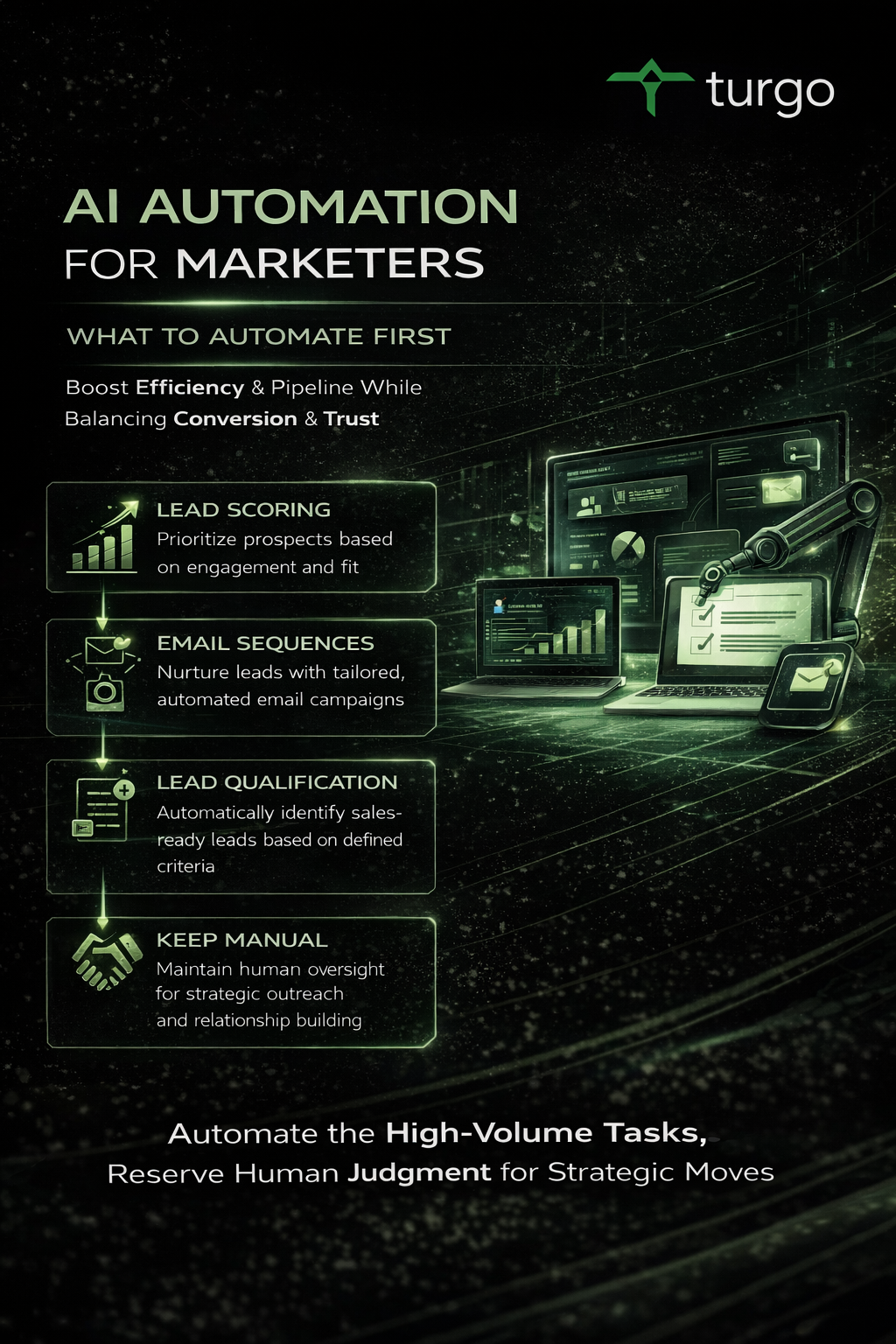
Meta Description: Discover which marketing processes to automate first for pipeline growth and which require human judgment to protect revenue and customer relationships.
AI Automation for Marketers: What to Automate First
Automation in marketing has moved beyond email sequences and social scheduling. Today's growth teams face a critical decision: which processes should be automated to accelerate pipeline velocity, and which should remain human-driven to protect conversion rates and brand trust?
The answer depends on understanding where automation creates measurable business value—faster lead qualification, lower customer acquisition cost, improved conversion rates—and where it introduces risk. This guide helps CMOs, growth leaders, and revenue teams make that distinction and prioritize automation investments that directly impact pipeline and revenue outcomes.
What Is Marketing Automation in a Go-to-Market Context?
Marketing automation is the use of software and AI systems to execute repetitive, rule-based marketing tasks at scale without manual intervention. In a go-to-market strategy, automation serves one primary purpose: accelerate the movement of qualified prospects through the buyer journey while reducing the operational cost of that movement.
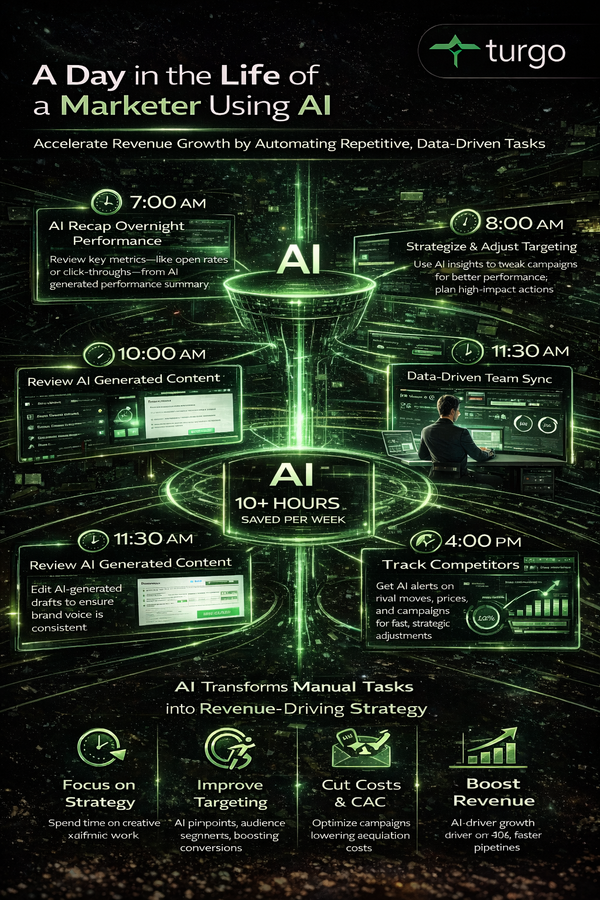
Automation is not about replacing marketers. It's about freeing marketing and sales teams from low-value repetitive work so they can focus on high-impact decisions: messaging strategy, competitive positioning, account selection, and relationship building. For revenue leaders evaluating automation investments, the business case is straightforward: automation should reduce cost per marketing-qualified lead, improve lead-to-opportunity conversion rates, or shorten sales cycle length. If it doesn't move one of those metrics, it's not a priority.
Why Does Automation Matter for Pipeline Growth?
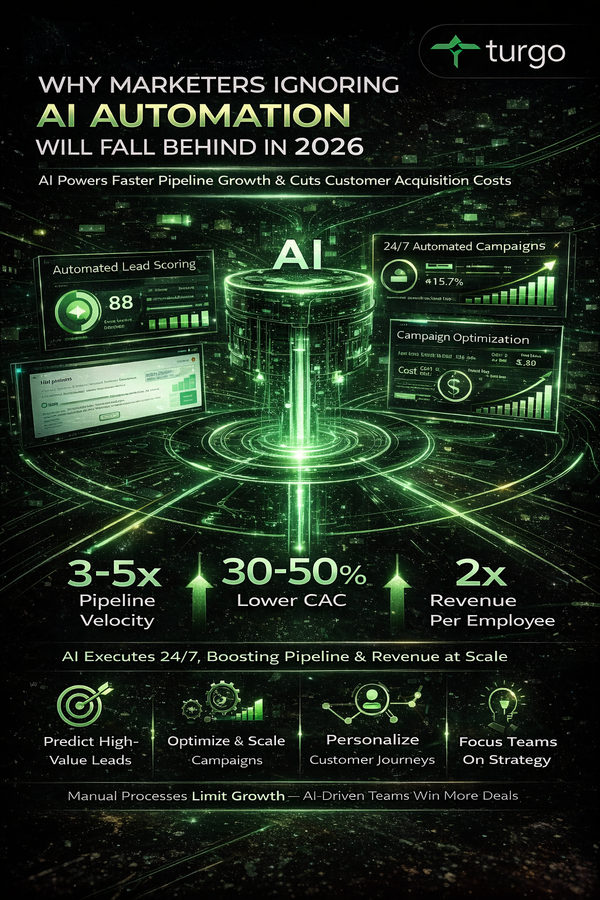
Automation directly impacts three metrics that drive revenue: pipeline velocity, customer acquisition cost, and conversion rates. When a prospect enters your system, every day they spend in a manual workflow is a day they're not moving toward a buying decision. Automation compresses that timeline by ensuring consistent, immediate follow-up and qualification.
For growth teams evaluating automation, the pipeline impact is measurable. A typical B2B sales cycle involves 5–7 touchpoints across 30–60 days. Manual workflows often introduce 2–3 day delays between touchpoints due to team capacity constraints. Automation eliminates those delays, moving prospects from awareness to evaluation to decision faster. Faster movement means more deals close in the same quarter, improving pipeline predictability.
The cost impact is equally important. If your current cost per marketing-qualified lead is $150 and your sales team spends 4 hours per week manually qualifying inbound leads, automation can reduce that cost by 20–30% by handling initial qualification rules automatically. That's $30–45 per lead saved, which compounds across hundreds or thousands of leads annually.
What Should You Automate First?
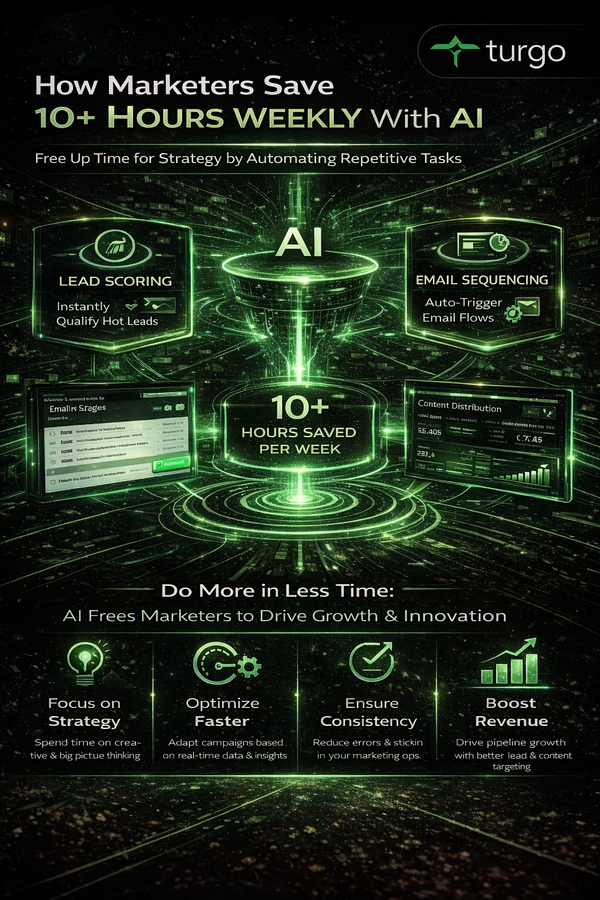
The highest-ROI automation targets processes that are high-volume, rule-based, and currently creating bottlenecks in your pipeline. Lead scoring, email nurture sequences, and initial qualification workflows should be automated first because they directly impact how many prospects reach your sales team and how quickly.
Lead scoring automation is the foundation. Instead of sales reps manually reviewing every inbound lead, an automated system assigns scores based on explicit criteria: job title, company size, engagement level, and fit signals. A prospect who visits your pricing page, downloads a comparison guide, and opens three emails automatically receives a higher score than someone who visited once. This ensures your sales team focuses on the 20% of leads most likely to convert, not the 80% that need more nurturing.
Email nurture sequences are the second priority. Once a prospect is identified as not-yet-ready, an automated sequence delivers relevant content based on their behavior and profile. If a prospect downloads a "buyer's guide" but doesn't request a demo, they enter a nurture sequence focused on education and social proof. If they download a "pricing guide," they enter a sequence focused on ROI and implementation. This personalization at scale is impossible manually but drives measurable conversion improvements.
A realistic scenario: a B2B SaaS company with 500 monthly inbound leads currently has one demand generation manager manually reviewing and scoring leads. That manager can realistically handle 100 leads per week, leaving 100 leads per week unqualified. By implementing lead scoring automation, all 500 leads are scored within 24 hours. Sales reps immediately focus on the top 150 qualified leads. Result: pipeline increases 25–30% in the first quarter because more qualified prospects reach the sales team faster.
When Should You Automate Lead Qualification?
Lead qualification—determining whether a prospect meets your ideal customer profile—is a strong candidate for automation when your qualification criteria are clear and consistent. If your sales team uses the same five questions to qualify every prospect, that process should be automated.
Automated qualification works best when your ICP (ideal customer profile) is well-defined. If you know that your best customers are companies with 50–500 employees in the financial services industry with annual revenue above $10M, you can automate the initial qualification check. A prospect from a 30-person startup in retail automatically receives a different treatment than a prospect from a 200-person fintech company.
However, qualification automation fails when your ICP is unclear or when your best customers don't fit a single profile. If your top customers range from 20-person startups to 5,000-person enterprises, automated qualification will either reject good prospects or waste time on poor ones. In this case, keep qualification manual or use automation only to flag prospects for human review.
A practical example: a B2B marketing platform with a clear ICP (mid-market SaaS companies, $5M–$50M ARR) implemented automated qualification. Prospects were scored based on company size, industry, and engagement. Prospects scoring above 70 were automatically routed to sales; those scoring 40–70 entered a nurture sequence; those below 40 were marked as "not a fit." Within two months, sales cycle length decreased from 45 days to 38 days because reps spent less time on unqualified prospects. CAC decreased 18% because the team focused on higher-probability opportunities.
What Processes Should Remain Manual?
Not everything should be automated. Processes that require judgment, creativity, or relationship-building should remain human-driven. Sales outreach, competitive positioning, and account strategy are examples of high-value work that automation can support but not replace.
Sales outreach—the initial contact from a sales rep to a prospect—should remain manual because it requires personalization and judgment. An automated email saying "Hi [First Name], I noticed you visited our pricing page" is less effective than a personalized message from a rep who has researched the prospect's company, recent news, and specific challenges. The personalized approach converts at 2–3x the rate of generic automation.
Competitive positioning and messaging strategy should remain manual because they require strategic thinking and market insight. Automation can deliver messaging, but humans must decide what message to deliver and why. If a prospect is evaluating your product against a competitor, the sales rep needs to understand the competitive landscape and make a judgment call about which differentiators matter most to that specific prospect.
Account strategy—deciding which accounts to pursue, in what order, with what resources—should remain manual. Automation can identify accounts that fit your ICP, but humans must decide whether to pursue a specific account based on strategic fit, timing, and resource availability. A prospect might fit your ICP perfectly but be a poor strategic fit if they're in a market you're deprioritizing or if they require custom implementation that strains your team.
How Do You Decide What to Automate?
The decision framework is simple: automate if the process is high-volume, rule-based, and currently creating a bottleneck. Avoid automation if the process requires judgment, is low-volume, or is already efficient.
For CMOs allocating budget to automation, ask three questions: First, is this process rule-based? Can you define clear criteria for how the process should work? If yes, automation is possible. If the process requires judgment calls or exceptions, automation is risky. Second, is this process high-volume? Does it happen hundreds or thousands of times per month? If yes, automation saves significant time and cost. If it happens a few times per week, the ROI is lower. Third, is this process currently a bottleneck? Is it slowing down your pipeline or consuming disproportionate team resources? If yes, automation directly improves outcomes. If the process is already efficient, automation is a nice-to-have, not a priority.
A realistic scenario: a B2B company with 1,000 monthly inbound leads currently has two demand generation specialists spending 60% of their time on manual lead routing and initial qualification. That's roughly 480 hours per month on a rule-based task. Automating this process costs $2,000–$5,000 per month in software and setup. The ROI is clear: the company saves $15,000–$20,000 per month in labor costs (assuming $40/hour fully loaded) while improving lead routing speed from 24 hours to 2 hours. Payback period is 1–2 months.
What Are the Risks of Over-Automating?
Over-automation creates two primary risks: reduced personalization and loss of human judgment. When too much of the buyer journey is automated, prospects feel like they're interacting with a system, not a company. This reduces trust and conversion rates.
The second risk is that automation can mask poor strategy. If your messaging is unclear, automating it at scale just means you're delivering unclear messaging faster. If your ICP definition is fuzzy, automating lead qualification just means you're qualifying the wrong prospects faster. Automation amplifies existing problems; it doesn't solve them.
For revenue leaders, the warning sign is when automation increases pipeline volume but decreases conversion rates. If you're generating 50% more leads but your lead-to-opportunity conversion rate drops 30%, you've over-automated. The solution is to pull back on automation, improve your messaging and qualification criteria, and then re-automate.
A realistic scenario: a B2B company automated their entire nurture sequence, sending 12 emails over 60 days to every prospect who didn't immediately convert. Email open rates were 15%, click rates were 2%, and conversion to opportunity was 3%. When they reduced the sequence to 5 emails and added manual check-ins from sales reps for high-fit prospects, open rates increased to 22%, click rates to 5%, and conversion to opportunity to 8%. The lesson: automation works best when combined with strategic human judgment, not as a replacement for it.
Should You Automate Email Nurture Sequences?
Email nurture sequences are ideal candidates for automation because they're high-volume, rule-based, and directly impact conversion rates. A well-designed nurture sequence moves prospects from "not ready to buy" to "ready for a sales conversation" without requiring manual intervention.
Automated nurture sequences should be segmented by prospect profile and behavior. A prospect who downloaded a technical whitepaper should receive different content than one who downloaded a pricing guide. A prospect from a company that's already a customer should receive different messaging than a prospect from a competitor's customer base. This segmentation ensures relevance and improves conversion rates.
However, nurture sequences should not be "set and forget." They require ongoing optimization based on engagement data. If email open rates are declining, subject lines need to be refreshed. If click rates are low, content relevance needs to be improved. If conversion rates are stagnant, the sequence length or timing may need adjustment. Automation handles the execution; humans handle the strategy and optimization.
A realistic scenario: a B2B company implemented a 6-email nurture sequence for prospects who visited the pricing page but didn't request a demo. The sequence was triggered automatically when a prospect visited pricing, with emails sent every 3 days. Initial conversion rate was 4% (4 prospects converted to opportunities per 100 in the sequence). After analyzing engagement data, they discovered that prospects who opened the third email (focused on ROI) were 3x more likely to convert. They restructured the sequence to lead with ROI content and shortened the sequence from 6 emails to 4. Conversion rate increased to 7%, and cost per opportunity decreased 35%.
When Should You Automate Account-Based Marketing?
Account-based marketing (ABM) automation is valuable for companies pursuing a limited set of high-value accounts. Instead of automating for volume, ABM automation ensures consistent, coordinated outreach to a specific list of target accounts.
ABM automation works by coordinating messaging across channels. When a prospect from a target account visits your website, they see personalized content. When they open an email, the sales rep is notified. When they engage with content, they're automatically added to a coordinated nurture sequence. This coordination ensures that every touchpoint reinforces your message and moves the prospect toward a buying decision.
However, ABM automation requires more upfront strategy than volume-based automation. You must define your target account list, develop account-specific messaging, and coordinate across marketing and sales. The payoff is higher conversion rates and larger deal sizes, but the setup cost is higher.
A realistic scenario: a B2B company pursuing 50 target accounts implemented ABM automation. Each account had customized landing pages, email sequences, and content recommendations. When a prospect from a target account visited the website, they saw account-specific messaging. When they opened an email, the sales rep was notified within 5 minutes. Result: conversion rate for target accounts increased from 8% to 18%, and average deal size increased from $50K to $75K. The additional revenue from these 50 accounts exceeded the cost of ABM automation by 10x.
How Do You Measure Automation ROI?
Automation ROI is measured through three lenses: cost savings, pipeline impact, and conversion rate improvement. Cost savings come from reduced labor hours. Pipeline impact comes from faster lead movement and increased volume. Conversion improvement comes from better personalization and timing.
For CMOs evaluating automation investments, establish baseline metrics before implementation. What is your current cost per marketing-qualified lead? What is your current lead-to-opportunity conversion rate? What is your current sales cycle length? After implementing automation, measure the same metrics. If cost per lead decreases, conversion rates improve, or cycle length shortens, automation is working.
However, don't measure automation in isolation. Measure it against your overall GTM strategy. If automation increases pipeline volume but decreases conversion rates, it's not aligned with your strategy. If automation reduces CAC but increases churn, it's attracting the wrong customers. Automation should improve multiple metrics simultaneously.
A realistic scenario: a B2B company implemented lead scoring and nurture automation. Before automation: 500 monthly leads, 12% conversion to MQL, 25% MQL-to-SQL conversion, 30% SQL-to-opportunity conversion, $180 cost per opportunity. After automation: 600 monthly leads (20% increase from improved lead routing), 18% conversion to MQL (50% improvement from better nurturing), 28% MQL-to-SQL conversion (12% improvement from faster follow-up), 32% SQL-to-opportunity conversion (7% improvement from better qualification), $140 cost per opportunity (22% decrease). The automation investment paid for itself in the first month and improved pipeline quality simultaneously.
What Automation Tools Should You Prioritize?
Prioritize tools that integrate with your existing tech stack and address your highest-priority bottleneck. If your bottleneck is lead qualification, prioritize a lead scoring platform. If it's email nurture, prioritize a marketing automation platform. If it's account coordination, prioritize an ABM platform.
The best automation tool is one that your team will actually use and maintain. A sophisticated platform that requires constant configuration is less valuable than a simple platform that works out of the box. For revenue leaders evaluating tool investments, focus on adoption and ongoing usage, not feature count.
Integration is critical. If your automation tool doesn't integrate with your CRM, sales reps won't see automated lead scores and won't trust the system. If it doesn't integrate with your analytics platform, you won't be able to measure ROI. Prioritize tools that integrate seamlessly with your existing stack.
How Do You Avoid Automation Mistakes?
The most common automation mistake is automating before you have a clear strategy. If your messaging is unclear, automating it just scales the problem. If your ICP is undefined, automating lead qualification just wastes time on the wrong prospects. Before automating, ensure your GTM strategy is solid.
The second mistake is automating too much too fast. Start with one high-impact process, measure results, and then expand. If you automate lead scoring, nurture, qualification, and outreach simultaneously, you won't know which automation is driving results and which is creating problems.
The third mistake is treating automation as a set-and-forget solution. Automation requires ongoing optimization. Email open rates decline over time. Lead scoring criteria become outdated. Nurture sequences need refreshing. Assign someone to monitor automation performance and optimize continuously.
Should You Automate Sales Outreach?
Sales outreach—the initial contact from a sales rep to a prospect—should generally remain manual because it requires personalization and judgment. However, automation can support outreach by identifying the right prospects and timing the outreach appropriately.
Automated outreach sequences (like LinkedIn connection requests followed by personalized messages) can work if they're truly personalized. A generic "I noticed you visited our website" message converts at 2–3% rates. A personalized message that references the prospect's company, recent news, or specific challenges converts at 5–8% rates. The difference is human judgment and research.
For sales teams evaluating outreach automation, the rule is: automate the identification and timing of outreach, but keep the messaging manual. Automation identifies that a prospect is ready for outreach (they've engaged with content, they fit your ICP, they're in a target account). A sales rep then personalizes the outreach message based on their research. This combination of automation and personalization drives the highest conversion rates.
How Do You Implement Automation Without Losing the Human Touch?
The key is to use automation to amplify human effort, not replace it. Automation handles the repetitive, high-volume work. Humans handle the strategic, relationship-building work. When these two work together, conversion rates improve and team efficiency increases.
For growth teams implementing automation, establish clear handoff points between automation and human work. Automation identifies and qualifies prospects. Humans personalize outreach and build relationships. Automation delivers nurture content. Humans follow up on high-engagement prospects. Automation routes leads to sales. Humans decide account strategy.
This hybrid approach requires clear communication between marketing and sales. Sales reps need to understand how automation is qualifying leads so they trust the system. Marketing needs to understand what sales reps are doing with automated leads so they can optimize the automation. Regular alignment meetings (weekly or bi-weekly) ensure both teams are working toward the same outcomes.
What Metrics Should You Track for Automation Success?
Track metrics that directly impact revenue: cost per marketing-qualified lead, lead-to-opportunity conversion rate, sales cycle length, and customer acquisition cost. These metrics tell you whether automation is improving your GTM efficiency.
Additionally, track adoption metrics: what percentage of your team is using the automation? If adoption is below 70%, the automation isn't working. Track quality metrics: are automated leads converting at the same rate as manually qualified leads? If conversion rates are lower, your automation criteria need adjustment. Track velocity metrics: how much faster are prospects moving through the pipeline with automation?
For revenue leaders, the ultimate metric is pipeline impact. Is automation increasing the number of qualified opportunities your sales team receives? Is it decreasing the cost of generating those opportunities? If yes, automation is working. If no, something needs to change.
FAQ
Should we automate everything that's possible to automate?
No. Automate only processes that are high-volume, rule-based, and currently creating bottlenecks. Processes that require judgment, creativity, or relationship-building should remain manual. Over-automation reduces personalization and can damage conversion rates. The goal is to automate repetitive work so your team can focus on high-impact strategic work. Start with one high-impact process, measure results, and expand from there. If automation increases pipeline volume but decreases conversion rates, you've automated too much.
How do we know if our automation is actually improving pipeline?
Establish baseline metrics before implementing automation: cost per marketing-qualified lead, lead-to-opportunity conversion rate, and sales cycle length. After implementing automation, measure the same metrics. If cost per lead decreases, conversion rates improve, or cycle length shortens, automation is working. However, don't measure automation in isolation. Measure it against your overall GTM strategy. If automation increases volume but decreases quality, it's not aligned with your strategy. Track both leading indicators (email open rates, click rates, lead scores) and lagging indicators (conversion rates, deal size, revenue) to understand the full impact.
What's the biggest risk of automating too much?
The biggest risk is losing personalization and human judgment. When too much of the buyer journey is automated, prospects feel like they're interacting with a system, not a company. This reduces trust and conversion rates. Additionally, automation can mask poor strategy. If your messaging is unclear, automating it just scales the problem. If your ICP is undefined, automating lead qualification just wastes time on the wrong prospects. Before automating, ensure your GTM strategy is solid. Automation amplifies existing problems; it doesn't solve them.
How do we balance automation with the human touch?
Use automation to amplify human effort, not replace it. Automation handles repetitive, high-volume work. Humans handle strategic, relationship-building work. Establish clear handoff points: automation identifies and qualifies prospects; humans personalize outreach. Automation delivers nurture content; humans follow up on high-engagement prospects. This hybrid approach requires clear communication between marketing and sales. Regular alignment meetings ensure both teams are working toward the same outcomes and understand how automation is supporting their work.
Should we automate lead qualification?
Lead qualification is a strong candidate for automation when your qualification criteria are clear and consistent. If your sales team uses the same five questions to qualify every prospect, that process should be automated. However, qualification automation fails when your ICP is unclear or when your best customers don't fit a single profile. In that case, keep qualification manual or use automation only to flag prospects for human review. The key is ensuring your ICP is well-defined before automating qualification.
What's the ROI timeline for marketing automation?
ROI timeline depends on what you're automating. Lead scoring and email nurture automation typically show ROI within 1–3 months because they directly impact cost per lead and conversion rates. Account-based marketing automation may take 3–6 months because it requires more upfront strategy and coordination. The key is establishing baseline metrics before implementation and measuring consistently. Most companies see measurable pipeline impact within the first quarter if automation is implemented correctly.
How do we avoid automating the wrong processes?
Use a simple decision framework: automate if the process is high-volume, rule-based, and currently creating a bottleneck. Ask three questions: Is this process rule-based? Is it high-volume? Is it currently a bottleneck? If yes to all three, automation is a priority. If no to any of them, focus on other processes first. Start with your highest-priority bottleneck and measure results before expanding to other processes. This ensures you're automating processes that directly impact pipeline and revenue.
What happens if our automation breaks or needs updating?
Automation requires ongoing maintenance and optimization. Assign someone to monitor automation performance and optimize continuously. Email open rates decline over time, so subject lines need refreshing. Lead scoring criteria become outdated as your market evolves. Nurture sequences need refreshing based on engagement data. Set up regular reviews (monthly or quarterly) to assess automation performance and make adjustments. If automation is working well, you'll see consistent metrics. If metrics are declining, something needs to change.
Can we automate sales outreach?
Sales outreach should generally remain manual because it requires personalization and judgment. However, automation can support outreach by identifying the right prospects and timing the outreach appropriately. Automate the identification and timing of outreach, but keep the messaging manual. A sales rep should personalize the outreach message based on their research of the prospect's company and challenges. This combination of automation and personalization drives the highest conversion rates and maintains the human touch that builds trust.
How do we get sales buy-in for marketing automation?
Sales buy-in is critical for automation success. Sales reps need to understand how automation is qualifying leads so they trust the system. Share baseline metrics and explain how automation will improve their pipeline. Show them that automated leads convert at similar or higher rates than manually qualified leads. Involve sales in defining lead scoring criteria so they feel ownership of the system. Provide regular feedback on automation performance. If sales reps see that automation is delivering higher-quality leads and reducing their manual work, they'll support it.
How Will You Prioritize Automation for Maximum Impact?
Consider the processes that, when automated, will deliver measurable business value and directly impact pipeline and revenue outcomes. Maintain a balanced approach of automation and human judgment to optimize your GTM strategy. Start with strategic analysis, proceed with disciplined execution.
Citations:
- [1] https://reteno.com/glossary/go-to-market-gtm-strategy
- [2] https://trailhead.salesforce.com/content/learn/modules/go-to-market-planning/develop-a-go-to-market-strategy
- [3] https://blog.growstack.ai/how-ai-automation-shapes-revenue-outcomes-for-marketers/
- [4] https://www.leanlabs.com/blog/components-of-a-go-to-market-strategy
- [5] https://stripe.com/resources/more/what-is-a-go-to-market-strategy-a-quick-gtm-guide-for-startups
- [6] https://directiveconsulting.com/ca/resources/glossary/go-to-market-strategy/
- [7] https://asana.com/resources/go-to-market-gtm-strategy
- [8] https://pipeline.zoominfo.com/marketing/go-to-market-strategy
- [9] https://www.mural.co/blog/what-is-go-to-market-strategy
- [10] https://amplitude.com/glossary/terms/go-to-market-strategy