How AI Automation Cuts CAC and Boosts Revenue Velocity
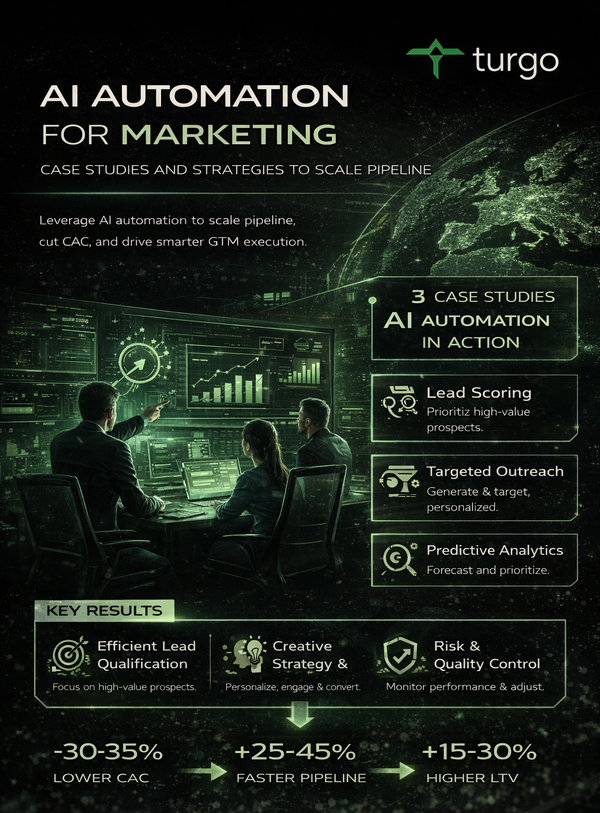
Discover how AI automation in marketing not only saves you valuable time but directly drives business outcomes by improving campaign optimization, lead scoring, and revenue velocity.
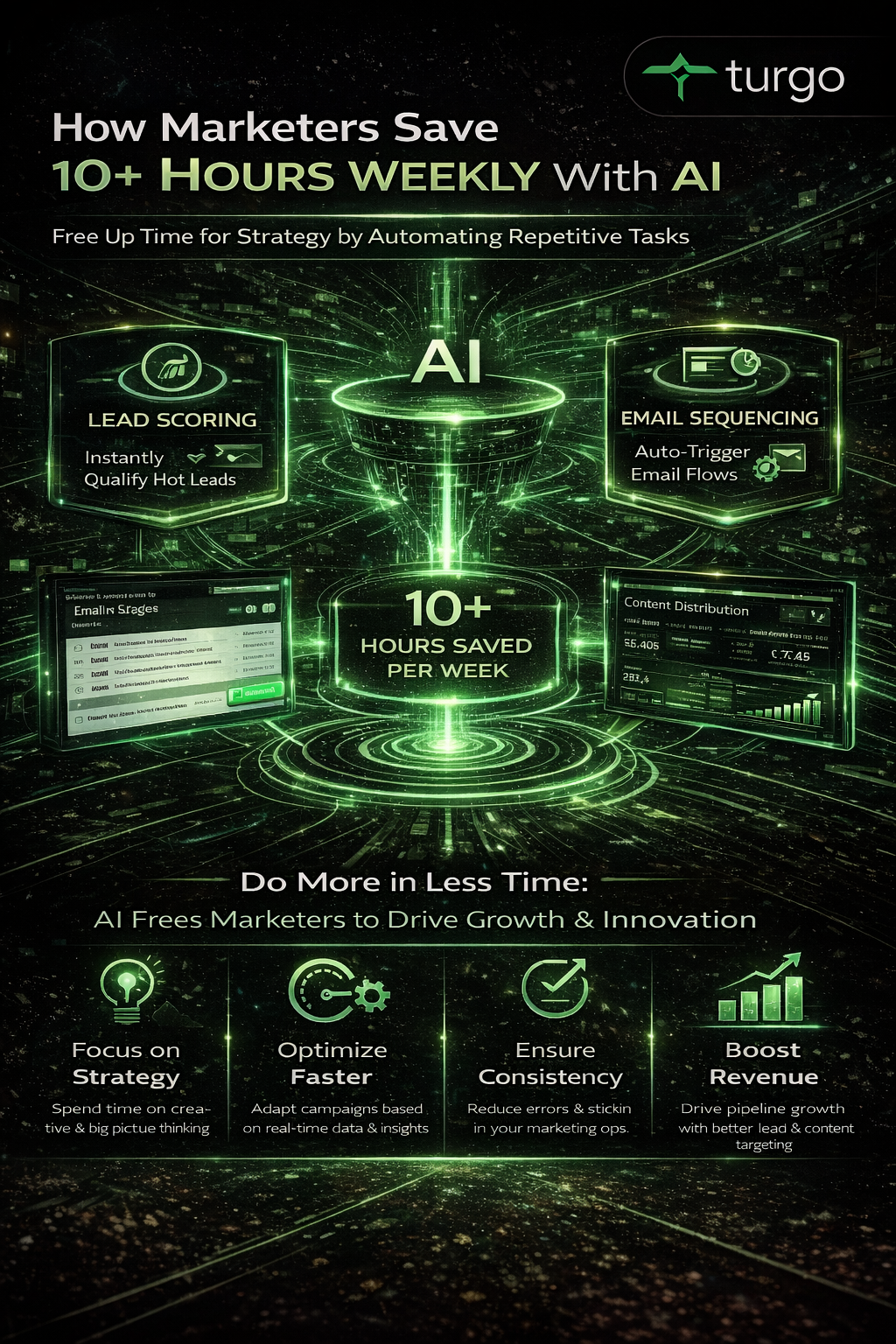
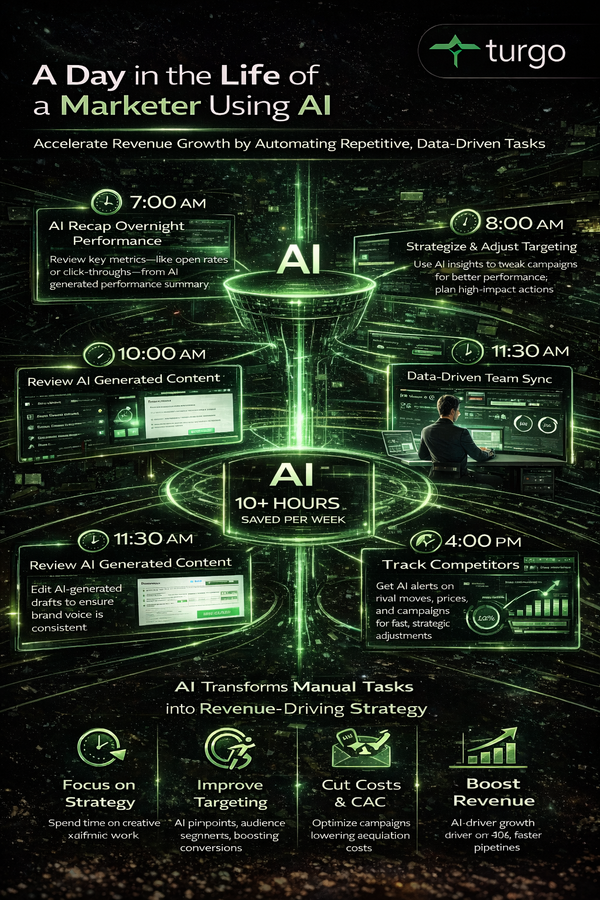
How Marketers Save 10+ Hours Weekly With AI
Marketers can reclaim 10+ hours per week by automating repetitive tasks like email sequencing, lead scoring, content distribution, and campaign reporting through AI-powered tools. This frees teams to focus on strategy, creative work, and revenue-driving decisions rather than manual execution.
Opening
AI automation in marketing isn't about replacing human judgment—it's about eliminating the administrative work that prevents good judgment from happening. Most marketing teams spend 30–40% of their time on tasks that don't require creativity or strategic thinking: scheduling posts, tagging leads, updating spreadsheets, pulling reports, and sending templated messages. AI handles these tasks in seconds, not hours.
For growth leaders and CMOs, this time recovery translates directly to business outcomes. When your demand generation team isn't buried in manual work, they can run more experiments, optimize campaigns faster, and respond to market signals in real time. When your RevOps team isn't manually scoring leads, they can focus on pipeline quality and conversion velocity. The math is simple: fewer hours on busywork equals more hours on decisions that move revenue.
What Is AI Marketing Automation?
AI marketing automation uses machine learning and natural language processing to handle repetitive marketing tasks without human intervention for each instance. These systems learn from historical data, recognize patterns, and execute actions—sending emails, scoring leads, personalizing content, or generating reports—at scale and speed no human team could match.
The key difference between traditional automation and AI automation is intelligence. Traditional automation follows rigid rules: "If lead clicks email, move to next sequence." AI automation learns: "This type of lead, with these characteristics, at this time in the buyer journey, responds best to this message." It adapts based on outcomes, not just triggers.
For revenue teams, this matters because AI automation reduces the gap between what you know should happen and what actually gets executed. It's the difference between having a lead scoring model and actually using it on every single lead, every single day.
Why Are Marketers Losing 10+ Hours Per Week to Manual Work?
Most marketing teams operate with a mix of disconnected tools, spreadsheets, and manual processes that were never designed to scale. A demand gen manager might spend 2 hours daily moving leads between systems, updating CRM fields, and checking if campaigns are running. A content marketer might spend 3 hours scheduling posts across channels and monitoring engagement. A RevOps person might spend 4 hours pulling data from five different sources to build a weekly report.
These aren't failures of individual contributors—they're structural inefficiencies. When tools don't talk to each other, humans become the connective tissue. When processes rely on memory instead of automation, scaling becomes impossible. When reporting is manual, insights arrive too late to act on them.
The cost isn't just time. It's also accuracy (manual data entry has error rates of 1–3%), consistency (different people do things differently), and speed (by the time a report is finished, the data is already stale). For growth teams competing on velocity, this is a competitive disadvantage.
How Does AI Automation Actually Save Time?
AI automation saves time by handling four categories of work simultaneously: data movement, decision-making, content creation, and reporting. Instead of a human checking a lead's behavior, deciding if they're qualified, moving them to a new list, and logging the action, an AI system does all four in milliseconds.
Consider a concrete example: lead scoring. Without AI, a RevOps person manually reviews leads weekly, assigns scores based on company size and engagement, and moves qualified leads to sales. With AI, the system scores every lead in real time, learns which scoring criteria actually predict conversion, and adjusts weights automatically. The RevOps person now spends 30 minutes reviewing the model instead of 4 hours scoring leads.
The time savings compound across the funnel. Email sequences that used to require manual sends now trigger automatically based on behavior. Content recommendations that used to be guesses are now personalized based on what each segment actually engages with. Reports that used to take a day to build now generate automatically and alert you when metrics drift.
For a team of five marketers, this typically recovers 10–15 hours per week. For a team of 20, it's 40–60 hours. The larger the team, the more time automation saves because it eliminates the coordination overhead that grows with headcount.
What Tasks Should Marketers Automate First?
The highest-impact automation targets tasks that are repetitive, high-volume, and directly connected to revenue. Lead scoring, email sequencing, and campaign reporting should be your first three priorities because they affect pipeline velocity and quality simultaneously.
Lead scoring automation is the fastest ROI play. If your sales team currently spends time sorting through leads to find the good ones, you're losing deals to slow response times. AI scoring systems learn which lead characteristics correlate with conversion and flag hot leads instantly. Sales can focus on the 20% of leads that matter instead of wading through the 80% that don't.
Email sequencing automation comes second. Most teams send the same email to everyone or manually customize sequences for different segments. AI systems can personalize subject lines, send times, and content based on individual behavior and preferences. Open rates typically increase 15–25%, and more importantly, the sequences run without human intervention.
Campaign reporting automation is third. If someone on your team spends 3–4 hours weekly pulling data from Google Analytics, HubSpot, LinkedIn, and your CRM to build a dashboard, that's an immediate candidate for automation. AI reporting tools can aggregate data from all sources, calculate metrics, and flag anomalies automatically.
After these three, prioritize based on your team's pain points: content distribution, social listening, chatbot responses, or predictive analytics. The principle is the same: automate high-volume, low-judgment tasks first.
Can AI Automation Handle Personalization at Scale?
Yes, and this is where AI automation creates competitive advantage. Traditional personalization requires either manual effort (unsustainable at scale) or basic rules-based logic (limited effectiveness). AI personalization learns individual preferences and adapts in real time.
An AI system can personalize email subject lines, send times, content recommendations, and offer timing based on what each person has engaged with before. It can recognize that one segment prefers educational content while another prefers case studies, and route them accordingly. It can identify when a lead is most likely to open an email (Tuesday at 10 AM for one person, Thursday at 2 PM for another) and send accordingly.
The business impact is measurable. Personalized email campaigns typically see 20–30% higher open rates and 15–25% higher click rates compared to generic sends. Personalized landing pages see 10–20% higher conversion rates. For a team running 50 campaigns per quarter, this difference compounds quickly into pipeline impact.
The key constraint is data quality. AI personalization requires clean, complete data about what each person has done and engaged with. If your CRM is messy or your tracking is incomplete, personalization will be mediocre. But if your data foundation is solid, AI personalization is one of the highest-ROI automations you can implement.
How Does AI Lead Scoring Improve Sales Productivity?
AI lead scoring improves sales productivity by eliminating the time sales teams spend sorting through unqualified leads. Instead of a sales rep spending 30 minutes daily reviewing leads to find the ones worth calling, they see a prioritized list with the hottest leads at the top.
The system learns which lead characteristics predict conversion by analyzing historical data: company size, industry, engagement level, page visits, email opens, and dozens of other signals. It assigns each new lead a score based on how similar they are to leads that actually converted. As leads engage more (opening emails, visiting pages, downloading content), their scores update in real time.
For sales teams, this means higher conversion rates and shorter sales cycles. A rep calling a scored lead is 3–5x more likely to close than a rep calling a random lead. For a team of 10 reps, each closing one additional deal per month due to better lead quality, that's 10 extra deals annually—potentially $500K–$2M in additional revenue depending on deal size.
The secondary benefit is morale. Sales reps prefer working qualified leads. When they spend their time on conversations with real potential instead of cold outreach to unqualified prospects, productivity and retention both improve.
What's the Difference Between Marketing Automation and AI Automation?
Traditional marketing automation executes workflows based on rules you define: "If lead opens email AND clicks link, send follow-up." AI automation learns the rules from data: "Leads with these characteristics, who engage this way, convert best when we send this message at this time."
Traditional automation is deterministic—it does exactly what you tell it to do. AI automation is adaptive—it learns what works and adjusts. Traditional automation requires you to anticipate scenarios and build workflows for each one. AI automation discovers patterns you didn't anticipate.
For marketers, this means traditional automation is good for simple, predictable processes (welcome sequences, birthday emails, basic lead routing). AI automation is better for complex, variable processes (lead scoring, content recommendations, optimal send times, churn prediction).
Most mature marketing teams use both. They use traditional automation for the 20% of workflows that are simple and stable, and AI automation for the 80% that require adaptation and learning. The combination gives you reliability (traditional automation) plus intelligence (AI automation).
How Much Does AI Marketing Automation Cost?
AI marketing automation tools range from $500–$5,000 per month depending on features, data volume, and integration complexity. Entry-level tools (basic lead scoring, email automation) start around $500–$1,500. Mid-market tools (advanced personalization, predictive analytics, multi-channel orchestration) run $2,000–$4,000. Enterprise tools (custom models, unlimited data, dedicated support) can exceed $5,000.
The ROI calculation is straightforward: if automation saves your team 10 hours per week at an average loaded cost of $50/hour, that's $500/week or $26,000 annually in recovered time. If it also improves conversion rates by 15% (conservative estimate), that's additional pipeline value. Most teams see payback within 2–3 months.
For growth leaders evaluating budget, the question isn't "Can we afford automation?" but "Can we afford not to automate?" A team of five marketers spending 50 hours weekly on manual work is leaving significant revenue on the table. That time could be spent on strategy, experimentation, and optimization—the activities that actually move the needle.
What Data Do You Need to Make AI Automation Work?
AI automation requires clean, complete data about leads, customers, and campaigns. Specifically: lead attributes (company, industry, role, company size), engagement history (emails opened, pages visited, content downloaded, time spent), conversion outcomes (did they become a customer, how long was the sales cycle, what was deal size), and campaign performance (which messages, channels, and timing worked best).
The quality bar is higher than most teams expect. If your CRM has 30% missing data, AI models will be mediocre. If your tracking is incomplete (you're missing mobile behavior or dark social), the model will be blind to important signals. If your data is inconsistent (the same company name spelled three different ways), the model will treat them as separate entities.
Before implementing AI automation, audit your data. How complete is your CRM? How accurate is your lead source tracking? How consistent is your data entry? If you're below 80% completeness and consistency, invest in data cleanup first. The AI will only be as good as the data feeding it.
For most teams, this means 2–4 weeks of data hygiene work before AI automation becomes truly effective. But this is a one-time investment that pays dividends across all your marketing systems.
How Do You Measure the Impact of AI Automation?
Measure AI automation impact through three lenses: time saved, quality improved, and revenue influenced. Time saved is the easiest to quantify: track hours spent on manual tasks before and after automation. Most teams see 30–50% reduction in time spent on repetitive work.
Quality improvement is measured through accuracy and consistency. Lead scoring accuracy is measured by comparing AI scores to actual conversion outcomes (did high-scored leads actually convert?). Email personalization quality is measured by open rates, click rates, and conversion rates. Campaign reporting quality is measured by how quickly insights are available and how often they're acted on.
Revenue influence is the ultimate metric. Track pipeline influenced by automated lead scoring, conversion rate lift from personalized campaigns, and sales cycle compression from faster lead routing. For a team running $10M in annual pipeline, a 10% improvement from better lead quality and faster routing is $1M in additional pipeline.
For CMOs allocating budget, the business case is clear: $2,000–$4,000 monthly investment in AI automation typically generates $20,000–$50,000 monthly in recovered time value plus measurable pipeline improvement. The payback period is 1–3 months.
What Are the Common Mistakes Teams Make With AI Automation?
The most common mistake is implementing AI automation without fixing data quality first. Teams buy a lead scoring tool, turn it on, and wonder why it's not working. The answer is usually: garbage in, garbage out. The AI can't learn from bad data.
The second mistake is automating the wrong processes. Teams automate things that are easy to automate (like email scheduling) instead of things that matter most (like lead qualification). Automation should target high-volume, high-impact tasks, not just tasks that are technically easy to automate.
The third mistake is setting it and forgetting it. AI models degrade over time as market conditions change. A lead scoring model trained on 2024 data might not work well in 2026 if buyer behavior has shifted. Successful teams review and retrain their models quarterly.
The fourth mistake is not integrating automation with sales and RevOps. If your AI system scores leads but sales doesn't trust the scores, they'll ignore them. If your automation generates insights but nobody acts on them, you've wasted the investment. Automation only works when it's integrated into actual workflows and decision-making.
How Does AI Automation Affect Team Structure and Hiring?
AI automation doesn't eliminate marketing jobs—it changes what jobs look like. Instead of hiring people to execute tasks, you hire people to manage and optimize automation. A demand gen team of five might shift from "3 people executing campaigns, 1 person managing tools, 1 person analyzing results" to "2 people optimizing automation, 2 people running experiments, 1 person managing tools."
The skill set changes too. You need fewer people who are good at execution and more people who are good at data analysis, experimentation, and strategic thinking. You need people who can interpret what the AI is doing and decide if it's right. You need people who can identify new automation opportunities and build business cases for them.
For revenue leaders planning headcount, this is actually good news. You can do more with the same number of people, or do the same with fewer people. Most teams use the freed-up capacity to run more experiments, optimize more campaigns, and move faster—not to reduce headcount.
When Should You Implement AI Automation?
The best time to implement AI automation is when you have a clear business problem (leads aren't being qualified fast enough, campaigns aren't personalized, reporting is slow) and the data to solve it. Don't automate for automation's sake. Automate to solve a specific problem that's costing you time or revenue.
For growth teams evaluating timing, consider: Do you have clean data? Do you have a clear process to automate? Do you have buy-in from the teams that will use the automation? If you answered yes to all three, you're ready. If you answered no to any, address that first.
The implementation timeline is typically 4–8 weeks: 1–2 weeks for data audit and cleanup, 1–2 weeks for tool selection and setup, 2–4 weeks for training and optimization. Most teams see measurable impact within the first month.
What's the Relationship Between AI Automation and GTM Strategy?
AI automation is a tactical execution tool that supports your GTM strategy, not a replacement for it. Your GTM strategy defines who you're targeting, what message resonates, which channels matter, and what pricing works. AI automation executes that strategy faster, more consistently, and at greater scale.
A strong GTM strategy identifies your target customer, their pain points, and the value you deliver. AI automation ensures every target customer sees the right message at the right time through the right channel. It personalizes your GTM strategy to individual segments and learns which variations work best.
For CMOs building GTM strategy, think of AI automation as force multiplication. If your GTM strategy is solid but your execution is inconsistent or slow, AI automation will amplify the impact. If your GTM strategy is weak, automation will just execute the weak strategy faster.
How Do You Choose Between Different AI Automation Tools?
Evaluate AI automation tools on three criteria: Does it solve your specific problem? Does it integrate with your existing stack? Can your team actually use it?
The first criterion is obvious but often overlooked. A tool that's great for email personalization might be terrible for lead scoring. A tool that's great for B2B might not work for B2C. Understand your specific problem before evaluating tools.
The second criterion is integration. The best tool in the world is worthless if it doesn't connect to your CRM, email platform, and analytics tools. Before selecting a tool, map out your tech stack and verify the tool integrates with your critical systems.
The third criterion is usability. Some AI tools require data science expertise to configure. Others are designed for marketers with no technical background. Understand your team's technical capability and choose accordingly.
For revenue leaders evaluating tools, ask for a pilot period. Most vendors will let you test their tool for 30 days. Use that time to see if it actually solves your problem and if your team will actually use it. Tool selection is 20% features and 80% fit with your team and processes.
FAQ
How much time does AI automation actually save per week?
Most marketing teams save 10–15 hours per week in the first month, with additional savings as they automate more processes. The exact amount depends on team size, current process maturity, and which tasks you automate first. A demand gen team of five typically saves 10–12 hours weekly from lead scoring and email automation alone. A RevOps person typically saves 4–6 hours weekly from automated reporting. The savings are real and measurable, but they're not infinite—you're automating specific tasks, not eliminating work entirely. The freed-up time should be redirected toward strategy, experimentation, and optimization, not just absorbed as extra capacity.
Do I need a data scientist to implement AI automation?
No, most modern AI automation tools are designed for marketers without data science expertise. You need someone who understands your data (what fields exist, what they mean, how clean they are) and someone who understands your business process (what decisions need to be made, what outcomes matter). You don't need someone who can build machine learning models from scratch. That said, having someone on your team who understands data fundamentals (how to audit data quality, how to interpret model outputs, how to spot when a model is degrading) is valuable. If you don't have that person internally, most vendors offer training or can provide a consultant for implementation.
What if my CRM data is messy?
Start with a data cleanup project before implementing AI automation. Messy data will produce mediocre results, and you'll blame the tool instead of the data. Spend 2–4 weeks cleaning your CRM: deduplicating records, filling in missing fields, standardizing data entry. This is boring work, but it's essential. Once your data is 80%+ complete and consistent, AI automation will work well. If you skip this step, you'll implement a tool, see mediocre results, and abandon it—wasting time and money. The data cleanup is a one-time investment that pays dividends across all your marketing systems.
How long does it take to see ROI from AI automation?
Most teams see measurable ROI within 2–3 months. The time savings are immediate (you stop doing manual tasks right away), but the revenue impact takes longer because it depends on campaign cycles and sales cycles. A demand gen team might see improved lead quality within 30 days, but the revenue impact of those better leads might not show up for 60–90 days. For CMOs evaluating budget, assume 3 months to full ROI and you'll be pleasantly surprised if it's faster. The payback period is typically 2–4 months, which is fast enough to justify the investment even if you're conservative about projecting benefits.
Can AI automation work for B2B and B2C, or just one?
AI automation works for both, but the implementation differs. B2B automation typically focuses on account-based marketing, lead scoring, and sales enablement because deals are complex and sales cycles are long. B2C automation typically focuses on personalization, churn prediction, and customer lifecycle marketing because volume is high and decisions are individual. The underlying technology is the same—machine learning and pattern recognition—but the application is different. If you operate in both B2B and B2C, you'll likely need different tools or different configurations of the same tool.
What happens if the AI makes a mistake?
AI automation makes mistakes, but less frequently than humans do the same task manually. A lead scoring model might occasionally score a bad lead as good or a good lead as bad. An email personalization system might occasionally send the wrong message to the wrong person. The key is building in safeguards: human review of high-stakes decisions, monitoring for anomalies, and regular audits of model performance. For most use cases, occasional AI mistakes are better than consistent human mistakes because the AI is right 95%+ of the time while humans are right 85–90% of the time. But you should never fully automate decisions that have high consequences without some human oversight.
How do I get sales buy-in for AI lead scoring?
Sales teams are skeptical of lead scoring because they've seen bad scoring systems before. The best way to build trust is to show them data: compare AI-scored leads to leads they currently work, show conversion rates by score, and demonstrate that high-scored leads actually convert better. Start with a pilot where you score leads but don't change their workflow—just show them the scores and let them see if the scores are accurate. Once they trust the scores, gradually shift to using scores to prioritize their outreach. Involve sales in the model development process so they understand what signals the AI is using and why. Sales buy-in is critical because they're the ones who will use (or ignore) the automation.
Should I automate everything or just the most important processes?
Start with the most important processes that have the highest impact on revenue or the most time savings. Don't try to automate everything at once. Pick 2–3 high-impact processes, implement them well, measure the results, and then move to the next batch. This approach lets you learn what works in your organization, build internal expertise, and demonstrate value before expanding. Most successful teams automate 3–5 major processes in the first year, then add more as they mature. Trying to automate everything at once usually results in poor implementation, low adoption, and wasted investment.
What's the difference between AI automation and traditional marketing automation platforms?
Traditional marketing automation platforms (like HubSpot, Marketo, Pardot) are good at executing workflows based on rules you define. AI automation tools add intelligence on top of those workflows—they learn which rules work best and adapt automatically. Most mature teams use both: traditional automation for simple, stable processes and AI automation for complex, variable processes. Some newer platforms combine both capabilities in one tool. The key difference is that traditional automation requires you to anticipate scenarios and build workflows for each one, while AI automation discovers patterns and adapts without you having to anticipate everything.
How often do I need to update or retrain AI models?
Review and potentially retrain AI models quarterly or whenever you notice performance degradation. A lead scoring model trained on 2024 data might not work as well in 2026 if buyer behavior has shifted. An email personalization model might degrade if your audience composition changes. Most tools have built-in monitoring that alerts you when model performance is declining. When that happens, retrain the model with recent data. This is typically a 1–2 hour process, not a major project. The key is not to set it and forget it—treat AI models like any other marketing asset that needs regular maintenance and optimization.
Ready to Reclaim Your Team's Time?
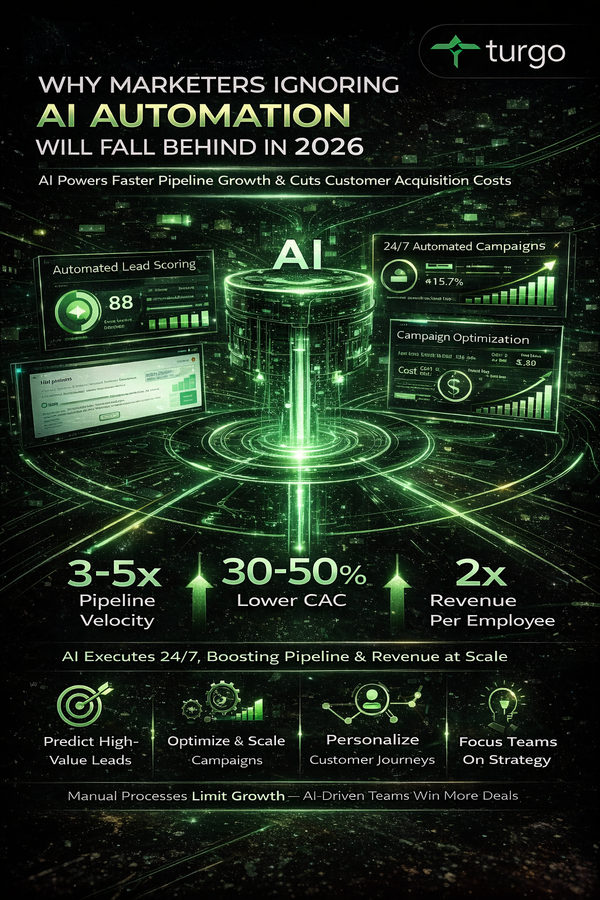
Consider the strategic advantage of AI automation in your marketing efforts. It’s an opportunity to drive pipeline growth, improve CAC efficiency, and bring clarity to your GTM execution. Evaluate its potential for your team today.
Citations:
- [1] https://www.productmarketingalliance.com/your-guide-to-go-to-market-strategies/
- [2] https://blog.growstack.ai/how-internal-posting-boosts-pipeline-and-reduces-cac/
- [3] https://xgrowth.com.au/blogs/go-to-market-strategy-framework/
- [4] https://online.hbs.edu/blog/post/go-to-market-strategy-framework
- [5] https://www.coursera.org/articles/go-to-market-strategy
- [6] https://www.salesforce.com/sales/go-to-market-strategy/
- [7] https://www.leanlabs.com/blog/components-of-a-go-to-market-strategy
- [8] https://reteno.com/glossary/go-to-market-gtm-strategy
- [9] https://www.highspot.com/blog/go-to-market-strategy/
- [10] https://amplitude.com/glossary/terms/go-to-market-strategy