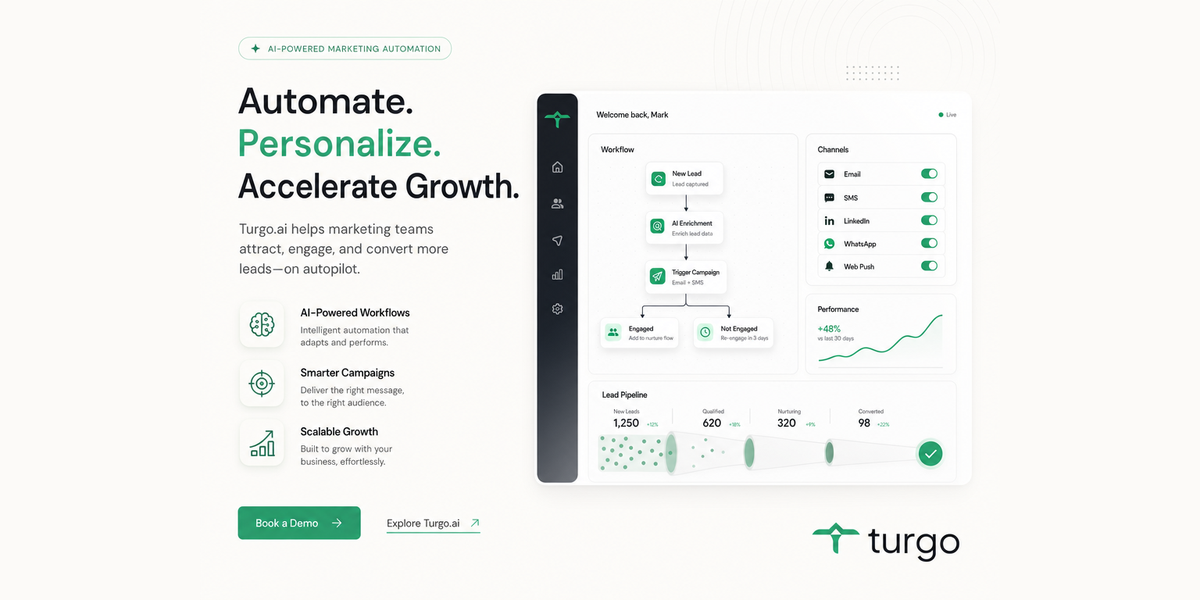
How AI Automation Cuts CAC and Accelerates Campaign Velocity
AI automation reduces launch cycles by 50–70%, improves pipeline velocity, and lowers CAC by replacing manual campaign workflows with real-time optimization.
AI Automation Accelerates Marketing Campaigns
AI automation in marketing uses intelligent software agents and tools to handle repetitive tasks like audience targeting, content creation, and performance analysis, enabling teams to launch campaigns in days instead of weeks. These systems learn from data patterns to optimize in real time, making campaigns not just faster but more effective at driving revenue.
For growth teams under pressure to deliver pipeline quickly, this shift matters because manual processes slow velocity and inflate costs, while AI cuts launch times by 50-70% and boosts ROI through precise targeting. Revenue leaders prioritizing scalable GTM see campaigns that generate qualified leads faster, shortening sales cycles and improving customer acquisition costs.
What Are AI Agents in Marketing?
AI agents in marketing are autonomous software programs that execute multi-step tasks, such as building personalized email sequences or running A/B tests, without constant human input. They integrate data from multiple sources to make decisions that align with campaign goals.
Growth teams use these agents to automate complex workflows, freeing marketers to focus on strategy and yielding outcomes like 30% higher open rates and reduced manual errors. Tradeoffs include initial setup time versus long-term efficiency gains, with the decision hinging on campaign volume—high-volume teams benefit most.
A SaaS company launching a product webinar series manually took 3 weeks per event, with 15% attendance and $50K pipeline per event. Switching to AI agents cut prep to 4 days, lifted attendance to 28%, and generated $120K pipeline per event, dropping CAC by 40% as agents optimized invites based on past engagement data.
Why Does Speed Matter in Campaign Launches?
Speed in campaign launches directly accelerates pipeline velocity, allowing revenue to compound faster as leads enter sales funnels sooner. For CMOs allocating budget, faster launches mean testing more variations and iterating toward higher conversions.
The tradeoff is quality versus quantity—rushing without AI risks poor targeting, but AI ensures speed without sacrificing precision, often improving ROI by enabling real-time adjustments. Teams decide based on market windows; in competitive spaces, a 1-week edge captures 20-30% more market share.
A B2B tech firm faced a seasonal buying surge; manual campaigns lagged by 10 days, missing $300K in potential pipeline. AI automation launched in 3 days, capturing the window with 2x lead volume at the same CAC, resulting in $650K closed-won revenue that quarter.
How Do AI Marketing Optimization Tools Work?
AI marketing optimization tools analyze campaign data continuously to adjust variables like bids, messaging, and timing for maximum performance. They predict outcomes using historical patterns and machine learning.
For revenue leaders, these tools support decisions on scaling spend by automating tweaks that lift conversions 20-40%, with tradeoffs in data dependency—strong data yields big wins, sparse data requires hybrids. Operators integrate them into existing stacks for seamless velocity gains.
An e-commerce brand's paid social campaigns averaged 2.5% conversion pre-AI, with monthly manual optimizations costing 20 engineer hours. AI tools automated adjustments, pushing conversions to 4.1% in week one, adding $180K revenue monthly while cutting optimization time to zero and CAC by 25%.
What Is Marketing Automation Enhanced by AI?
Marketing automation enhanced by AI goes beyond basic scheduling to include predictive personalization and anomaly detection, turning static workflows into dynamic revenue engines. It sequences customer journeys intelligently across channels.
Growth marketers decide to adopt when pipeline predictability lags; AI resolves this by boosting nurture completion rates 35%, trading upfront integration for sustained LTV growth. For founders, it scales lean teams without headcount bloat.
A fintech startup's drip campaigns had 12% completion rates, generating sporadic $40K monthly pipeline. AI-enhanced automation personalized based on behavior, hitting 45% completion, $140K pipeline, and shortening sales cycles from 60 to 38 days, with CAC falling 28%.
Can AI Agents Handle Full Campaign Creation?
Yes, AI agents can create full campaigns by generating assets, segmenting audiences, and scheduling delivery from a single prompt describing goals and audience. They iterate based on early feedback loops.
For demand gen managers, this supports rapid testing decisions, cutting creation time 60-80% and improving relevance for 25% better engagement. Tradeoffs involve creativity oversight—AI excels at scale but pairs best with human strategy.
A growth agency built Q4 campaigns manually in 2 weeks each, yielding $200K pipeline at $120 CAC. AI agents produced 5 variants in 2 days, with the top performer driving $450K pipeline at $85 CAC, enabling 3x more campaigns and 40% velocity lift.
Why Integrate AI in Email Marketing?
Integrating AI in email marketing personalizes at scale, predicts send times, and optimizes subject lines to boost opens and clicks by 30-50%, directly feeding hotter leads to sales. It turns emails from blasts into revenue drivers.
CMOs prioritize this for high-ROI channels; tradeoffs are list quality dependency versus automation ease, deciding based on email's pipeline share. RevOps teams use it to align with sales handoffs seamlessly.
A SaaS provider's newsletters averaged 18% opens and 2% clicks, contributing $60K quarterly pipeline. AI integration personalized content and timing, lifting to 32% opens, 5% clicks, $210K pipeline, and reducing unsubscribe rates by 15% while halving list management time.
How Does AI Improve Digital Marketing ROI?
AI improves digital marketing ROI by allocating budget to top-performing tactics in real time, reducing waste and scaling winners to achieve 2-4x returns on ad spend. It focuses spend where conversions peak.
For revenue leaders evaluating tools, this supports ROI-focused budgets; tradeoffs include learning curves versus immediate gains in data-rich environments. Outcomes emphasize pipeline quality over volume.
An online retailer spent $500K annually on ads with 3.2x ROAS. AI reallocated dynamically, hitting 5.8x ROAS, adding $1.2M revenue, and dropping CAC from $45 to $28 per customer, with pipeline velocity up 35% from faster iterations.
What Role Do AI Agents Play in Social Media?
AI agents in social media schedule, engage, and analyze content to elevate strategies, growing reach 40% while maintaining brand voice through sentiment-aware responses. They turn platforms into lead gen machines.
Growth teams use them for consistent presence without burnout; tradeoffs are authenticity risks, mitigated by human review gates. Founders decide based on social's role in top-of-funnel pipeline.
A consumer brand managed social manually, gaining 5K followers quarterly at 1% engagement. AI agents optimized posting and replies, exploding to 22K followers, 4.2% engagement, and $90K pipeline from DM leads, cutting content costs 50%.
When Should Teams Adopt AI for Campaigns?
Teams should adopt AI for campaigns when manual processes exceed 1-2 weeks per launch or CAC climbs above 3-month payback thresholds. It's ideal for scaling beyond 10 campaigns monthly.
For GTM leaders prioritizing velocity, this decision hinges on growth stage—Series A+ benefits most from efficiency. Tradeoffs favor AI when data maturity supports it, yielding 25-50% faster launches.
A mid-stage startup hit bottlenecks at 8 campaigns/month, with $300K pipeline but rising CAC to $150. Adopting AI dropped launch time to 3 days, scaled to 25 campaigns, generated $950K pipeline, and normalized CAC at $95.
Does AI Replace Marketers in Campaign Planning?
No, AI augments marketers by handling execution and optimization, letting strategists focus on high-level decisions that drive outsized outcomes like 30% pipeline growth. It elevates roles from tactical to visionary.
Demand gen managers decide integration levels based on team size; tradeoffs are skill shifts, with upskilling yielding 2x productivity. Outcomes show hybrid teams outperform pure manual or full AI.
A marketing team of 12 spent 60% time on ops, yielding $2M annual pipeline. AI took ops, freeing time for strategy, boosting pipeline to $3.4M, conversions up 28%, and team morale as focus shifted to creative wins.
How to Measure AI's Impact on Campaign Velocity?
Measure AI's impact on campaign velocity by tracking time-to-launch, pipeline per week, and sales cycle reduction, targeting 40-60% improvements in end-to-end speed. Use dashboards for real-time visibility.
RevOps teams decide metrics alignment with revenue goals; tradeoffs involve baseline establishment, but clear KPIs justify budgets. For growth leaders, velocity ties directly to quarterly targets.
Pre-AI, a firm launched bi-weekly with 14-day cycles, $150K weekly pipeline. Post-AI, weekly launches in 4 days generated $320K weekly, cycles to 9 days, and 55% velocity gain, enabling aggressive scaling.
Can AI Personalization Boost Conversion Rates?
Yes, AI personalization boosts conversion rates 20-40% by tailoring content to individual behaviors and preferences across channels. It makes every interaction feel bespoke, accelerating funnel progression.
For founders assessing tools, this supports lean GTM with high LTV; tradeoffs are privacy compliance, balanced by value delivery. Outcomes focus on revenue per lead.
A lead gen agency saw 8% conversions from generic campaigns, $400K pipeline yearly. AI personalization hit 14% conversions, $780K pipeline, with LTV up 32% from better-qualified leads entering sales.
Why Prioritize AI in Multi-Channel Campaigns?
Prioritizing AI in multi-channel campaigns unifies data for cohesive experiences, lifting cross-channel conversions 35% and pipeline attribution accuracy. It prevents siloed efforts from diluting impact.
CMOs allocate budgets here for holistic GTM; tradeoffs are integration complexity, offset by unified ROI views. Revenue teams gain from synchronized velocity.
A brand ran disjointed email/social/ads, with 12% overall conversion and fragmented $500K pipeline. AI orchestration synced channels, pushing 18% conversion, $1.1M pipeline, and 25% CAC reduction through better attribution.
What Tradeoffs Come with AI Campaign Tools?
Tradeoffs with AI campaign tools include higher upfront costs and data needs versus 50%+ time savings and ROI lifts, with decisions favoring mature data environments. Reliability improves with usage.
For revenue decision-makers, evaluate against manual baselines; outcomes prioritize scalable growth over perfection. Operators manage integrations for net gains.
A growth team invested $50K in AI tools, facing 2-month ramp-up but cutting annual ops costs $200K, boosting pipeline 45% to $4.5M with CAC down 22%, proving long-term dominance.
How Does AI Support GTM Revenue Goals?
AI supports GTM revenue goals by compressing launch cycles and optimizing for pipeline quality, routinely delivering 2x faster revenue ramps. It aligns marketing with sales outcomes precisely.
GTM leaders prioritize for expansion phases; tradeoffs are vendor lock-in risks, mitigated by modular stacks. Focus remains on metrics like ARR growth.
A scaling SaaS hit $10M ARR plateau; AI-driven campaigns launched 4x faster, adding $4.2M pipeline, 28% win rate lift, and $3M new ARR in one year.
Is AI Automation Improving Your GTM Velocity?
AI automation in marketing reduces launch cycles, improves pipeline quality, and lowers CAC through continuous optimization.
Revenue teams that operationalize AI-driven campaign execution gain measurable speed and predictable growth across channels.
FAQ
What’s the biggest ROI win from AI in marketing campaigns?
The biggest ROI win comes from real-time optimization that reallocates budgets to high-performing tactics, often doubling ROAS while cutting CAC 25-40%. Growth teams see this in faster pipeline velocity, where campaigns launch weekly instead of monthly, feeding sales with qualified leads that shorten cycles by 20-30 days. For CMOs, the decision hinges on current inefficiencies— if manual tweaks waste 30% of spend, AI delivers payback in 2-3 months. Tradeoffs include data quality needs, but with clean inputs, outcomes like 3x revenue per campaign make it essential for scaling without headcount growth. Revenue leaders track this via pipeline coverage ratios, ensuring AI drives sustainable expansion.
How quickly can AI cut campaign launch times?
AI typically cuts launch times from weeks to days—often 60-80% faster—by automating audience segmentation, asset creation, and testing. Demand gen managers use this to run more iterations, boosting conversion rates 25% through data-driven variants. The key decision is team readiness; startups with basic data stacks see gains in 1-2 weeks post-setup. Tradeoffs involve oversight to maintain brand voice, but net results include $100K+ extra pipeline per quarter from velocity alone. Founders prioritize when hitting growth walls, as shorter cycles compound revenue faster without proportional cost increases.
Does AI in marketing require a big tech team?
No, AI marketing tools are designed for non-technical users, with drag-and-drop interfaces and pre-built agents handling complexity. RevOps teams integrate in days, focusing on strategy over code, yielding 40% productivity lifts. For operators, the decision is stack compatibility—most play nice with CRMs like Salesforce. Tradeoffs are minimal training time versus massive ops savings, enabling small teams to punch like enterprises. Outcomes show pipeline doubling without hires, as AI scales execution while humans own vision, making it ideal for lean GTM setups chasing aggressive revenue targets.
Can AI agents personalize at enterprise scale?
Yes, AI agents personalize at enterprise scale by processing millions of data points for hyper-targeted messaging, lifting engagement 30-50% across channels. Revenue leaders decide based on audience size; for 100K+ lists, it’s a must for maintaining relevance. Tradeoffs include compliance hurdles like GDPR, solved via built-in controls, with outcomes like 2x LTV from nurtured leads. Growth marketers see sales cycles shrink 25% as personalization warms prospects faster. This scales GTM without proportional costs, turning mass outreach into high-conversion machines.
What if our data isn’t ready for AI marketing?
Start with clean, structured data from CRM and analytics—AI thrives here, delivering 20-40% immediate lifts in campaign performance. For teams with messy data, prioritize audits first; 4-6 weeks prep unlocks full value. CMOs weigh this against manual baselines, where poor data means stalled ROI. Tradeoffs favor phased rollout: test on subsets for quick wins like 15% CAC drops. Outcomes build confidence, with pipeline quality improving as AI refines over time, supporting bolder GTM investments without full overhauls.
How does AI impact marketing team roles?
AI elevates roles from tactical execution to strategic orchestration, boosting productivity 2-3x as agents handle grunt work. Marketers shift to hypothesis testing and creative direction, driving 30% higher pipeline impact. Founders decide for growth stages needing scale; tradeoffs are reskilling, offset by role satisfaction gains. RevOps ensures smooth transitions, with outcomes like faster promotions and revenue ownership. Teams become force multipliers, focusing on high-leverage decisions that accelerate overall GTM velocity.
Is AI worth it for small marketing budgets?
Yes, for budgets under $100K quarterly, AI pays off via efficiency—cutting costs 40% while lifting output, often yielding 2.5x ROAS. Demand gen pros test with low-commit pilots, scaling on proven wins. Tradeoffs are subscription fees, but ROI hits in 1-2 months through optimized spend. For bootstrapped founders, it enables enterprise tactics without big teams, adding $50K+ pipeline monthly. Focus on metrics like velocity to justify, ensuring every dollar works harder toward revenue goals.
What metrics prove AI’s value in campaigns?
Key metrics are time-to-launch (target 50% reduction), CAC (20-30% drop), conversion rates (25%+ lift), and pipeline velocity (40% faster). Track via unified dashboards tying marketing to revenue. GTM leaders baseline pre-AI, then measure uplift; tradeoffs involve attribution setup, but clarity drives budget confidence. Outcomes like $1M+ added pipeline quarterly validate for CMOs. Prioritize these for decisions, ignoring vanity stats to focus on bottom-line growth.
How to avoid AI hype in marketing tools?
Vet tools by demanding outcome proofs like case studies with CAC/ROI numbers, not vague claims—pilot for 30 days on real campaigns. Revenue teams decide on data integration ease and human-AI balance. Tradeoffs are shiny features versus proven execution; stick to agents optimizing core workflows. Results show 35% efficiency without over-reliance, sustaining long-term GTM edges. This pragmatic approach ensures AI amplifies, not distracts from, revenue priorities.
Citations:
- [1] https://www.productplan.com/glossary/go-to-market-strategy/
- [2] https://stripe.com/resources/more/what-is-a-go-to-market-strategy-a-quick-gtm-guide-for-startups
- [3] https://turgo.ai/blogs/ai-driven-personalization-the-40-revenue-risk-of-getting-it-wrong
- [4] https://www.coursera.org/articles/go-to-market-strategy
- [5] https://www.salesforce.com/sales/go-to-market-strategy/
- [6] https://pipeline.zoominfo.com/marketing/go-to-market-strategy
- [7] https://www.leanlabs.com/blog/components-of-a-go-to-market-strategy
- [8] https://catalant.com/sales-and-marketing/ultimate-guide-to-a-successful-go-to-market-strategy/