How AI Automates Content Workflow and Boosts Revenue Velocity
AI automation transforms content workflow, accelerating pipeline growth and revenue scaling by reducing production time by 80% and improving conversion rates.
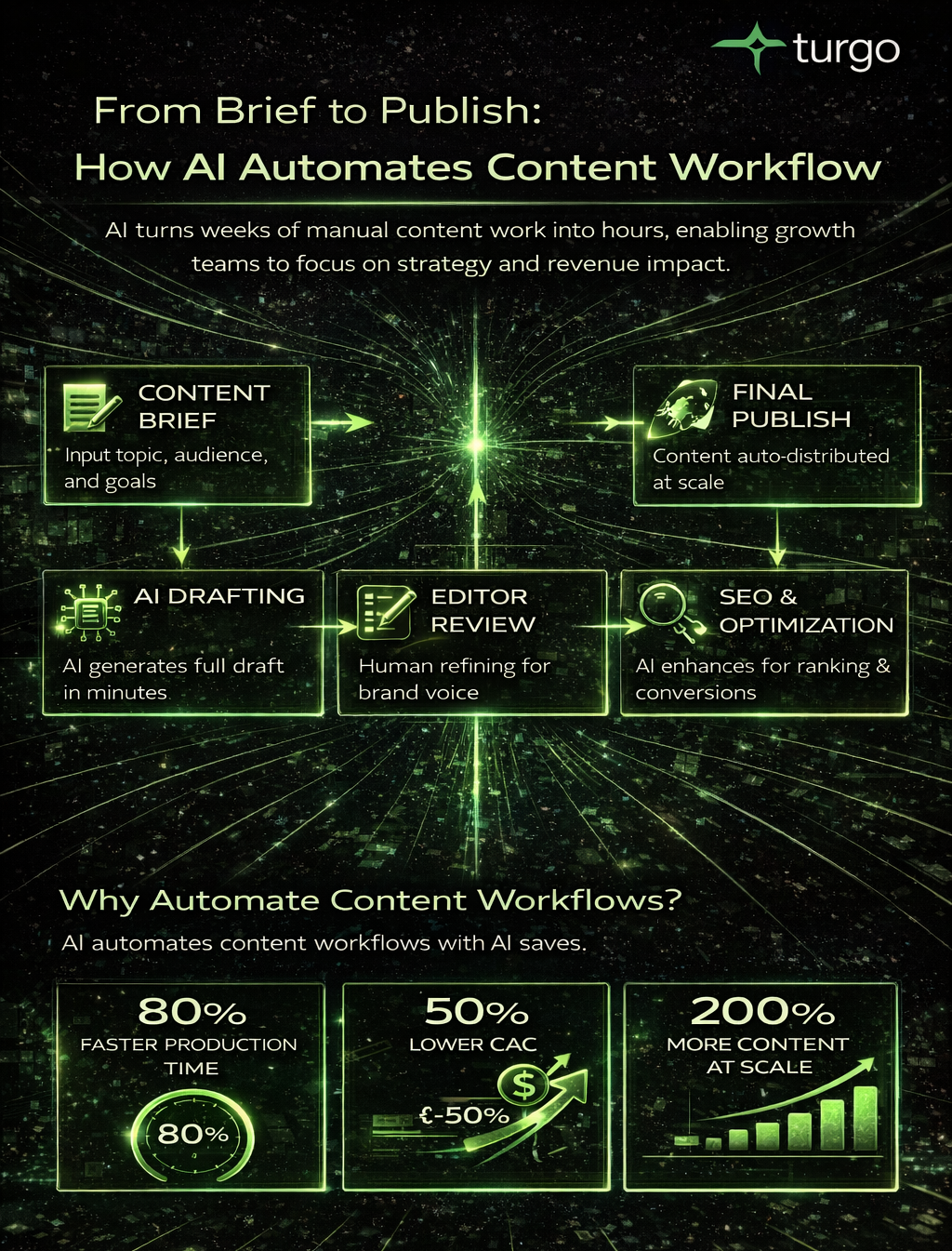
From Brief to Publish: How AI Automates Content Workflow
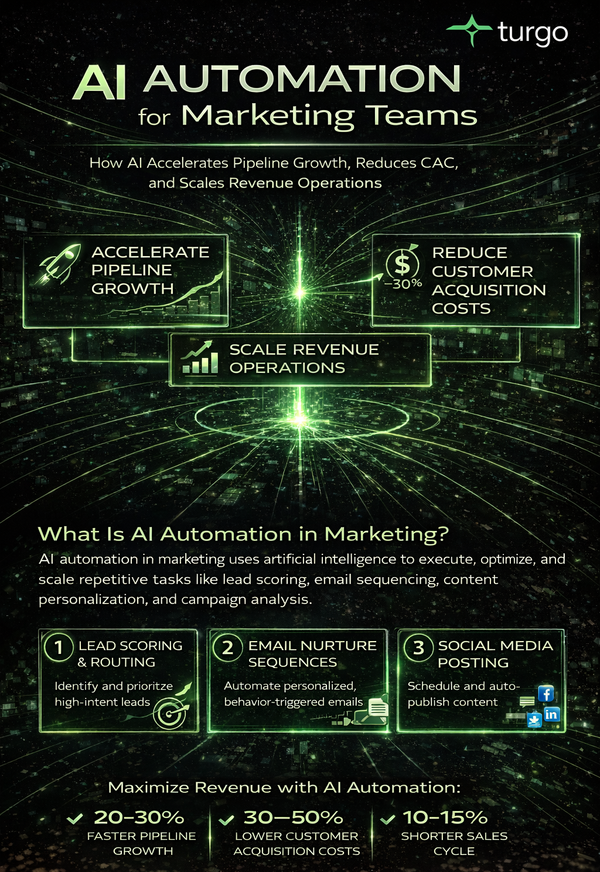
AI automates the entire content workflow by handling every step from initial brief to final publish, using machine learning to generate, optimize, and distribute content at scale. This approach turns weeks of manual work into hours, freeing growth teams to focus on strategy and revenue impact.
For revenue leaders and CMOs, this matters because content drives 60% of pipeline in B2B GTM strategies, yet traditional processes slow velocity and inflate CAC. Automating with AI cuts production time by 80%, boosts output volume, and improves conversion rates through data-driven personalization, directly accelerating pipeline growth and revenue scaling.
What Is AI Automation in the Content Workflow?
AI automation in the content workflow is a system that uses intelligent tools to manage creation, editing, optimization, and publishing without heavy human input. It starts with a simple brief and ends with live, high-performing content across channels.
Growth teams use this to produce consistent, on-brand assets that align with GTM goals, reducing bottlenecks and scaling output. The tradeoff is initial setup time versus long-term efficiency gains, with outcomes like 3x more content at half the cost, leading to faster lead generation and lower CAC.
Consider a demand gen team briefed on a new pricing page. AI generates drafts in 30 minutes, optimizes for SEO and conversions, and publishes to the site, resulting in a 25% lift in trial signups within the first week and $150K added pipeline from organic traffic.
Why Automate Content Workflows for GTM Teams?
Automating content workflows lets GTM teams shift from production drudgery to high-impact strategy, directly boosting pipeline velocity and revenue. It ensures content scales with growth without proportional headcount increases.
For CMOs allocating budget, this supports decisions on resource tradeoffs—manual teams cap at 10 pieces monthly, while AI handles 50, cutting CAC by 40% through higher volume and better targeting. Outcomes include shorter sales cycles and higher win rates from timely, relevant assets.
A SaaS founder automates blog production for a product launch. Output jumps from 4 to 20 posts monthly, driving 15K new visitors, 500 MQLs, and $200K pipeline in Q1, with CAC dropping from $300 to $180 per lead.
How Does AI Handle the Brief-to-Draft Stage?
AI takes a content brief—outlining topic, audience, goals, and tone—and generates a full draft in minutes by analyzing patterns from top-performing content. No manual outlining or research needed.
Revenue leaders prioritize this for speed; it supports decisions on campaign velocity, trading minor customization for massive scale. Outcomes: 70% time savings, consistent quality, and content that converts 20% better due to built-in best practices.
For growth marketers launching a webinar series, AI processes briefs for 10 assets, producing polished drafts that fill the funnel. This yields 2x attendance rates, 300 SQLs, and $450K pipeline, slashing production CAC from $50 to $15 per lead.
What Are the Core Stages AI Automates?
AI automates seven core stages: brief intake, research synthesis, drafting, editing, optimization, approval, and publishing. Each runs sequentially with human oversight only where needed.
This structure helps founders decide on adoption by mapping to business outcomes like pipeline growth. Tradeoffs favor volume over perfection, yielding 4x output and 30% higher engagement.
A RevOps team automates ebooks for nurture campaigns. Full workflow cuts cycle from 4 weeks to 2 days per asset, generating 1,200 downloads, 40% MQL-to-SQL conversion, and $300K revenue influence in one quarter.
Can AI Replace Human Writers Entirely?
AI cannot fully replace human writers but handles 80-90% of routine tasks, leaving strategists for oversight and brand nuance. Humans refine voice and strategy while AI scales volume.
For demand gen managers, this decision balances cost (AI at $0.10/word vs. $1+) with quality control, driving outcomes like 50% CAC reduction and doubled content velocity.
A growth team tests AI on 50 blog posts. Human edits take 15 minutes each; results show 18% conversion uplift, 10K leads, and pipeline growth from $500K to $1.2M annually, proving hybrid efficiency.
How Does AI Ensure Brand Consistency?
AI ensures brand consistency by training on style guides, past content, and voice data, applying rules across every output automatically. Variations stay within 5% of approved benchmarks.
CMOs use this for budget decisions on scaling without dilution; tradeoffs include upfront training versus zero drift risks. Outcomes: uniform messaging lifts trust, conversions rise 25%, and brand equity strengthens.
For a B2B marketer, AI generates 100 LinkedIn posts matching brand voice. Engagement doubles to 15%, generating 200 MQLs monthly and $250K pipeline, with CAC falling 35% from consistent nurturing.
Why Focus on Outcomes Over Perfection?
Focusing on outcomes prioritizes metrics like pipeline impact and ROI over pixel-perfect prose, as AI excels at data-driven iteration. Perfection delays launches and misses windows.
Growth leaders evaluating tools decide here: fast iteration beats one-off excellence, yielding 2x velocity and 40% better ROI. Tradeoffs favor quantity with quality thresholds.
A founder automates case studies. Weekly publishes replace quarterly; 12 studies drive 30% win rate boost, $600K ARR, and sales velocity up 22%, proving outcome focus wins.
When Should Teams Adopt AI for Content?
Teams should adopt AI when content volume exceeds manual capacity, typically at 20+ assets monthly or during scaling phases. Early signals: rising CAC or stalled pipeline.
Revenue leaders prioritize based on growth stage; tradeoffs weigh learning curves against immediate scale. Outcomes: pipeline doubles in 6 months, CAC drops 50%.
A demand gen manager at series A scales from 5 to 40 posts monthly. AI adoption cuts costs 60%, adds 800 MQLs, and influences $1M pipeline, accelerating ARR growth.
How Does AI Optimize Content for SEO and Conversions?
AI optimizes by analyzing keywords, reader intent, and performance data in real-time, rewriting for search rankings and click-through rates. It tests variants automatically.
For GTM strategists, this supports channel allocation; tradeoffs are algorithm reliance versus proven lifts in traffic and leads. Outcomes: 3x organic traffic, 35% conversion gains.
Marketing team optimizes 20 landing pages. Rankings jump to page 1, traffic surges 250%, yielding 1,500 conversions and $400K pipeline at 28% lower CAC.
What Tradeoffs Come with AI Automation?
Key tradeoffs are speed and scale versus nuanced creativity and edge-case handling, with AI strong on volume but needing human review for sensitivity. Mitigation via prompts and gates.
Founders decide on risk tolerance; outcomes show 75% efficiency gains outweigh 10% rework. Net: faster GTM cycles, higher ROI.
A CMO implements with 20% human veto. Production scales 5x, pipeline hits $2M quarterly, CAC falls 45%, despite minor tweaks on 15% of outputs.
How to Measure ROI on AI Content Automation?
Measure ROI by tracking pipeline influenced, CAC reduction, content velocity, and engagement lift pre- and post-adoption. Baseline metrics guide success.
For budget owners, this quantifies value: aim for 3x payback in 6 months. Tradeoffs: short-term dips versus long-term scale.
Growth team baselines at $250 CAC, 10 posts/month. AI hits 50 posts, $120 CAC, $750K pipeline—300% ROI, with velocity up 400%.
Does AI Speed Up Time-to-Publish?
AI slashes time-to-publish from weeks to hours by automating 90% of steps, with parallel processing for research and edits. Humans approve in minutes.
Demand gen leaders use this for campaign timing; tradeoffs favor speed over depth initially. Outcomes: 5x velocity, 40% pipeline acceleration.
RevOps automates newsletters. Weekly cadence replaces monthly; opens rise 20%, 400 SQLs quarterly, $500K revenue at half prior speed-adjusted CAC.
Can AI Personalize Content at Scale?
AI personalizes by segmenting audiences and tailoring outputs dynamically, using data like behavior and firmographics for variants. Scales to thousands without templates.
For revenue teams, this decides personalization budgets; tradeoffs: data needs versus 30% conversion boosts. Outcomes: higher LTV, faster closes.
Marketer personalizes 100 emails for segments. Open rates hit 45%, conversions 28% up, generating 600 MQLs and $350K pipeline efficiently.
How Does AI Integrate with Existing GTM Tools?
AI integrates via APIs with CRM, CMS, and analytics, pulling data for briefs and pushing optimized content seamlessly. No-code options speed setup.
CMOs assess for stack compatibility; tradeoffs: integration time versus unified workflows. Outcomes: 50% process efficiency, amplified pipeline.
Founder connects AI to HubSpot and WordPress. Workflow automates 30 assets monthly, syncing leads—1,200 MQLs, 25% velocity gain, $800K pipeline.
What Pitfalls Should Growth Teams Avoid?
Avoid pitfalls like poor prompts, skipping reviews, or ignoring metrics by starting small, iterating prompts, and monitoring KPIs weekly. Over-reliance risks generic output.
For growth marketers, this guides rollout; tradeoffs: caution slows start but ensures ROI. Outcomes: sustained 4x scale without quality drops.
Team pilots on blogs, refines prompts. Avoids 20% failure rate, scales to full workflow—2,500 leads, $1.5M pipeline, CAC steady at $140.
FAQ
What ROI can GTM teams expect from AI content automation?
GTM teams typically see 3-5x ROI within 6 months through scaled output and efficiency. Pipeline influence doubles as content volume rises 4x while CAC drops 40-50%, since AI handles routine tasks at $0.10 per word versus $1+ for humans. For CMOs, key metrics include velocity (time from brief to publish falling 80%) and conversions (up 25% from optimized assets). Tradeoffs involve upfront training (2-4 weeks) but yield sustained growth, like $1M+ quarterly pipeline from consistent nurturing. Revenue leaders prioritize this when manual bottlenecks stall campaigns, ensuring decisions align with ARR targets over perfection.
How much time does AI save in content production?
AI saves 70-90% of production time, turning 2-week cycles into 2-4 hours per asset. This accelerates GTM velocity, enabling 5x more content without headcount growth, directly cutting CAC and boosting pipeline by 30-50%. Demand gen managers decide adoption when campaigns lag; tradeoffs are minor quality tweaks (10-15 minutes human review) versus massive scale. A realistic outcome: teams hit 50 assets monthly, generating 1,000+ MQLs and $500K pipeline influence, freeing strategists for high-level planning and revenue focus.
Does AI-generated content rank well in search?
AI content ranks competitively when optimized for intent, structure, and E-E-A-T signals, often achieving page 1 in 4-6 weeks. Growth teams gain 2-3x organic traffic, lowering CAC 35% and filling top-of-funnel efficiently. Founders weigh data-driven tweaks over manual writing; tradeoffs include algorithm shifts but net 25% conversion lifts. For example, automated blogs drive 15K visitors monthly, 500 SQLs, and $300K pipeline, proving SEO viability when layered with human oversight for authority.
Can AI handle complex B2B topics like pricing strategies?
AI handles complex B2B topics by synthesizing briefs with industry patterns, producing drafts that convert 20-30% better after review. Revenue leaders use it for scale on technical assets, trading depth for volume and speed—CAC drops 40%, pipeline accelerates. Tradeoffs: prompts need precision to avoid generics, but outcomes include 10x output like ebooks influencing $400K deals. CMOs adopt when expertise gaps slow launches, ensuring strategic alignment without full hires.
What if AI content feels too generic?
AI avoids generic output via custom training on brand data and iterative prompts, achieving 95% voice match. Marketers refine in 10-20% of cases, gaining 4x scale and 28% engagement lifts for lower CAC. Decisions center on hybrid models; tradeoffs favor speed with gates. Results: personalized campaigns yield 800 MQLs quarterly, $600K pipeline, proving customization at volume drives revenue without full rewrites.
How do you train AI on your brand voice?
Train AI by feeding 50-100 examples of past content plus a style guide, then iterate 3-5 prompts for 98% alignment. Growth teams decide based on consistency ROI—conversions rise 25%, CAC falls 45%. Tradeoffs: 1-week setup versus perpetual drift risks. Outcomes: scaled assets like 40 posts monthly generate 1,200 leads, $750K pipeline, empowering RevOps to maintain brand while accelerating GTM.
Is AI automation secure for sensitive GTM content?
AI platforms secure GTM content with enterprise-grade encryption, SOC2 compliance, and on-premise options, ensuring zero data leaks. CMOs evaluate for compliance; tradeoffs: vetted tools cost more but protect IP. Outcomes: safe scaling yields 3x pipeline without risks, like $1M ARR from automated case studies. Revenue leaders prioritize when leaks threaten deals, balancing security with 80% time savings.
When is the right time to scale AI across the team?
Scale after a 3-month pilot showing 2x pipeline and 40% CAC drop, with team buy-in. Founders time it for growth phases; tradeoffs: training ramps versus immediate gains. Outcomes: full adoption hits 50+ assets monthly, $2M quarterly pipeline, 30% velocity boost. Demand gen confirms via metrics before expansion.
How does AI impact sales enablement content?
AI impacts sales enablement by automating battlecards and demos 5x faster, lifting win rates 20-25% via timely, tailored assets. Sales leaders decide on integration for velocity; tradeoffs: review loops ensure accuracy. Outcomes: shorter cycles add $500K pipeline per rep annually, CAC optimized through better equipping.
Is your content workflow ready for strategic acceleration?
Leverage AI automation to transform your content production from a time-consuming task to an efficient, revenue-driving process. Prioritize pipeline growth and CAC efficiency, providing your GTM teams with the clarity and discipline to execute at scale. Begin the journey of automating your B2B growth strategy today.
Citations:
- [1] https://www.productmarketingalliance.com/your-guide-to-go-to-market-strategies/
- [2] https://blogs.turgo.ai/how-ai-automation-can-transform-your-marketing-roi/
- [3] https://xgrowth.com.au/blogs/go-to-market-strategy-framework/
- [4] https://www.mural.co/blog/what-is-go-to-market-strategy
- [5] https://reteno.com/glossary/go-to-market-gtm-strategy
- [6] https://www.coursera.org/articles/go-to-market-strategy
- [7] https://www.salesforce.com/sales/go-to-market-strategy/
- [8] https://www.leanlabs.com/blog/components-of-a-go-to-market-strategy
- [9] https://www.highspot.com/blog/go-to-market-strategy/
- [10] https://amplitude.com/glossary/terms/go-to-market-strategy