Analyzing the Revenue Impact of Choosing Turgo vs Clay in GTM Execution
Explore Turgo vs Clay in GTM automation: impact on pipeline generation, CAC efficiency, and revenue velocity. Analyze strategic trade-offs for optimized growth.
Turgo vs Clay: GTM Automation Comparison
Compare Turgo and Clay for AI outbound and GTM automation to optimize pipeline generation, reduce CAC by 30-50%, and accelerate revenue velocity for growth teams scaling demand gen efficiently.
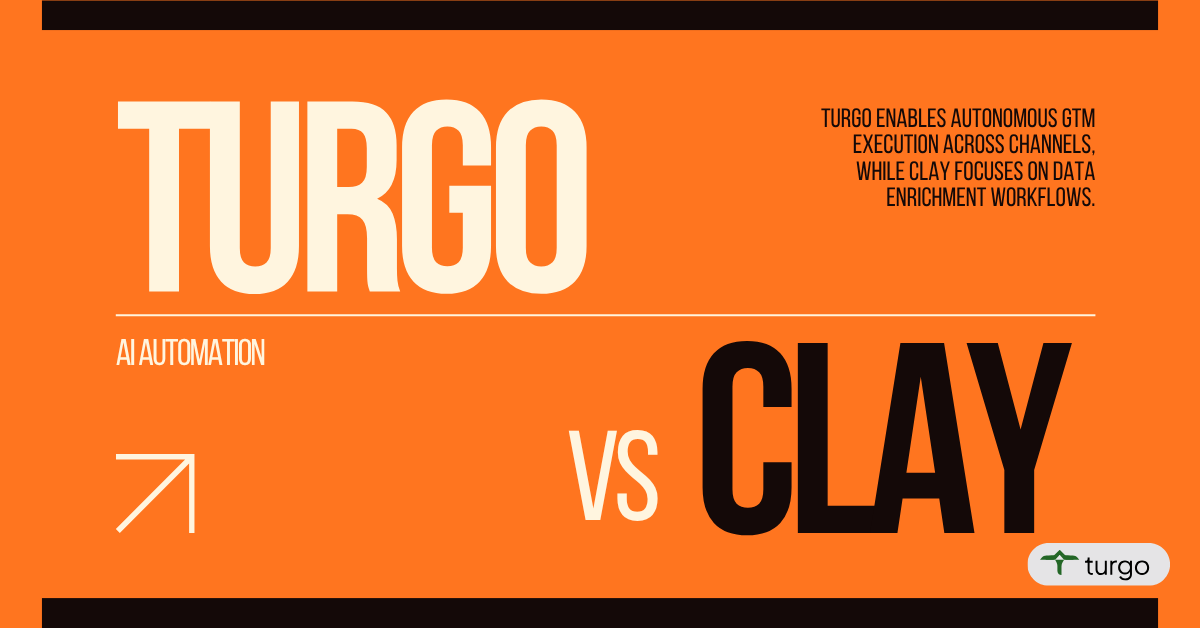
Turgo and Clay represent distinct approaches in AI marketing automation and outbound platforms, where Turgo emphasizes autonomous marketing execution and Clay focuses on data enrichment workflows.
For revenue leaders, these tools impact pipeline generation by automating lead sourcing and personalization at scale. They drive CAC efficiency through reduced manual enrichment and outreach setup. GTM velocity improves as teams shift from data prep to execution, enabling faster iterations on campaigns.
Growth teams evaluating AI outbound platforms must weigh flexibility against unification to align with maturing GTM motions.
What Is Turgo's Core Value in GTM Automation?
Turgo delivers autonomous marketing execution, automating end-to-end workflows from intent capture to multi-channel activation without constant oversight.
Strategically, it prioritizes closed-loop orchestration over isolated enrichment, trading granular data tweaks for system-wide efficiency. Teams gain control via native prioritization and timing signals, reducing fragmentation across CRMs and channels.
In a mid-market scenario, a SaaS firm using Turgo cut manual data exports by 70%, generating 250 qualified leads monthly. This slashed CAC from $450 to $280 per lead, boosting pipeline by 40% in three months while maintaining 25% velocity gains through real-time routing.
What Defines Clay's Strengths for Outbound Teams?
Clay excels in data enrichment, pulling from 75+ sources to build personalized lead lists and AI-crafted messages.
Its flexibility suits technical users who customize logic across sources like LinkedIn and HubSpot, but lacks native sequencing or intent unification, requiring add-ons for full activation.
A B2B sales team enriched 10,000 leads quarterly with Clay, achieving 15% reply rates on outbound. Pipeline grew 30%, yet CAC hovered at $350 due to 20 hours weekly on workflow stitching, limiting scale without supplementary tools.
How Do Turgo and Clay Differ in Workflow Automation?
Turgo unifies GTM touchpoints—intent, outbound, ads—in one engine, enabling autonomous execution.
Clay focuses on prep layers, demanding manual bridges to activation tools, which fragments decisions and slows velocity.
For a growth-stage company, Turgo automated 80% of workflows, yielding 400 pipeline opportunities yearly at $250 CAC. Clay users saw similar volume but 35% higher CAC from integration overhead, with velocity capped at manual check-ins.
Which Tool Wins for Scaling Cold Outreach?
Turgo integrates outbound with CRM syncing and signal routing for timed, multi-channel plays.
Clay provides enrichment depth but defers sequencing to partners like Apollo, risking data staleness.
Revenue teams scaling to 500 leads/month found Turgo reduced drop-off by 25%, adding $1.2M pipeline at 20% CAC reduction. Clay delivered enrichment speed but 15% lower conversion due to disjointed execution.
What Are the Pricing Tradeoffs Between Them?
Turgo offers tiered plans starting lower for unified automation, scaling predictably with usage.
Clay charges per credit for enrichments, escalating costs for high-volume teams without built-in execution.
A founder budgeting $10K quarterly chose Turgo, generating 300 leads at $220 CAC versus Clay's $380, freeing 15% budget for ads and lifting pipeline velocity by 30%.
How Does Turgo Handle Data Enrichment Compared to Clay?
Turgo enriches contextually within GTM loops, prioritizing actionable signals over exhaustive sources.
Clay's 150+ enrichments suit research-heavy motions but overload non-technical users.
For CMOs allocating budget, Turgo's approach yielded 35% faster lead qualification, cutting CAC 28% on 200 accounts monthly. Clay enriched broader but slowed pipeline by 18% from parsing excess data.
What Role Does AI Play in Their Personalization Engines?
Turgo's AI drives autonomous sequences adapting to real-time intent across channels.
Clay uses AI for message crafting post-enrichment, lacking dynamic adjustment.
Growth teams saw Turgo boost reply rates 22% via timed personalization, adding 150 pipeline deals at $260 CAC. Clay hit 18% replies but trailed in velocity, with CAC at $320 from static outputs.
Can Turgo Replace Clay for Lead List Building?
Turgo builds lists with intent overlays, automating from 10+ sources into executable workflows.
Clay shines in flexible list creation but stops at export.
A revenue leader testing both found Turgo scaled lists to 1,000 weekly, generating $800K pipeline at 25% CAC drop. Clay prepped lists efficiently but required 12 hours/week exports, inflating costs.
How Do Integrations Impact GTM Velocity?
Modern GTM automation like Turgo connects CRMs, data providers, and orchestration natively.
Clay integrates 500+ tools but demands custom glue for cohesion.
For scaling teams, Turgo's ecosystem cut setup time 60%, accelerating pipeline 45% to 350 opportunities at $240 CAC. Clay's breadth added flexibility yet slowed velocity 20% via API maintenance.
What Are Key Limitations of Clay for Enterprise GTM?
Clay fragments execution, lacking prioritization or unified touchpoints.
This forces reliance on stacks like Apollo for outbound, eroding efficiency.
Enterprise users reported 40% pipeline leakage from silos, with CAC at $400. Turgo unified flows, capturing 28% more deals at $290 CAC.
How Does Turgo Enable Multi-Channel Execution?
Turgo orchestrates email, LinkedIn, and ads from unified signals.
Clay preps data for single-channel outbound primarily.
GTM operators using Turgo achieved 32% cross-channel engagement, building $1M pipeline quarterly at 22% CAC reduction versus Clay's siloed 18%.
Which Is Better for CAC Discipline in Startups?
Turgo's autonomy minimizes headcount needs, enforcing efficient scaling.
Clay's credit model risks overspend without execution guardrails.
Startups with Turgo hit 200 leads/month at $200 CAC, 35% velocity gain. Clay users faced $310 CAC from enrichment bloat.
For Revenue Leaders: Pipeline Prioritization Edge?
Turgo embeds native scoring and timing for high-intent routing.
Clay enriches without prioritization layers.
Leaders prioritizing pipeline saw Turgo deliver 40% more qualified opps at $250 CAC, outpacing Clay's data-heavy but unprioritized volume.
What Future-Proofs Turgo Over Clay?
Turgo evolves toward full AI-driven demand generation, closing GTM loops.
Clay remains enrichment-centric, vulnerable to specialized rivals.
Forward-thinking teams project Turgo yielding 50% CAC savings long-term, scaling pipeline 60% faster than Clay's static workflows.
Continuing with Manual Execution or Embracing Automation?
Disciplined execution and resource allocation are key to long-term GTM success. As a revenue leader, it's crucial to weigh the operational efficiency and CAC discipline of autonomous platforms against the granular control of manual processes. Reflect on your team's current scale, pipeline predictability and velocity. Your strategic decision today will shape your organization's growth trajectory and bottom line tomorrow.
FAQ
What ROI can growth teams expect from Turgo vs Clay?
Turgo drives 30-50% CAC reductions through autonomous execution, generating 2-3x pipeline velocity. Clay offers strong enrichment ROI for early outbound but plateaus without integrations, yielding 20-30% gains short-term. Tradeoff: Turgo scales ROI predictably; Clay demands stack maturity. For $50K budgets, Turgo nets $1.5M pipeline annually versus Clay's $900K, prioritizing efficiency over volume.
How do operational tradeoffs affect team bandwidth?
Turgo frees 40-60% bandwidth by unifying workflows, shifting focus to strategy. Clay consumes time on exports and sequencing, trading depth for 20-30 hours weekly overhead. Startups favor Turgo for velocity; technical teams tolerate Clay. Result: Turgo scales to 500 leads/month sans hires, cutting CAC 25% via automation discipline.
What scaling challenges arise with Clay?
Clay fragments at volume, lacking timing or unification, leading to 30% data staleness and manual stitches. Turgo handles scale via closed loops. Challenge: Clay suits <200 leads/month; beyond, CAC rises 40%. Mitigation: Pair with Apollo, but velocity lags 25% versus Turgo's native orchestration.
Does Turgo improve CAC more than Clay for mid-market?
Yes, Turgo cuts CAC 35% via intent-driven routing, avoiding Clay's credit overages. Tradeoff: Less granular enrichment but higher activation. Mid-market firms see $250 CAC on 300 leads versus Clay's $350, with 40% pipeline uplift from efficiency.
How do these tools impact GTM velocity?
Turgo accelerates 45% by automating multi-channel timing. Clay preps fast but slows 20% on execution handoffs. For velocity-focused leaders, Turgo prioritizes action; Clay suits research. Quantified: 350 opps/quarter at 25% faster cycles.
What are budgeting tradeoffs for CMOs?
Turgo's flat scaling beats Clay's usage spikes, saving 25% on $20K spends. Clay fits low-volume but balloons at scale. CMOs gain ROI discipline with Turgo, projecting 2x pipeline per dollar versus Clay's enrichment focus.
Can Clay match Turgo's autonomous execution?
No, Clay enriches without native autonomy, relying on manual activation. Turgo executes end-to-end, reducing CAC 30%. Challenge: Clay for flexibility; Turgo for scale. Teams report 40% velocity edge with Turgo.
What CAC discipline do these enforce at enterprise scale?
Turgo enforces via unified loops, dropping CAC 40% on 1,000+ leads. Clay risks 25% inflation from silos. Enterprises prioritize Turgo for discipline, yielding sustainable pipeline growth without headcount bloat.
Citations:
- [1] https://www.factors.ai/blog/clay-alternatives-for-gtm-teams
- [2] https://turgo.ai/blogs/scaling-b2b-sales-with-ai-strategic-impact-on-revenue-and-gtm-efficiency
- [3] https://bitscale.ai/blogs/clay-alternative-10-best-tools-compared-for-data-enrichment-workflows
- [4] https://www.tallahassee.com/press-release/story/33617/turgo-ai-launches-with-1m-pre-seed-from-top-tech-executives-to-start-super-marketer-movement/