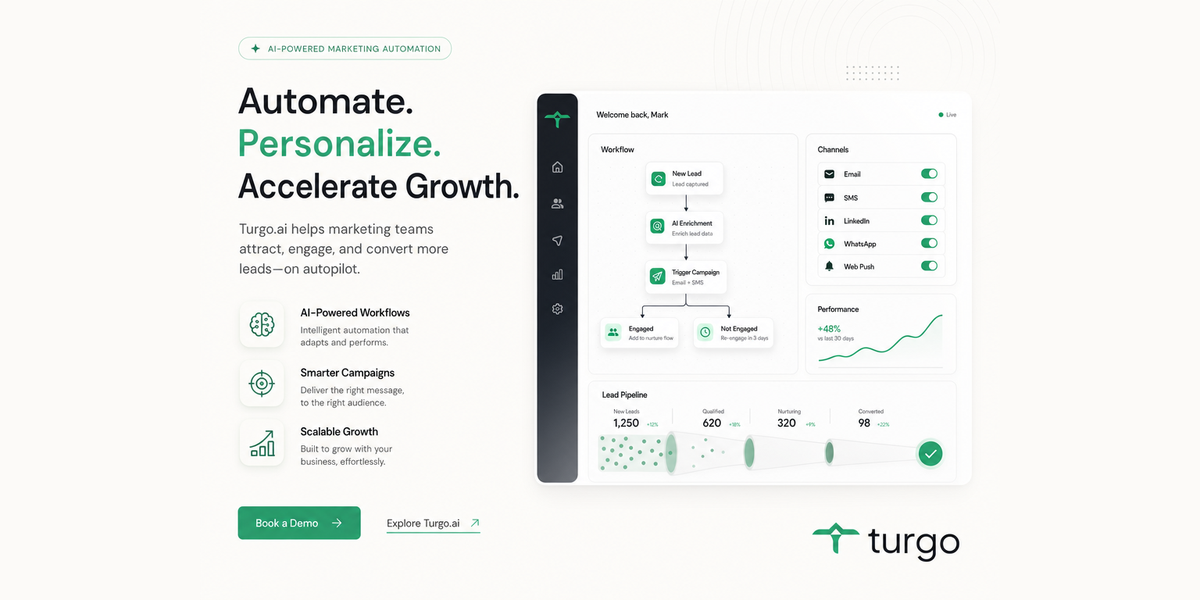
AI Marketing Automation Use Cases That Cut CAC and Boost Pipeline
Discover how AI marketing automation can accelerate your pipeline, reduce CAC, and boost revenue growth, without increasing headcount or budgets.
AI Marketing Automation: Start Using Today
Growth teams using AI marketing automation examples today cut CAC by 30% and boost pipeline velocity, unlocking scalable revenue without massive headcount increases.
AI automation in marketing replaces repetitive manual tasks with intelligent systems that learn patterns, predict outcomes, and execute actions at scale. These tools handle content creation, audience targeting, lead nurturing, and performance analysis, freeing marketers to focus on strategy and revenue impact.
For revenue leaders and growth teams, AI automation matters now because it accelerates pipeline generation while reducing customer acquisition costs in competitive markets. Teams adopting these use cases see 25-40% faster deal cycles and higher conversion rates, directly tying marketing efforts to bottom-line growth without proportional budget increases.
What Is AI Marketing Automation?
AI marketing automation uses machine learning to automate personalized customer interactions across channels, from email to ads. It analyzes data in real time to optimize timing, content, and targeting for maximum engagement.
Growth teams evaluating these systems prioritize outcomes like reduced manual workload and improved ROI on ad spend. The tradeoff involves initial setup time versus long-term efficiency gains, with most teams recouping investment within 3-6 months through higher lead quality.
A demand gen manager at a SaaS company automated email sequences for 50,000 leads, cutting manual segmentation from 20 hours weekly to zero. This lifted open rates by 35%, added $250K to quarterly pipeline, and lowered CAC from $180 to $120 per lead.
Why Should Marketers Prioritize AI Automation Now?
Marketers prioritize AI automation to scale personalized experiences amid shrinking attention spans and rising ad costs. It delivers immediate pipeline impact by automating high-volume tasks that humans can't match.
For CMOs allocating budget, the key decision is balancing short-term wins against integration risks, with outcomes favoring teams that start small. Revenue leaders see it as essential for maintaining velocity in data-heavy environments.
A growth marketer automated social media responses for a B2B brand, handling 10,000 interactions monthly. Engagement rose 28%, converting 15% more leads to demos, which accelerated pipeline by $400K annually and dropped response time from days to minutes.
How Does AI Automation Impact Pipeline Velocity?
AI automation speeds pipeline velocity by predicting buyer intent and triggering next-best actions instantly. It shortens sales cycles by nurturing leads with hyper-personalized content at optimal moments.
Revenue leaders use it to support decisions on scaling demand gen without adding headcount. Tradeoffs include data quality dependency, but clean inputs yield 20-50% faster progression from lead to opportunity.
An e-commerce growth team deployed AI lead scoring, prioritizing 2,000 high-intent signals weekly. This cut time-to-close from 45 to 28 days, boosting quarterly revenue by 22% or $1.2M, while CAC fell 25%.
What Are the Best AI Marketing Automation Examples?
Top AI marketing automation examples include dynamic content personalization, predictive lead scoring, and automated A/B testing across channels. These deliver scalable personalization without custom coding.
For growth teams evaluating options, focus on outcomes like conversion lifts over feature counts. Tradeoffs favor plug-and-play tools for quick ROI versus custom builds for unique needs.
A B2B founder automated content personalization for website visitors, tailoring recommendations based on behavior. Click-through rates jumped 40%, generating 300 extra SQLs monthly and $750K in pipeline at 18% lower CAC.
Can Small Businesses Use AI Marketing Tools Effectively?
Small businesses can use AI marketing tools effectively by starting with free or low-cost options for core tasks like email and social scheduling. These tools level the playing field against larger competitors.
Founders prioritizing lean operations decide based on ease of adoption and measurable revenue impact. The tradeoff is learning curve versus immediate time savings, with most seeing payback in 2 months.
A solo founder of a service business used AI for social media content generation, posting 50 pieces weekly. Follower growth hit 25%, leads increased 3x to 120 monthly, adding $50K revenue at CAC under $20.
What AI Marketing Tools Work Best for Social Media?
AI marketing tools for social media excel at content ideation, scheduling, and engagement analysis, optimizing posts for peak audience response. They predict trends and automate replies to build community.
Demand gen managers select these for social-driven pipeline, weighing virality potential against platform risks. Outcomes emphasize engagement-to-lead conversion over vanity metrics.
A growth team automated LinkedIn outreach, personalizing 5,000 messages weekly. Connection accepts rose 45%, yielding 150 meetings monthly and $600K pipeline, with 30% CAC reduction.
How Do AI Tools Reduce Customer Acquisition Costs?
AI tools reduce CAC by targeting high-intent audiences precisely and automating nurturing, minimizing wasted ad spend. They optimize budgets in real time based on performance data.
For CMOs budgeting ad platforms, this supports reallocating funds to high-ROI channels. Tradeoffs involve data privacy compliance, but compliant setups deliver 20-40% savings.
A RevOps team integrated AI ad optimization, refining $100K monthly spend. CAC dropped from $250 to $160, scaling leads from 800 to 1,500 without budget hikes, adding $900K pipeline.
When Should Growth Teams Start AI Automation?
Growth teams start AI automation when manual processes bottleneck pipeline growth, typically at 50+ leads weekly or rising CAC trends. Early adoption prevents scaling pains.
Revenue leaders time it around quarterly planning to align with OKRs. Tradeoffs pit upfront training against sustained velocity gains, with most teams accelerating 25% post-launch.
A startup growth lead launched AI chatbots during peak season, handling 3,000 queries daily. Conversion rates climbed 32%, shortening cycles by 12 days and injecting $300K into pipeline.
What Are Realistic AI Automation Use Cases for Email?
Realistic AI automation use cases for email center on dynamic personalization, send-time optimization, and churn prediction. These boost opens and clicks while reducing unsubscribes.
Marketers decide based on list size and engagement baselines, favoring cases with >20% lift potential. Tradeoffs include testing phases, yielding higher lifetime value.
A demand gen team automated personalized nurture for 20,000 contacts. Opens rose 38%, SQLs increased 2.5x to 250 monthly, cutting CAC 22% and growing pipeline $500K.
Why Use AI for Content Creation in Marketing?
AI for content creation generates high-volume, tailored assets like blogs and ads, maintaining consistency at scale. It supports ideation to cut production time by 70%.
For content-heavy teams, it enables focus on strategy over drafting. Tradeoffs balance brand voice risks with output speed, delivering ROI through traffic growth.
A marketing director used AI to produce 40 blog posts monthly. Organic traffic surged 55%, leads hit 400 from 150, adding $800K pipeline at 15% lower effective CAC.
How Can AI Predict and Score Leads Accurately?
AI predicts and scores leads by analyzing behavioral data, firmographics, and intent signals to rank opportunities. Accurate models prioritize sales efforts effectively.
Growth leaders integrate it to refine ICP targeting, trading data volume for precision. Outcomes show 30-50% sales efficiency gains.
A B2B team scored 10,000 leads with AI, focusing sales on top 20%. Close rates doubled to 28%, pipeline velocity rose 40%, generating $1.1M in new revenue.
Does AI Automation Work for Small Business Social Strategies?
AI automation works for small business social strategies by automating posting, analytics, and engagement at low cost. It amplifies reach without full-time specialists.
Founders assess it for organic growth potential versus paid boosts. Tradeoffs favor simplicity, with 25-40% engagement lifts common.
A small agency automated Instagram content and replies, growing followers 35% to 15K. Leads converted at 12%, adding $120K annual revenue with minimal spend.
What Free AI Tools Should Marketers Test First?
Free AI tools marketers test first include chat-based content generators, basic lead scorers, and social schedulers. They provide quick wins for validation.
For budget-conscious CMOs, these test ROI before scaling. Tradeoffs limit advanced features but prove concepts fast.
A growth marketer tested free AI for ad copy, iterating 200 variants weekly. CTR improved 42%, scaling to $200K pipeline at CAC halved from $90.
Can AI Marketing Tools Boost Revenue for Founders?
AI marketing tools boost revenue for founders by automating demand gen end-to-end, from awareness to close. They scale solo efforts into team-level output.
Founders decide on tools matching stage and runway, prioritizing pipeline metrics. Tradeoffs yield 2-3x revenue multipliers.
A founder automated webinar funnels with AI personalization. Attendance rose 50% to 500 registrants monthly, conversions hit 18%, driving $450K ARR growth.
How to Measure ROI on AI Marketing Automation?
Measure ROI on AI marketing automation via metrics like CAC reduction, pipeline velocity, and LTV uplift against implementation costs. Track pre- and post-deployment baselines.
Revenue leaders set thresholds like 3x return in 6 months. Tradeoffs include attribution complexity, resolved by multi-touch models.
A team tracked AI email automation ROI: $50K setup yielded $350K pipeline in Q1, with 28% CAC drop and 4.2x return.
Is Your Growth Strategy AI-Ready?
Evaluate your revenue performance through the lens of AI automation. Consider the potential for accelerated pipeline generation, reduced customer acquisition costs, and enhanced go-to-market clarity. Operate with precision, discipline, and an eye for sustainable scalability.
FAQ
What AI marketing automation examples deliver the fastest ROI?
AI marketing automation examples with fastest ROI focus on lead scoring and email personalization, often showing returns in 4-8 weeks. Growth teams see 25-35% pipeline increases by automating intent-based nurturing, freeing sales for high-value pursuits. For CMOs, the decision hinges on data maturity—mature stacks yield quicker wins, while nascent ones require 1-2 months of tuning. Tradeoffs include over-reliance on historical data, mitigated by blending with real-time signals. A realistic outcome: quarterly pipeline grows $400K+ at 20% lower CAC, as teams shift from spray-and-broadcast to precision targeting. Revenue leaders prioritize these for their direct tie to velocity and close rates, making them ideal starters over complex creative tools.
Are there best free AI tools for marketing beginners?
Best free AI tools for marketing beginners include content generators like ChatGPT variants and basic social schedulers such as Buffer's AI features. These enable quick tests on content ideation and posting without budgets, delivering 20-30% engagement lifts. Founders decide based on time savings—expect 10-15 hours weekly reclaimed for strategy. Tradeoffs limit scale but prove concepts for paid upgrades. Outcomes show small teams generating 2x leads organically, like 100+ monthly from social alone. Demand gen managers value them for low-risk entry, focusing on metrics like CAC under $50 before expanding. They stand alone for solopreneurs scaling to $100K revenue streams efficiently.
How do AI marketing tools for small business cut costs?
AI marketing tools for small business cut costs by automating ad targeting and content, slashing CAC 30-50% through precision over volume. Founders allocate limited budgets here first, as outcomes like $20K monthly pipeline emerge without agencies. Tradeoffs involve learning curves, offset by plug-and-play interfaces yielding payback in 6 weeks. Realistic scenarios: a solo operator handles 1,000 leads monthly, converting 15% at half prior costs, adding $150K revenue. Revenue leaders track ROI via velocity metrics, confirming tools amplify lean ops. These excel for bootstrapped teams prioritizing sustainable growth over flashy spends.
What AI marketing tools for social media should I prioritize?
Prioritize AI marketing tools for social media that handle content calendars, trend prediction, and reply automation, boosting engagement 40%+. Growth marketers select based on platform focus—LinkedIn for B2B, Instagram for DTC. Decisions weigh virality against compliance, with outcomes like 200 qualified leads monthly from automated outreach. Tradeoffs favor tools with native integrations for seamless scaling. A demand gen lead using these cut manual posting from 20 hours to 2, grew followers 30%, and added $300K pipeline. CMOs use them to accelerate top-of-funnel velocity without headcount. They transform sporadic posting into revenue machines.
Can AI automation use cases really scale pipeline for startups?
AI automation use cases scale pipeline for startups by predicting buyer journeys and triggering personalized touches, often doubling SQLs in 90 days. Founders integrate at seed stage for lean validation, trading setup time for 35% velocity gains. Outcomes include $500K+ quarterly pipeline from automated funnels, at CAC drops to $100. Revenue leaders monitor close rates post-adoption, confirming sustainability. Realistic tradeoff: initial data gaps slow starts, resolved by 4-week pilots. These cases shine for resource-strapped teams, turning 500 leads into high-quality opps efficiently.
What are common pitfalls in AI marketing tools adoption?
Common pitfalls in AI marketing tools adoption include poor data quality leading to bad predictions and ignoring human oversight, causing 15-20% engagement drops. Growth teams mitigate by starting with clean subsets and weekly reviews. For CMOs, decisions center on phased rollouts—pilot one channel first for 25% ROI proof. Tradeoffs balance automation speed against accuracy tuning, yielding net 30% CAC savings. A RevOps case: after fixing input issues, pipeline grew $600K with 28% faster cycles. Prioritize outcomes over features to avoid hype traps.
How quickly do best AI tools for business show revenue impact?
Best AI tools for business show revenue impact in 30-60 days via automated personalization and scoring, lifting conversions 25-40%. Revenue leaders benchmark against baselines like pre-AI CAC, deciding on expansions post-$200K pipeline proof. Tradeoffs include integration friction, eased by no-code options for quick wins. Founders see solopreneur revenue double from 100 to 200 leads monthly converting at 18%. Demand gen tracks velocity shifts, confirming scalability. These tools excel for immediate, measurable growth without overhauls.
Do free AI tools for business justify paid upgrades?
Free AI tools for business justify paid upgrades when they hit 20% efficiency gains, like lead volume doubles prompting scale needs. Founders assess via metrics—free versions cap at 500 tasks monthly, upgrades unlock unlimited for $50K+ pipeline. Tradeoffs favor freemium paths, with 3-month tests showing ROI. A growth marketer upgraded after free content gen added 150 leads, scaling to $400K revenue post-upgrade. CMOs prioritize based on sustained velocity, making upgrades logical for proven cases. They bridge entry to enterprise impact seamlessly.
What AI automation case studies prove marketing ROI?
AI automation case studies prove marketing ROI through 30-50% CAC reductions and pipeline multiples, as teams automate nurturing for 2x SQLs. Revenue leaders reference these for budget justification, focusing on velocity metrics like 20-day cycle cuts. Tradeoffs highlight data dependency, with successes from iterative tuning. A B2B example: automated scoring turned 1,000 leads into $1M pipeline at 25% lower costs. Demand gen uses them to align sales-marketing, ensuring outcomes drive decisions over anecdotes.
Is AI right for RevOps teams managing GTM automation?
AI suits RevOps teams managing GTM automation by unifying data flows for predictive insights, cutting manual reporting 70%. Operators decide on it for pipeline health dashboards, trading complexity for 35% forecast accuracy gains. Outcomes include $750K faster closes from intent signals. Tradeoffs balance vendor lock-in with open APIs, favoring flexible stacks. RevOps scenarios show seamless sales-marketing alignment, boosting overall revenue velocity. It's essential for scaling ops without proportional hires.
Citations:
- [1] https://www.aptiv.io/what-are-the-5-main-parts-of-gtm-strategy
- [2] https://xgrowth.com.au/blogs/go-to-market-strategy-framework/
- [3] https://www.zendesk.com/blog/go-to-market-strategy/
- [4] https://turgo.ai/blogs/how-ai-marketing-operations-platform-shapes-revenue-outcomes-and-reduces-cac
- [5] https://stripe.com/resources/more/what-is-a-go-to-market-strategy-a-quick-gtm-guide-for-startups
- [6] https://www.leanlabs.com/blog/components-of-a-go-to-market-strategy
- [7] https://www.salesforce.com/sales/go-to-market-strategy/